
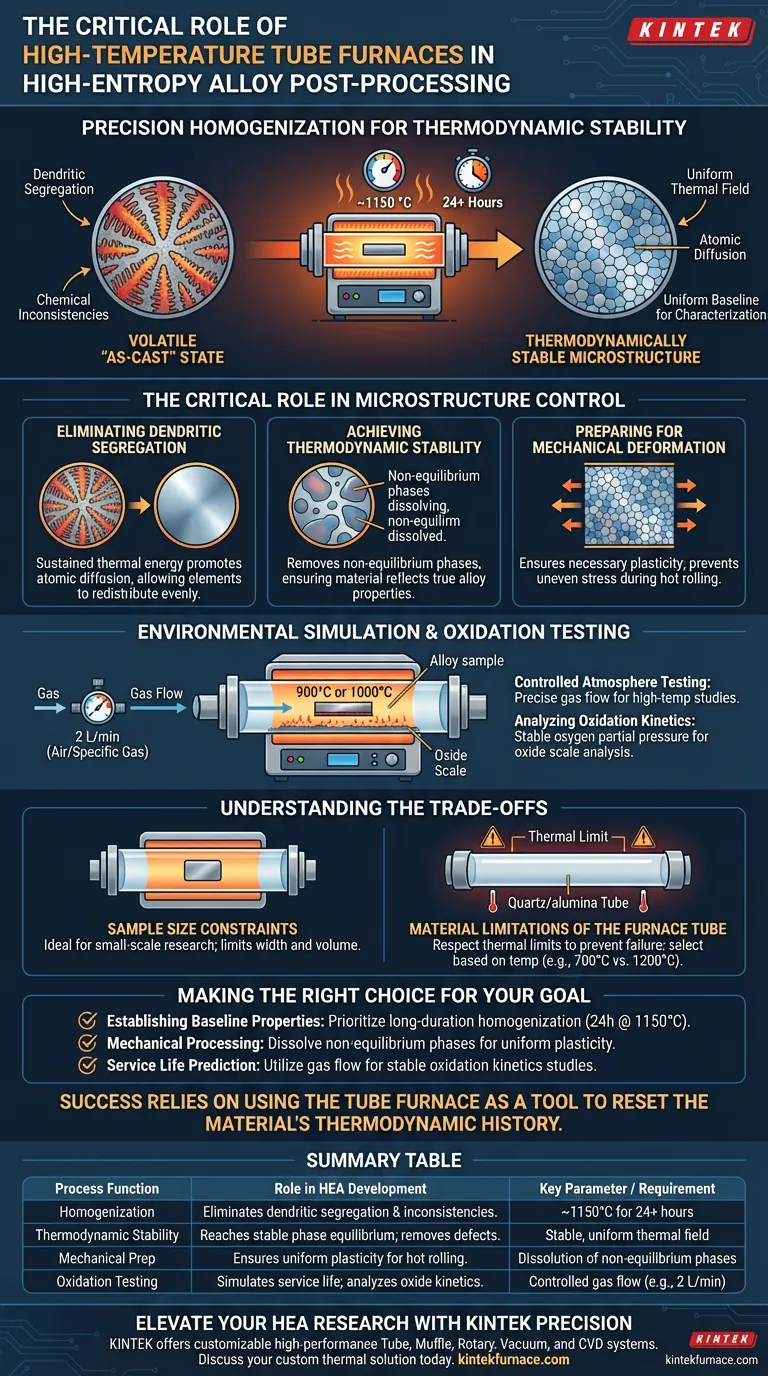
A high-temperature tube furnace serves as a precision instrument for the homogenization annealing of high-entropy alloys, typically maintaining temperatures around 1150 °C for extended periods. Its primary function is to provide a highly stable and uniform thermal field that drives atomic diffusion, effectively eliminating the chemical inconsistencies and dendritic segregation inherited from the initial casting process.
Core Takeaway The tube furnace transitions high-entropy alloys from a volatile "as-cast" state to a thermodynamically stable microstructure. By eliminating composition segregation through controlled heat, it creates a uniform baseline essential for accurate material characterization and successful subsequent mechanical processing.
The Critical Role in Microstructure Control
Eliminating Dendritic Segregation
When high-entropy alloys solidify, they often form uneven chemical structures known as dendritic segregation. The tube furnace combats this by maintaining a constant high temperature (e.g., 1150 °C) for long durations, such as 24 hours. This sustained thermal energy promotes atomic diffusion, allowing elements to redistribute evenly throughout the material.
Achieving Thermodynamic Stability
The ultimate goal of this post-processing step is to reach a stable thermodynamic state. By removing non-equilibrium phases formed during rapid cooling, the furnace ensures the material reflects its true alloy properties. This stability allows researchers to accurately assess how specific element contents influence microstructural evolution without the interference of casting defects.
Preparing for Mechanical Deformation
Homogenization in a tube furnace is often a prerequisite for further processing, such as hot rolling. By creating a completely uniform initial microstructure, the furnace treatment ensures the alloy has the necessary plasticity. This uniformity prevents uneven stress distribution during rolling, enabling high reduction rates and dynamic recrystallization.
Environmental Simulation and Oxidation Testing
Controlled Atmosphere Testing
Beyond annealing, industrial tube furnaces are essential for simulating high-temperature service environments. Because the "tube" design allows for precise gas flow, researchers can introduce air or specific gases at constant rates (e.g., 2 L/min). This capability is critical for studying how the alloy interacts with oxygen at temperatures like 900°C or 1000°C.
Analyzing Oxidation Kinetics
The furnace ensures a stable oxygen partial pressure throughout the reaction. This control allows for the accurate simulation of real-world operating conditions and the analysis of oxide scale growth. By maintaining these variables, engineers can predict the long-term performance and corrosion resistance of the alloy.
Understanding the Trade-offs
Sample Size Constraints
The geometry of a tube furnace inherently limits the size of the alloy sample you can process. Unlike box furnaces, the tubular chamber restricts the width and volume of the workload. This makes it ideal for small-scale research samples but less suitable for processing large industrial ingots.
Material Limitations of the Furnace Tube
The furnace tube itself, often made of quartz or alumina, dictates the maximum operating temperature. While chemically stable, these materials have thermal limits that must be respected to prevent tube failure. Users must select the correct tube material based on whether they are annealing at 700°C or testing oxidation at 1200°C.
Making the Right Choice for Your Goal
To maximize the utility of a high-temperature tube furnace, align the processing parameters with your specific research or production objectives.
- If your primary focus is establishing baseline properties: Prioritize long-duration homogenization (e.g., 24 hours at 1150°C) to fully eliminate dendritic segregation and casting defects.
- If your primary focus is mechanical processing (Hot Rolling): Use the furnace to dissolve non-equilibrium phases first, ensuring the material has uniform plasticity for deformation.
- If your primary focus is service life prediction: Utilize the tube's gas flow capabilities to maintain stable oxygen partial pressure for accurate oxidation kinetics studies.
Success in high-entropy alloy development relies on using the tube furnace not just as a heater, but as a tool to reset the material's thermodynamic history.
Summary Table:
| Process Function | Role in HEA Development | Key Parameter / Requirement |
|---|---|---|
| Homogenization | Eliminates dendritic segregation and chemical inconsistencies. | ~1150°C for 24+ hours |
| Thermodynamic Stability | Reaches stable phase equilibrium; removes casting defects. | Stable, uniform thermal field |
| Mechanical Prep | Ensures uniform plasticity for subsequent hot rolling. | Dissolution of non-equilibrium phases |
| Oxidation Testing | Simulates service life and analyzes oxide scale kinetics. | Controlled gas flow (e.g., 2 L/min) |
Elevate Your HEA Research with KINTEK Precision
Ready to transform your high-entropy alloy development? Backed by expert R&D and manufacturing, KINTEK offers high-performance Tube, Muffle, Rotary, Vacuum, and CVD systems, all fully customizable to your specific research needs. Whether you require precise homogenization or controlled atmosphere oxidation testing, our furnaces provide the stability your materials demand.
Contact KINTEK today to discuss your custom thermal solution and see how our lab high-temperature furnaces can streamline your material characterization and mechanical processing.
Visual Guide
References
- Gökhan Polat, Hasan Kotan. Microstructural Evolution and Mechanical Properties of Y Added CoCrFeNi High-entropy Alloys Produced by Arc-melting. DOI: 10.17350/hjse19030000328
This article is also based on technical information from Kintek Furnace Knowledge Base .
Related Products
- 1400℃ High Temperature Laboratory Tube Furnace with Alumina Tube
- 1700℃ High Temperature Laboratory Tube Furnace with Alumina Tube
- 1200℃ Split Tube Furnace Laboratory Quartz Tube Furnace with Quartz Tube
- Vertical Laboratory Quartz Tube Furnace Tubular Furnace
- 1700℃ High Temperature Muffle Oven Furnace for Laboratory
People Also Ask
- How does zone-melting in tube furnaces synthesize bismuth micro-wires? Master Single-Crystal Thermoelectric Growth
- How are high-temperature laboratory tube furnaces applied in long-term vacuum homogenization heat treatments for intermetallic samples?
- How do high-temperature laboratory tube furnaces ensure environmental stability? Precision Thermal Reduction Tips
- How are high-temp tube furnaces used to measure diffusion coefficients per Fick's law? Master Precision Annealing
- How are high-temperature tube furnaces applied in testing ceramic-supported alloy membranes? Insights



















