
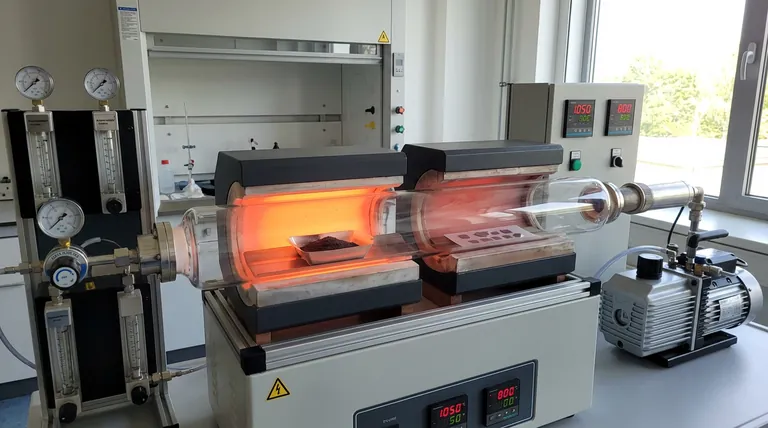
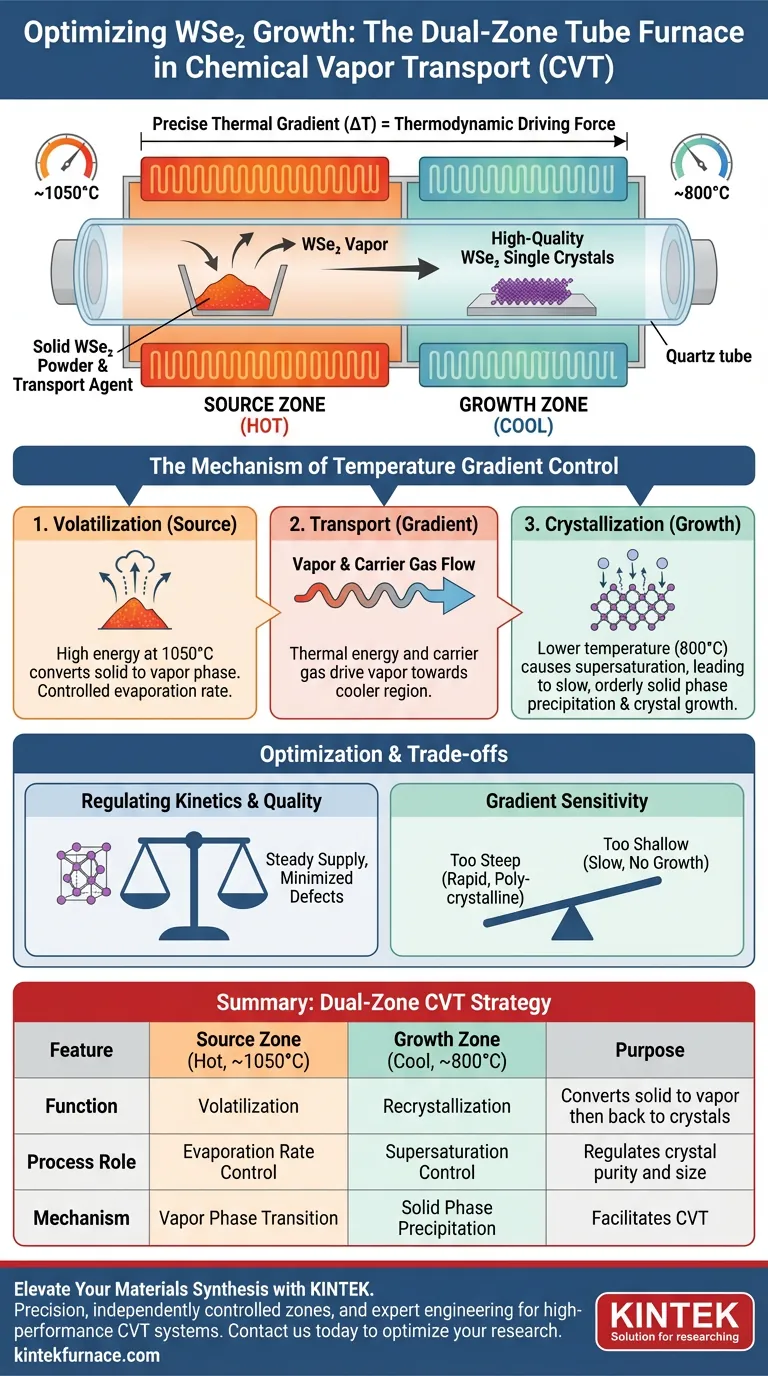
A horizontal dual-zone tube furnace facilitates the Chemical Vapor Transport (CVT) growth of Tungsten Diselenide (WSe2) by establishing two distinct, independently controlled thermal environments. By maintaining a high-temperature source zone (typically 1050°C) and a lower-temperature growth zone (typically 800°C), the furnace creates a precise thermal gradient. This temperature difference provides the necessary thermodynamic driving force to volatilize the precursor materials at the hot end and drive their recrystallization into high-quality single crystals at the cooler end.
Core Takeaway The dual-zone configuration transforms a simple temperature difference into a tunable transport mechanism. By decoupling the volatilization temperature from the crystallization temperature, the system allows for precise regulation of reaction kinetics and supersaturation, which is essential for growing large, high-purity WSe2 crystals.
The Mechanism of Temperature Gradient Control
Independent Zone Management
The defining feature of a dual-zone furnace is the ability to control the source zone and the growth zone independently.
Unlike single-zone furnaces, where the temperature is relatively uniform, a dual-zone system allows you to define a specific "Delta T" (temperature difference).
For WSe2, the primary reference dictates a setup where the source is heated to approximately 1050°C while the growth zone is held at 800°C.
The Thermodynamic Driving Force
This specific gradient creates a non-equilibrium state that drives the chemical transport.
The high temperature in the source zone provides the energy required to react the solid WSe2 powder (or precursors) with a transport agent, converting them into a gaseous phase.
The natural flow of thermal energy—and often a carrier gas like Argon—moves these vapor-phase reactants toward the cooler zone.
Controlling Supersaturation
The lower temperature in the growth zone (800°C) is the critical control knob for crystallization.
As the hot gas enters this cooler region, it becomes supersaturated because the gas cannot hold as much material at lower temperatures.
This supersaturation forces the WSe2 to precipitate out of the gas phase, depositing onto a substrate or the tube walls to form crystals.
Optimization of Crystal Quality
Regulating Reaction Kinetics
Precise temperature zoning regulates the evaporation rate of the precursors.
If the source is too hot, evaporation may occur too quickly, leading to disordered growth.
By fine-tuning the source temperature, you ensure a steady, controlled supply of vapor to the growth zone.
Promoting Single Crystal Growth
The stability of the dual-zone environment facilitates the growth of large-sized single crystals.
A stable gradient ensures that the crystallization process occurs slowly and consistently.
This slow precipitation allows the atoms to arrange themselves perfectly into the crystal lattice, minimizing defects and maximizing structural uniformity.
Understanding the Trade-offs
Gradient Sensitivity
The steepness of the temperature gradient is a double-edged sword.
A gradient that is too steep may cause rapid precipitation, resulting in small, poly-crystalline structures rather than large single crystals.
Conversely, a gradient that is too shallow may result in insufficient transport, halting growth entirely.
Positioning Sensitivity
The placement of the source material and the substrate relative to the heating elements is critical.
As noted in supplementary contexts regarding CVD, the local concentration of vapor changes based on position.
In a dual-zone CVT setup, slight misalignments of the transport tube within the furnace zones can shift the actual temperatures experienced by the chemicals, deviating from the setpoints of 1050°C and 800°C.
Making the Right Choice for Your Goal
When configuring a dual-zone tube furnace for WSe2 growth, your specific objectives should dictate your temperature strategy.
- If your primary focus is large single crystals: Prioritize a stable, moderate gradient (e.g., 1050°C to 800°C) to ensure slow, high-quality crystallization driven by controlled supersaturation.
- If your primary focus is thin film deposition: You may need to adjust the substrate position within the growth zone to control the local vapor concentration, ensuring uniform thickness rather than bulk crystal formation.
Ultimately, the dual-zone furnace is not just a heater; it is a flow control device that uses temperature differentials to dictate the speed and quality of material transport.
Summary Table:
| Feature | Source Zone (Hot) | Growth Zone (Cool) | Purpose |
|---|---|---|---|
| Temperature | ~1050°C | ~800°C | Creates thermodynamic driving force |
| Function | Volatilization | Recrystallization | Converts solid precursors to gas then back to crystals |
| Process Role | Evaporation Rate Control | Supersaturation Control | Regulates crystal purity and size |
| Mechanism | Vapor Phase Transition | Solid Phase Precipitation | Facilitates Chemical Vapor Transport (CVT) |
Elevate Your Materials Synthesis with KINTEK
Precision is non-negotiable in 2D material growth. Backed by expert R&D and manufacturing, KINTEK offers high-performance Tube, Muffle, Rotary, Vacuum, and CVD systems designed to meet the rigorous demands of Chemical Vapor Transport (CVT).
Why Choose KINTEK?
- Independently Controlled Zones: Achieve stable, repeatable thermal gradients for large-scale WSe2 single crystals.
- Customizable Solutions: Our high-temp lab furnaces are tailored to your unique research or production needs.
- Expert Engineering: Minimize defects and maximize structural uniformity with our advanced heating technology.
Ready to optimize your thin film deposition or crystal growth? Contact us today to discuss your project requirements!
Visual Guide
References
- Monaam Benali, Zdeněk Sofer. 2D Rhenium- and Niobium-Doped WSe<sub>2</sub> Photoactive Cathodes in Photo-Enhanced Hybrid Zn-Ion Capacitors. DOI: 10.1021/acsanm.4c01405
This article is also based on technical information from Kintek Furnace Knowledge Base .
Related Products
- Custom Made Versatile CVD Tube Furnace Chemical Vapor Deposition CVD Equipment Machine
- Multi Heating Zones CVD Tube Furnace Machine for Chemical Vapor Deposition Equipment
- Slide PECVD Tube Furnace with Liquid Gasifier PECVD Machine
- Split Chamber CVD Tube Furnace with Vacuum Station CVD Machine
- Magnesium Extraction and Purification Condensing Tube Furnace
People Also Ask
- Why are CVD tube furnace sintering systems indispensable for 2D material research and production? Unlock Atomic-Scale Precision
- What is a CVD tube furnace and what is its primary function? Discover Precision Thin-Film Deposition
- Which industries and research fields benefit from CVD tube furnace sintering systems for 2D materials? Unlock Next-Gen Tech Innovations
- How does CVD tube furnace sintering enhance graphene growth? Achieve Superior Crystallinity and High Electron Mobility
- How might AI and machine learning enhance CVD tube furnace processes? Boost Quality, Speed, and Safety



















