
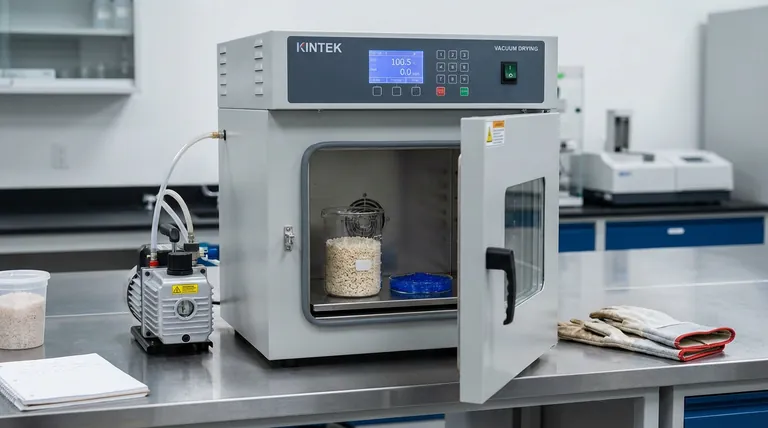
Vacuum drying ovens and silica gel desiccants are used in tandem to achieve deep, preliminary dehydration of simulated pyroprocessing salts. This combination accelerates the removal of moisture from both the surface and pores of the material while simultaneously trapping the escaped water vapor to prevent re-absorption.
The primary goal of this dual-approach is to ensure chemical stability. By effectively removing moisture, you prevent the formation of corrosive gases and oxide impurities that can compromise high-temperature experiments.
The Mechanics of Effective Dehydration
Accelerating Moisture Removal
The vacuum drying oven plays the active role in extraction. By significantly reducing ambient pressure, the oven lowers the boiling point of water.
This accelerates the evaporation of moisture trapped not just on the surface, but deep within the pores of the salt materials.
Trapping the Escaped Vapor
While the oven liberates the moisture, silica gel desiccants act as a trap. They are placed within the setup to absorb the water vapor released from the salts.
Without this desiccant, the liberated vapor could linger in the chamber or re-deposit onto the material, rendering the drying process less effective.
Why Purity Is Critical in Pyroprocessing
Preventing Corrosive Environments
Moisture is not just an impurity; it is a catalyst for damage. If water remains in the salts during high-temperature experiments, it can lead to the formation of corrosive gases.
These gases can attack the experimental apparatus, leading to equipment failure or contamination of the sample.
Avoiding Oxide Impurities
The presence of water at high temperatures often results in unwanted chemical reactions. Specifically, residual moisture facilitates the formation of oxide impurities.
These impurities alter the chemical composition of the melt, potentially invalidating the results of the pyroprocessing simulation.
Ensuring Storage Stability
The benefits of this process extend beyond the immediate experiment. The combined use of vacuum and desiccants minimizes secondary moisture absorption during storage.
This ensures that the salts remain stable and dry between the initial preparation and the actual experimental run.
Understanding the Process Limitations
The Necessity of the Combination
It is a mistake to rely on just one part of this system. A vacuum oven alone may liberate moisture, but without a desiccant, the vapor remains in the closed system.
Conversely, silica gel alone is passive and cannot effectively pull moisture from deep within the salt pores without the pressure differential provided by the vacuum.
Saturation Risks
While silica gel is effective, it has a finite capacity. If the salt is heavily saturated, the desiccant may reach its absorption limit before the process is complete.
Operators must ensure the ratio of desiccant to salt is sufficient to handle the total moisture load.
Ensuring Experimental Integrity
To apply this to your specific requirements, consider the following:
- If your primary focus is Equipment Safety: Prioritize this dehydration method to eliminate moisture that converts into corrosive gases which damage high-temperature rigs.
- If your primary focus is Chemical Purity: Use this setup to prevent the formation of oxide impurities that inevitably occur when wet salts are heated.
Eliminating moisture at the preliminary stage is the single most effective way to guarantee the reliability of your pyroprocessing data.
Summary Table:
| Dehydration Component | Primary Role | Key Benefit |
|---|---|---|
| Vacuum Drying Oven | Lowers boiling point & extracts internal moisture | Accelerates evaporation from salt pores |
| Silica Gel Desiccant | Traps and absorbs liberated water vapor | Prevents moisture re-absorption & secondary saturation |
| Synergistic Effect | Complete moisture removal & chemical stabilization | Eliminates corrosive gases & ensures chemical purity |
Protect Your Experimental Integrity with KINTEK
Don't let residual moisture compromise your research with corrosive gases or oxide impurities. At KINTEK, we understand the precision required for high-temperature material science. Backed by expert R&D and manufacturing, we offer high-performance Vacuum Drying Ovens, Muffle, Tube, and CVD systems—all customizable to meet your unique pyroprocessing needs.
Ensure the reliability of your data today. Contact our technical specialists to find the perfect dehydration solution for your lab.
References
- Alex Scrimshire, Paul A. Bingham. Benchtop Zone Refinement of Simulated Future Spent Nuclear Fuel Pyroprocessing Waste. DOI: 10.3390/ma17081781
This article is also based on technical information from Kintek Furnace Knowledge Base .
Related Products
- Vacuum Heat Treat Sintering and Brazing Furnace
- Vacuum Heat Treat Sintering Furnace Molybdenum Wire Vacuum Sintering Furnace
- Dental Porcelain Zirconia Sintering Ceramic Vacuum Press Furnace
- Molybdenum Vacuum Heat Treat Furnace
- Vacuum Hot Press Furnace Machine Heated Vacuum Press
People Also Ask
- What are the benefits of using vacuum heat treating furnaces for metal alloys? Achieve Superior Metal Properties and Performance
- What is one of the most important uses of vacuum heat treating furnaces in aerospace? Achieve Superior Strength in Aircraft Alloys
- How does vacuum heat treating affect the grain structure of metal alloys? Achieve Precise Microstructure Control
- What is the temperature of a vacuum furnace brazing? Optimize Your Joint Strength and Cleanliness
- What are the steps involved in a typical vacuum brazing treatment? Master the Process for Strong, Clean Joints












