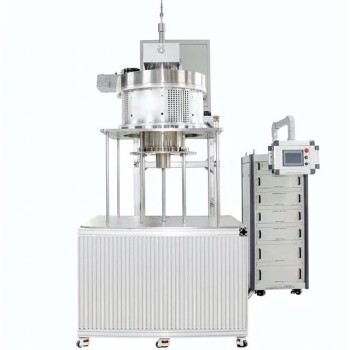
Vacuum Spark Plasma Sintering (SPS) systems fundamentally outperform traditional tube or muffle furnaces when the goal is preserving fine grain structure. While traditional furnaces rely on indirect heating with high thermal inertia, SPS utilizes pulsed currents to heat the sample and mold directly. This allows for heating rates of several hundred degrees per minute, enabling full densification before the grains have time to coarsen.
The Core Takeaway Traditional sintering forces a compromise between density and grain size due to long exposure to high heat. SPS eliminates this compromise by utilizing rapid thermal cycles—getting the material to full density so quickly that the diffusion processes responsible for grain growth never have a chance to take over.
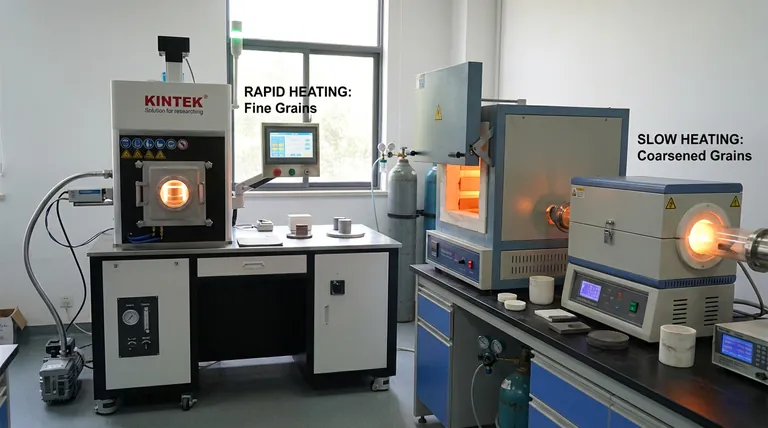
The Mechanism: Direct vs. Indirect Heating
Direct Volumetric Heating
Traditional tube or muffle furnaces rely on external heating elements to heat the air or environment, which then radiates heat to the sample. This is an "outside-in" process.
In contrast, SPS systems apply pulsed electric current directly through the mold and the powder sample. This generates heat internally within the volume of the material, rather than waiting for heat to soak in from the outside.
Eliminating Thermal Inertia
Traditional furnaces possess significant thermal inertia; they take a long time to ramp up to temperature and a long time to cool down.
SPS bypasses this inertia completely. Because the heat is generated directly by the current, the system can achieve heating rates exceeding 100°C per minute (up to several hundred degrees per minute), drastically reducing the overall cycle time.
Controlling Microstructure
Bypassing the "Coarsening Window"
Grain growth (coarsening) is a time-and-temperature-dependent process that typically accelerates during the long dwell times of traditional sintering.
SPS minimizes the time the material spends in these critical high-temperature zones. By utilizing short holding times, the material achieves high density while the microstructure remains frozen at the fine-grained (sub-micron or nanometric) stage.
The Impact on Material Properties
The preservation of fine grains is not merely cosmetic; it directly correlates to superior performance.
By inhibiting abnormal grain growth, SPS produces ceramics and alloys (such as Al2O3-TiC, TiB2-SiC, and Ti-6Al-4V) with significantly improved fracture toughness, hardness, and bending strength. Additionally, for transparent ceramics, maintaining a fine microstructure is critical for optimizing optical performance.
Understanding the Trade-offs
Equipment Complexity and Conductivity
While traditional furnaces are simple thermal chambers, SPS requires a complex setup involving pulsed DC generators and pressure application systems.
Furthermore, the "direct heating" mechanism relies on the conductivity of the mold (usually graphite) and the sample. While this enables the fast-firing characteristic, it means the process is fundamentally different from the passive heating of a muffle furnace, requiring specialized tooling and control strategies to manage the current distribution.
Making the Right Choice for Your Goal
When deciding between SPS and traditional sintering, consider your specific material requirements:
- If your primary focus is Maximum Mechanical Strength: Choose SPS to inhibit grain growth, which directly enhances hardness and fracture toughness in ceramics and alloys.
- If your primary focus is Optical Quality: Choose SPS to maintain the nanometer-scale grain structure required for high optical performance in transparent materials.
- If your primary focus is Processing Difficult Materials: Choose SPS to achieve full densification of refractory materials (like TiB2-SiC) at lower temperatures and faster speeds than conventional methods allow.
SPS converts the sintering process from a slow thermal soak into a rapid, precise electric pulse, locking in the microstructure that traditional heat treats destroy.
Summary Table:
| Feature | Traditional Tube/Muffle Furnaces | Vacuum SPS Systems |
|---|---|---|
| Heating Mechanism | Indirect (External Radiation) | Direct (Internal Pulsed Current) |
| Heating Rate | Slow (Low Thermal Inertia) | Rapid (>100°C/min) |
| Sintering Time | Hours to Days | Minutes |
| Grain Control | High Risk of Coarsening | Inhibits Growth (Preserves Fine Grains) |
| Final Properties | Standard Performance | Superior Hardness & Fracture Toughness |
| Common Applications | General Heat Treatment | Advanced Ceramics & Refractory Alloys |
Unlock Precision Microstructure with KINTEK
Don't let slow thermal cycles compromise your material's mechanical strength. KINTEK provides industry-leading Vacuum Spark Plasma Sintering (SPS) solutions alongside our full range of Muffle, Tube, Rotary, and CVD systems.
Whether you need to densify refractory materials or achieve peak optical performance in ceramics, our expert R&D and manufacturing team can deliver a system customized to your unique research or production needs.
Ready to stop grain growth and start innovating?
→ Contact KINTEK for a Custom Solution Today
References
- Agnieszka Nowak‐Król, Kenkera Rayappa Naveen. Boron-containing helicenes as new generation of chiral materials: opportunities and challenges of leaving the flatland. DOI: 10.1039/d4sc01083c
This article is also based on technical information from Kintek Furnace Knowledge Base .
Related Products
- Spark Plasma Sintering SPS Furnace
- Vacuum Heat Treat Sintering Furnace with Pressure for Vacuum Sintering
- 9MPa Air Pressure Vacuum Heat Treat and Sintering Furnace
- 600T Vacuum Induction Hot Press Vacuum Heat Treat and Sintering Furnace
- Small Vacuum Heat Treat and Tungsten Wire Sintering Furnace
People Also Ask
- How does the heating mechanism of Spark Plasma Sintering (SPS) function? Enhance TiC/SiC Composite Fabrication
- Why is it necessary to maintain a high vacuum environment during the SPS of SiC? Key to High-Density Ceramics
- What are the technical advantages of using an SPS sintering furnace? Elevate Al2O3-TiC Material Performance
- What are the steps in the discharge plasma sintering process? Master Fast, High-Density Material Consolidation
- What are the advantages of spark plasma sintering (SPS) over traditional forging? Precision Microstructural Control