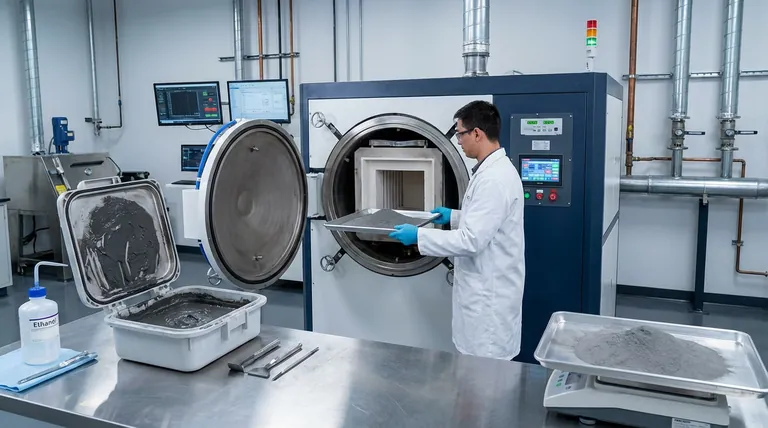
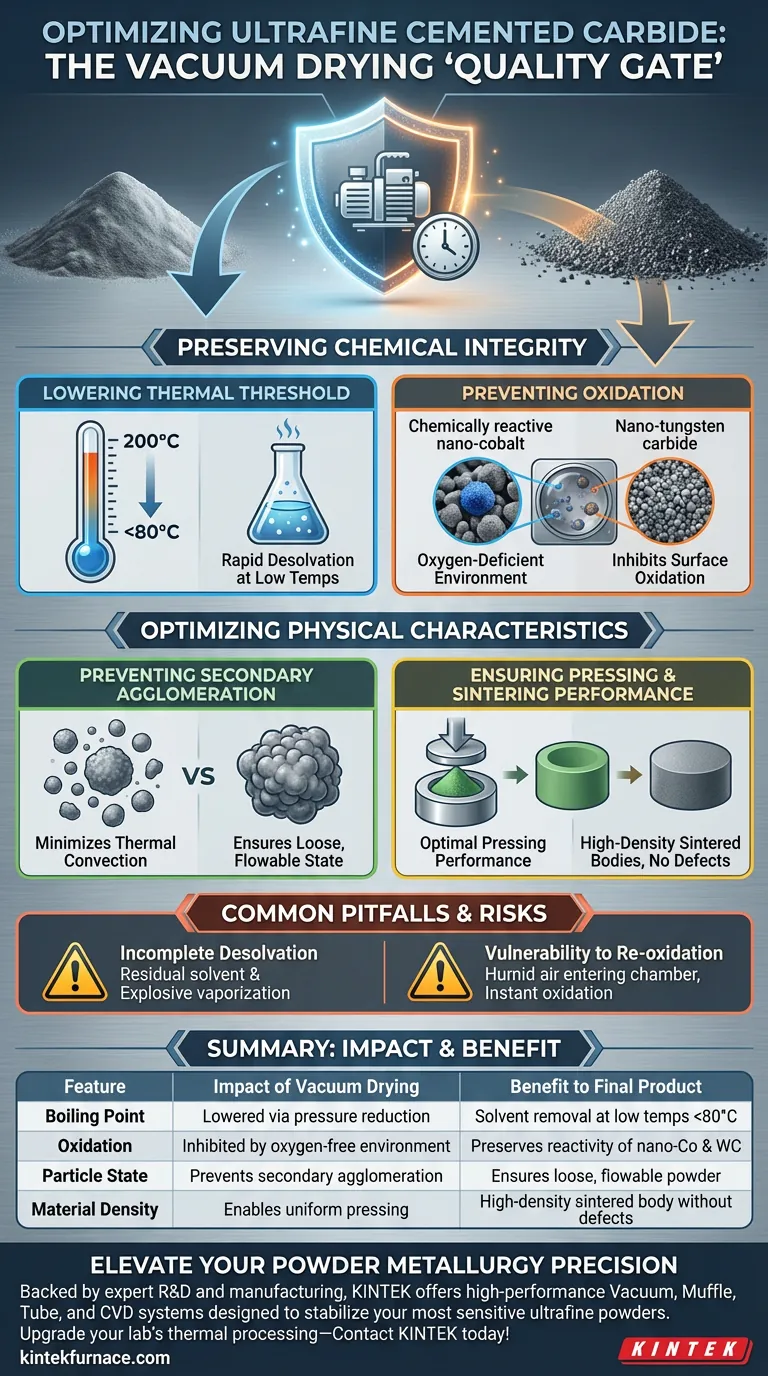
The vacuum drying process acts as a protective shield for ultrafine cemented carbide raw materials immediately following wet ball milling. Its primary function is to remove solvents, such as anhydrous ethanol, at significantly reduced temperatures. This prevents the oxidation of highly reactive nano-cobalt and nano-tungsten carbide powders, thereby preserving the material's chemical reactivity for the final sintering phase.
Core Insight: By lowering the boiling point of solvents, vacuum drying allows for rapid desolvation without the destructive heat that degrades nano-materials. This step is the "quality gate" that ensures the powder remains chemically pure and physically loose, directly enabling the production of high-density sintered bodies.
Preserving Chemical Integrity
The most immediate threat to ultrafine cemented carbide powders after milling is chemical degradation. Vacuum drying neutralizes this threat through pressure manipulation.
Lowering the Thermal Threshold
In a standard environment, removing solvents requires high heat. However, a vacuum environment significantly lowers the boiling point of organic solvents like anhydrous ethanol.
This allows the solvent to evaporate rapidly at much lower temperatures (often around 80°C). You achieve thorough drying without subjecting the material to thermal stress.
Preventing Oxidation of Active Agents
Ultrafine powders, particularly nano-cobalt and nano-tungsten carbide, have immense surface areas, making them chemically "highly active."
If exposed to high temperatures or air, these powders oxidize rapidly. Vacuum drying creates an oxygen-deficient environment that effectively inhibits surface oxidation, preserving the original chemical properties of the raw materials.
Optimizing Physical Characteristics
Beyond chemistry, the physical state of the dried powder dictates how well it can be processed in subsequent steps.
Preventing Secondary Agglomeration
Drying at high temperatures under normal atmospheric pressure often leads to severe agglomeration, where particles fuse together into hard clumps.
Vacuum drying prevents this by minimizing the intense thermal convection that drives segregation. The result is a powder that remains in a loose, flowable state, rather than becoming a dense cake.
Ensuring Pressing and Sintering Performance
For the final product to be durable, the green body (the pressed powder) must have uniform density.
By maintaining a loose state and preventing oxidation, the vacuum process ensures optimal pressing performance. This consistency allows the material to reach a high density during the final sintering process, avoiding structural defects.
Common Pitfalls and Risks
While vacuum drying is superior for ultrafine materials, it is not without operational sensitivities.
The Risk of Incomplete Desolvation
If the vacuum level is insufficient or the cycle time is too short, residual traces of ethanol may remain deep within the powder bed.
Any remaining solvent can vaporize explosively during the early stages of sintering or cause carbon porosity issues in the final cemented carbide.
Vulnerability to Re-oxidation
The dried powder is extremely reactive immediately after the process.
If the vacuum chamber is vented with humid air or if the powder is exposed to the atmosphere while still warm, instant oxidation or hydrolysis can occur. The material must be cooled under vacuum or inert gas before handling to maintain the gains made during drying.
Making the Right Choice for Your Goal
The significance of vacuum drying changes slightly depending on which aspect of the final product is your priority.
- If your primary focus is Final Material Hardness: Prioritize the prevention of oxidation in nano-tungsten carbide, as oxide impurities act as stress concentrators that weaken the sintered body.
- If your primary focus is Dimensional Accuracy: Focus on the prevention of agglomeration, as a loose, flowable powder ensures uniform die filling and consistent shrinkage during sintering.
Mastering the vacuum drying stage is not just about removing liquid; it is about stabilizing the material's potential before the fire of sintering.
Summary Table:
| Feature | Impact of Vacuum Drying | Benefit to Final Product |
|---|---|---|
| Boiling Point | Lowered via pressure reduction | Solvent removal at low temps (<80°C) |
| Oxidation | Inhibited by oxygen-free environment | Preserves reactivity of nano-Co and WC |
| Particle State | Prevents secondary agglomeration | Ensures loose, flowable powder |
| Material Density | Enables uniform pressing | High-density sintered body without defects |
Elevate Your Powder Metallurgy Precision
Don't let oxidation or agglomeration compromise your material integrity. Backed by expert R&D and manufacturing, KINTEK offers high-performance Vacuum, Muffle, Tube, and CVD systems designed to stabilize your most sensitive ultrafine powders. Whether you need a standard laboratory furnace or a fully customizable high-temperature system for unique sintering requirements, our technical team is ready to help.
Upgrade your lab’s thermal processing—Contact KINTEK today!
Visual Guide
References
- Hao Jiang, Zhiwei Zhao. Effect of Metal Elements on Microstructure and Mechanical Properties of Ultrafine Cemented Carbide Prepared by SPS. DOI: 10.3390/molecules29071678
This article is also based on technical information from Kintek Furnace Knowledge Base .
Related Products
- Vacuum Hot Press Furnace Machine for Lamination and Heating
- Vacuum Hot Press Furnace Machine Heated Vacuum Press
- Stainless Steel Quick Release Vacuum Chain Three Section Clamp
- Vacuum Hot Press Furnace Machine Heated Vacuum Press Tube Furnace
- Vacuum Induction Melting Furnace
People Also Ask
- What are the primary components of a vacuum hot press furnace? Master the Core Systems for Precise Material Processing
- What safety features are incorporated in vacuum hot press furnaces? Ensure Operator and Equipment Protection
- What are the benefits of the vacuum environment system in a vacuum hot press furnace? Unlock High-Density Sintering
- What industries benefit from the use of vacuum hot press furnaces? Unlock High-Performance Materials for Your Industry
- How does the uniaxial pressure applied by a vacuum hot press furnace affect the microstructure of ZrC-SiC materials?