
Achieving high film purity relies on reducing the thermal evaporator's chamber pressure to below $1 \times 10^{-6}$ Torr before deposition begins. This high vacuum environment minimizes the presence of residual gas molecules, preventing uncontrolled oxidation and contamination of the source material. Without this step, it is impossible to ensure the precise thickness and chemical integrity required for functional transition metal oxide (TMO) films like MoO3 or WO3.
Ideally, a vacuum system removes volatile impurities and moisture that would otherwise react with the heated source material. This controlled environment is the definitive requirement for ensuring the deposition of chemically pure, single-phase transition metal oxide films.
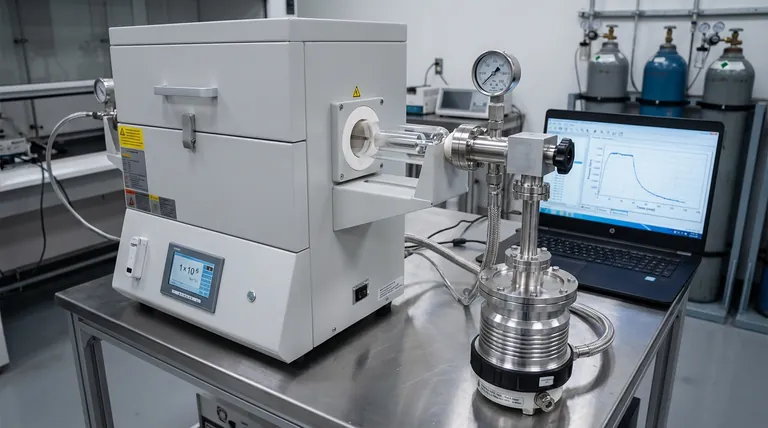
The Critical Role of High Vacuum
Minimizing Residual Gas Interaction
The primary function of a high vacuum (below $1 \times 10^{-6}$ Torr) is to drastically reduce the density of air and gas molecules within the chamber.
At atmospheric or low-vacuum pressures, residual gases occupy the gaps between particles and fill the chamber volume. These molecules act as physical and chemical barriers during the evaporation process.
Eliminating Volatile Impurities
As the system heats up, moisture and other trapped impurities tend to volatilize.
If these elements are not evacuated, they become contaminants that integrate into the depositing film. A high vacuum effectively excludes these volatile substances before the source material reaches its evaporation temperature.
Prevention of Chemical Defects
Controlling Oxidation Reactions
Although you are depositing oxides (like TMOs), the chemical environment must remain strictly controlled.
Residual air contains oxygen and moisture that can cause uncontrolled oxidation reactions at high temperatures. A high vacuum creates a neutral or pure reducing atmosphere, preventing the transition metal elements from reacting unpredictably.
Ensuring Single-Phase Purity
The aim of TMO deposition is often to create a specific high-entropy solid solution or a pure phase.
Contaminants from a poor vacuum lead to the formation of "harmful oxide impurities." These impurities compromise the structural integrity, resulting in multi-phase films with degraded hardness and thermophysical properties.
Operational Constraints and Trade-offs
Pump-Down Time vs. Throughput
Reaching $1 \times 10^{-6}$ Torr requires significantly more time than reaching rough vacuum levels.
Operators must balance the need for extreme purity against the cycle time required to pump the chamber down. For rapid prototyping where purity is less critical, this wait time is a significant bottleneck.
Sensitivity to Leaks and Outgassing
Operating at this vacuum level makes the process highly sensitive to virtual leaks.
Porous materials or dirty chamber walls can outgas slowly, artificially raising the pressure or introducing contaminants despite the pump's performance. Maintaining this level of vacuum requires rigorous system maintenance and cleaning.
Making the Right Choice for Your Goal
To determine how strictly you must adhere to the $1 \times 10^{-6}$ Torr threshold, consider your end-application requirements.
- If your primary focus is Electronic or Optical Grade Films: You must adhere to the $< 1 \times 10^{-6}$ Torr standard to ensure precise thickness and the absence of impurities that degrade performance.
- If your primary focus is Mechanical Hardness: You should prioritize high vacuum to prevent the inclusion of harmful oxide impurities that weaken the material's structural phase.
- If your primary focus is Basic Coatings: You may tolerate slightly higher pressures, but you must accept the risk of uncontrolled oxidation and reduced chemical purity.
A high vacuum is not merely an operational step; it is the fundamental control mechanism for defining the chemistry of your final material.
Summary Table:
| Factor | Requirement (High Vacuum) | Impact of Poor Vacuum |
|---|---|---|
| Pressure Level | Below $1 \times 10^{-6}$ Torr | Higher residual gas density |
| Film Purity | High; prevents uncontrolled oxidation | Contaminants & harmful oxide impurities |
| Phase Integrity | Single-phase purity achieved | Multi-phase films with degraded properties |
| Gas Interaction | Minimal residual gas molecules | Frequent collisions & reactions with source |
| Application | Electronic & Optical grade films | Basic coatings only |
Elevate Your Thin Film Quality with KINTEK
Precision in transition metal oxide deposition starts with the right environment. KINTEK provides industry-leading thermal evaporation solutions backed by expert R&D and manufacturing. Whether you need Muffle, Tube, Rotary, Vacuum, or CVD systems, our equipment is designed to reach the high vacuum levels necessary for high-purity, single-phase films.
Our value to you:
- Customizable Systems: Tailored high-temp furnaces to meet your unique research or production needs.
- Guaranteed Purity: Systems engineered to minimize outgassing and maximize vacuum integrity.
- Expert Support: Technical guidance to help you optimize pump-down times and deposition consistency.
Contact KINTEK today to discuss your vacuum system requirements and ensure your materials meet the highest performance standards.
References
- Jungtae Nam, Keun‐Soo Kim. Tailored Synthesis of Heterogenous 2D TMDs and Their Spectroscopic Characterization. DOI: 10.3390/nano14030248
This article is also based on technical information from Kintek Furnace Knowledge Base .
Related Products
- Laboratory Quartz Tube Furnace RTP Heating Tubular Furnace
- Multi Heating Zones CVD Tube Furnace Machine for Chemical Vapor Deposition Equipment
People Also Ask
- What physical conditions does a laboratory Tube Furnace provide for SOEC? Precision Heat for Solid Oxide Characterization
- What are the main features and functions of a laboratory tube furnace? Unlock Precise High-Temp Control for Your Lab
- What conditions do tube furnaces provide for Au-Seeded TiO2 nanowires? Master Precision Thermal Synthesis
- Why is control of heating rate and gas flow in a lab tube furnace critical for EM wave absorption materials?
- What role does a laboratory tube furnace play in geological and mineralogical research? Unlock Earth's Secrets with Precision

