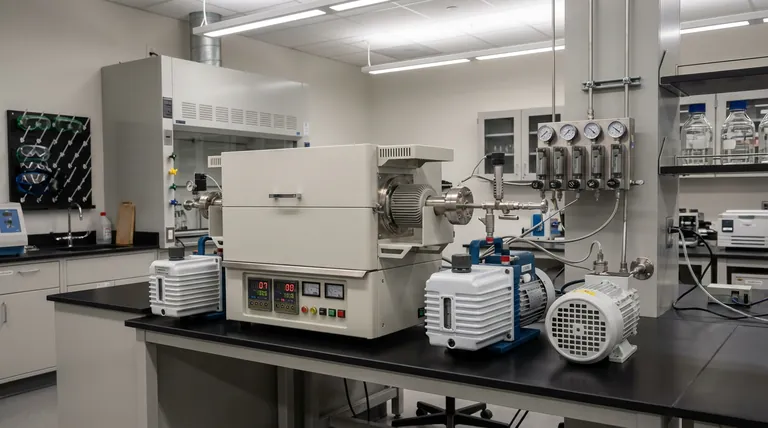
The primary purpose of a high-vacuum drying oven is to eliminate residual solvents, specifically N-Methyl-2-pyrrolidone (NMP), and moisture from electrode sheets by significantly lowering their boiling points in a low-pressure environment. This specialized treatment ensures the complete extraction of volatile contaminants trapped deep within the electrode's porous structure without exposing the materials to excessive temperatures that could damage their microstructure. Ultimately, this process stabilizes the electrode chemically and mechanically before the final cell assembly.
High-vacuum drying is a critical purification step, not just a drying method. By removing trace moisture and solvents from deep pores, it prevents catastrophic side reactions with electrolytes and ensures the active material remains bonded to the current collector during battery cycling.
The Mechanism of Vacuum Drying
Lowering Solvent Boiling Points
The core advantage of this equipment is its ability to depress the boiling point of liquids.
By creating a high-vacuum environment, solvents like NMP and water vaporize at much lower temperatures than they would at atmospheric pressure.
This allows for the thorough removal of stubborn solvents without subjecting the electrode to extreme heat that could degrade the binder or active components.
Deep Pore Extraction
Standard thermal drying often leaves residues trapped inside the complex, porous structure of the electrode.
The negative pressure of the vacuum oven forces these adsorbed gases, trace solvents, and moisture out from the deep internal pores of the carbon or active material.
This "deep cleaning" is essential for ensuring the entire volume of the electrode is electrochemically active and accessible.
Impact on Battery Performance and Integrity
Preventing Chemical Side Reactions
Residual moisture and solvents are chemically dangerous in a lithium-ion battery.
If left in the electrode, these contaminants react with the electrolyte during charge-discharge cycles, causing degradation.
Vacuum drying eliminates these triggers, preventing adverse reactions that would otherwise compromise the battery's electrochemical performance.
Strengthening Physical Adhesion
A critical function of this process is improving the interface between the electrode coating and the metal foil.
The removal of volatiles prevents the formation of vapor pockets that can push the coating away from the copper or molybdenum current collector.
This ensures robust adhesion, preventing the active material from detaching or delaminating during the expansion and contraction of battery cycling.
Preventing Oxidation and Preserving Structure
Heat in the presence of air can cause accidental oxidation, particularly on carbon surfaces.
The vacuum environment protects the materials by excluding oxygen during the heating process.
This preserves the highly developed pore structure and surface chemistry required for high-performance electrodes, ensuring better electrolyte infiltration efficiency.
Critical Process Controls
Balancing Temperature and Material Sensitivity
While vacuum lowers the heat required, precise temperature control is still vital.
Temperatures must be tailored to the specific binder and active material; for instance, aqueous binders may be treated at 120°C, while sensitive materials like Nickel Disulfide (NiS2) may require lower temperatures around 80°C.
Exceeding these limits, even in a vacuum, can damage the polymer binders that hold the electrode together.
Throughput Limitations
Vacuum drying is inherently a batch process that often requires significant time to be effective.
Protocols frequently call for drying times spanning 12 hours to ensure total solvent removal.
This creates a production bottleneck compared to continuous drying methods, representing a trade-off between throughput speed and the absolute quality required for high-performance cells.
Optimizing Your Drying Strategy
To ensure the highest quality electrode sheets, align your drying parameters with your specific performance targets:
- If your primary focus is Cycle Life: Prioritize maximum vacuum depth and duration to remove every trace of moisture, as this is the primary cause of electrolyte degradation over time.
- If your primary focus is Power and Conductivity: Focus on strictly controlling the temperature to prevent oxidation of carbon additives, preserving the pore structure for rapid ion transport.
- If your primary focus is Mechanical Stability: Ensure the ramp-up rate is controlled to prevent rapid solvent evaporation that could crack the electrode surface or weaken adhesion to the current collector.
The high-vacuum oven is the final gatekeeper of electrode quality, ensuring that chemical purity and structural integrity are preserved for the life of the battery.
Summary Table:
| Key Feature | Benefit for Electrode Treatment |
|---|---|
| Boiling Point Reduction | Removes NMP/solvents at lower temperatures to protect sensitive binders. |
| Deep Pore Extraction | Eliminates trapped moisture and gases from porous structures. |
| Oxygen-Free Environment | Prevents oxidation of carbon surfaces and preserves material integrity. |
| Enhanced Adhesion | Prevents vapor pockets to ensure robust bonding with current collectors. |
| Chemical Stabilization | Eliminates side reactions with electrolytes for longer battery cycle life. |
Elevate Your Battery Research with KINTEK Precision
Don't let trace moisture compromise your battery performance. Backed by expert R&D and manufacturing, KINTEK offers high-performance Vacuum, Muffle, and Tube systems—all fully customizable to meet the rigorous demands of electrode sheet processing.
Whether you are refining CVD systems for advanced materials or need reliable lab high-temp furnaces for batch drying, our technology ensures chemical purity and structural integrity for every cell.
Ready to optimize your drying strategy? Contact our technical team today to discuss your unique needs and find the perfect heating solution.
References
- Yunan Liu, Ali Reza Kamali. Cobalt Oxide-Decorated on Carbon Derived from Onion Skin Biomass for Li-Ion Storage Application. DOI: 10.3390/met14020191
This article is also based on technical information from Kintek Furnace Knowledge Base .
Related Products
- Ultra Vacuum Electrode Feedthrough Connector Flange Power Lead for High Precision Applications
- Vacuum Heat Treat Sintering Furnace Molybdenum Wire Vacuum Sintering Furnace
- High Temperature Muffle Oven Furnace for Laboratory Debinding and Pre Sintering
- 1700℃ High Temperature Muffle Oven Furnace for Laboratory
- Molybdenum Vacuum Heat Treat Furnace
People Also Ask
- Why is a high-precision vacuum sealing system necessary for CrSb? Ensure Pure Crystal Growth & Prevent Oxidation
- Why is an Ultra-High Vacuum (UHV) System Required for In2Se3? Achieving Atomic-Level Ferroelectric Clarity
- What is the function of quartz vacuum encapsulation in RhSeCl CVT? Mastering Pure Crystal Growth
- Why is vacuum sealing technology essential for K2In2As3 synthesis? Master High-Purity Solid-State Reactions
- What role do vacuum-sealed high-purity silica ampoules play in phase equilibrium experiments? Enhance Sample Integrity