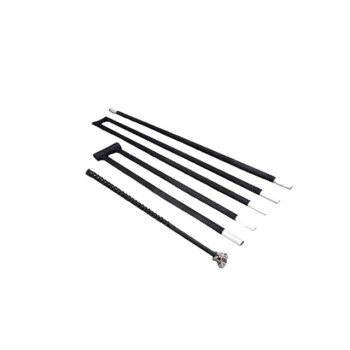
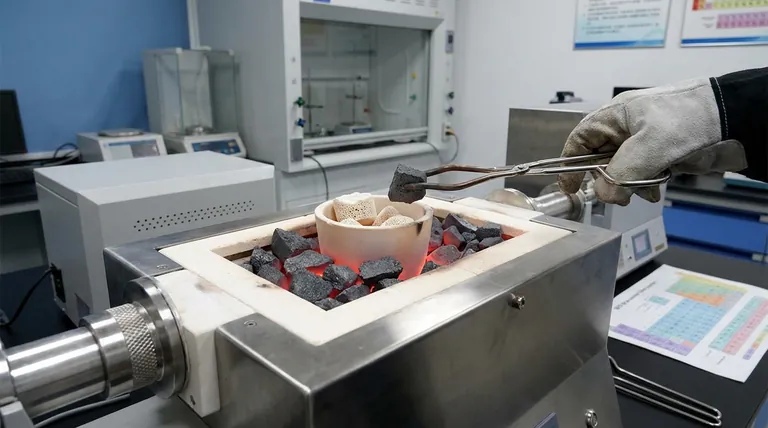
Silicon carbide (SiC) fragments serve as essential auxiliary heating elements that stabilize the microwave sintering process. Because SiC possesses high microwave coupling efficiency, it absorbs energy rapidly and converts it into heat, compensating for the natural inefficiencies of porous ceramics. This addition is critical for neutralizing the internal and external temperature differences that typically destroy large ceramic structures during firing.
By acting as a secondary heat source, SiC fragments bridge the gap between rapid microwave energy and the low thermal conductivity of porous ceramics. This prevents structural collapse by eliminating the severe temperature gradients that cause cracking in large components.
The Challenge of Sintering Porous Ceramics
The Thermal Conductivity Barrier
Porous ceramic skeletons are inherently difficult to heat evenly. Due to their porous nature, they exhibit low thermal conductivity, acting more like insulators than conductors.
This insulation prevents heat from distributing naturally through the material structure. In a standard microwave field, this leads to significant disparities between how the core and the surface of the material retain heat.
The Threat of Sintering Stress
When temperature distributions are uneven, thermal gradients form between the internal and external sections of the ceramic.
These gradients generate mechanical stress within the skeleton. If this stress exceeds the material's strength, the large-sized ceramic skeleton will crack or suffer a total structural collapse.
How Silicon Carbide Solves the Problem
Leveraging High Coupling Efficiency
Silicon carbide is utilized because it has high microwave coupling efficiency.
Unlike the porous ceramic, which may be slow to absorb energy, the SiC fragments react immediately to the microwave field. They effectively capture the electromagnetic energy and convert it into thermal energy.
Creating a Uniform Thermal Field
By acting as an auxiliary heating source, the SiC fragments radiate heat to the ceramic surroundings.
This external heat source works in tandem with the direct microwave heating. It balances the temperature of the environment, significantly improving the uniformity of the thermal field within the furnace.
Preventing Structural Failure
The primary outcome of this improved uniformity is the reduction of sintering stress.
By smoothing out the temperature gradients, the SiC allows the ceramic to sinter without developing the tension that leads to fractures. This is the key factor in successfully processing large-sized skeletons without defects.
Understanding the Trade-offs
Process Complexity
While SiC aids uniformity, it introduces a "hybrid" heating mechanism.
You are no longer relying solely on volumetric microwave heating; you are combining it with radiant heat from the SiC. This adds a variable that must be managed to ensure the heating curve remains precise.
Balancing Heating Rates
The presence of an auxiliary heater can impact the precision of the temperature control.
In processes requiring complex three-stage heating curves—such as those used to decompose pore-forming agents or grow mullite whiskers—the SiC contribution must be calculated carefully. Excessive auxiliary heat during a "slow heating" stage could inadvertently accelerate reactions beyond the desired rate.
Optimizing Sintering Outcomes
To achieve high-quality results in microwave sintering, align your use of SiC with your specific manufacturing goals:
- If your primary focus is structural integrity: Prioritize the strategic placement of SiC fragments to surround large components, ensuring external temperatures match internal heating to prevent collapse.
- If your primary focus is microstructural control: Use SiC to maintain a stable thermal baseline during the high-temperature constant stage, allowing for uniform crystal growth and mullite whisker development.
Success in microwave sintering lies not just in generating heat, but in mastering its distribution through the strategic use of auxiliary materials.
Summary Table:
| Feature | Role of SiC in Microwave Sintering |
|---|---|
| Material Property | High microwave coupling efficiency for rapid energy conversion. |
| Primary Function | Acts as an auxiliary heating source to balance thermal fields. |
| Thermal Impact | Eliminates severe temperature gradients between core and surface. |
| Key Benefit | Prevents structural collapse and cracking in large ceramic skeletons. |
| Process Control | Facilitates stable crystal growth and uniform mullite whisker development. |
Maximize Your Sintering Precision with KINTEK
Don’t let thermal gradients compromise your advanced materials. KINTEK provides industry-leading muffle, tube, and vacuum systems designed to master complex heating challenges. Backed by expert R&D and manufacturing, we offer fully customizable microwave-compatible solutions tailored for your unique lab needs.
Ready to achieve flawless structural integrity? Contact our technical experts today to find the perfect furnace for your application.
References
- Chunxia Xu, Wenbin Han. Research on preparation and related properties of macro–micro porous mullite ceramic skeletons <i>via</i> twice pore-forming technology. DOI: 10.1039/d4ra01277a
This article is also based on technical information from Kintek Furnace Knowledge Base .
Related Products
- Silicon Carbide SiC Thermal Heating Elements for Electric Furnace
- High Temperature Muffle Oven Furnace for Laboratory Debinding and Pre Sintering
- Spark Plasma Sintering SPS Furnace
- Vacuum Heat Treat Sintering Furnace with Pressure for Vacuum Sintering
- Vacuum Heat Treat Sintering Furnace Molybdenum Wire Vacuum Sintering Furnace
People Also Ask
- How do the different types of silicon carbide heating elements compare in terms of applications? Find the Best Fit for Your High-Temp Needs
- What are the temperature capabilities and mounting options for silicon carbide heating elements? Unlock High-Temp Flexibility and Durability
- How do silicon carbide heating elements enhance the heat treatment of alloys? Achieve Superior Temperature Control
- What is the recommended surface load for silicon carbide heating elements at different furnace temperatures? Maximize Lifespan & Performance
- What are the advantages of using silicon carbide heating elements in industrial furnaces? Boost Efficiency and Durability