
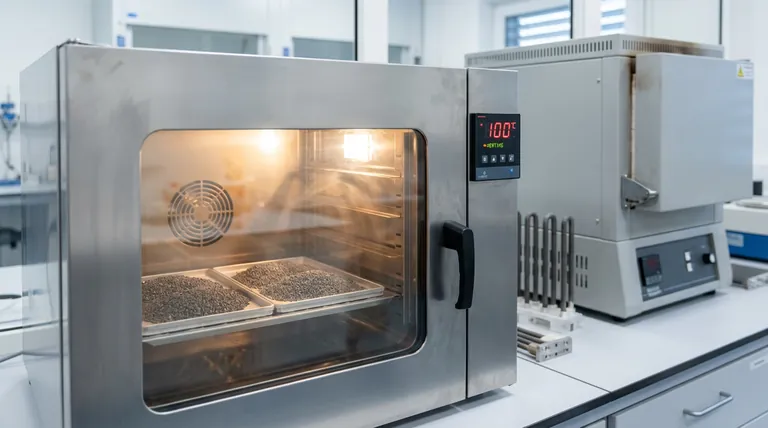
The blast drying oven acts as a critical stabilization phase. Before exposing nickel-based bimetallic catalyst precursors to extreme heat, they must undergo controlled drying at approximately 100°C. This step gently removes adsorbed water, ensuring that subsequent high-temperature processing does not physically destroy the catalyst's internal structure.
Rapid heating of moisture-laden precursors creates internal steam pressure capable of fracturing the material. A blast drying step serves as a safety valve, removing water slowly to prevent the peeling of active components and the collapse of the catalyst’s essential pore architecture.
The Mechanics of Moisture Removal
Targeting Adsorbed Water
Catalyst precursors naturally retain adsorbed water within their particulate structure.
The blast drying oven operates at a relatively low temperature, typically 100°C.
This controlled environment forces moisture to evaporate at a manageable, steady rate rather than flashing into steam instantly.
Preventing Internal Pressure Buildup
If wet precursors are introduced directly into high-temperature calcination, water vaporizes explosively.
This rapid phase change creates a spike in internal pressure within the catalyst particle.
By pre-drying the material, you eliminate the source of this pressure before the material faces significant thermal shock.
Protecting Structural Integrity
Avoiding Active Component Peeling
When internal pressure builds too fast, it seeks an escape route, forcing material outward.
This physical stress causes the peeling of active components (the nickel and bimetallic elements) from the support surface.
The blast drying step ensures these critical metals remain firmly attached to the substrate.
Preserving Pore Architecture
Catalytic efficiency relies on a complex, open network of pores.
Steam expansion within the particle can lead to the total collapse of the pore structure.
Pre-drying ensures the physical skeleton of the catalyst remains intact, maintaining the surface area required for chemical reactions.
Common Pitfalls to Avoid
Rushing the Thermal Cycle
It is a mistake to view the blast drying phase as optional or to shorten it to save manufacturing time.
Skipping this step introduces a high probability of structural failure, rendering the final catalyst mechanically weak and chemically inefficient.
Mismanaging Drying Temperatures
Setting the oven significantly below 100°C may leave residual moisture deep within the pores.
Conversely, aggressive drying temperatures can mimic calcination effects, potentially causing the very damage this step is designed to prevent.
Ensuring Catalyst Stability
To maximize the lifespan and efficiency of your nickel-based bimetallic catalysts, follow these guidelines:
- If your primary focus is mechanical stability: Ensure the drying cycle holds at 100°C until moisture is fully evacuated to rigidly prevent pore collapse.
- If your primary focus is catalytic activity: Prioritize this gentle drying phase to retain the maximum amount of active metal components on the surface, avoiding peeling.
By treating the blast drying oven as a mandatory quality assurance step, you safeguard the complex architecture necessary for a high-performance catalyst.
Summary Table:
| Feature | Impact of Blast Drying (100°C) | Risk of Direct Calcination |
|---|---|---|
| Moisture Removal | Controlled evaporation of adsorbed water | Explosive vaporization and steam pressure |
| Active Components | Firmly attached to the substrate | Peeling and loss of metallic elements |
| Pore Structure | Preserves complex internal architecture | Total structural collapse |
| Final Quality | High mechanical stability and activity | Weak, chemically inefficient catalyst |
Precision Heating for High-Performance Catalysts
Don't let improper thermal cycles compromise your research. Backed by expert R&D and manufacturing, KINTEK offers high-precision Drying Ovens, Muffle, Tube, Rotary, Vacuum, and CVD systems—all fully customizable for your unique lab requirements.
Our advanced high-temperature furnaces ensure the structural integrity and efficiency of your nickel-based catalysts and other sensitive materials. Optimize your catalyst synthesis today—Contact KINTEK for a Custom Solution!
Visual Guide

References
- Bo Zhang, Chundu Wu. Preparation of Nickel-Based Bimetallic Catalyst and Its Activation of Persulfate for Degradation of Methyl Orange. DOI: 10.3390/pr12020322
This article is also based on technical information from Kintek Furnace Knowledge Base .
Related Products
People Also Ask
- What thermal phenomena occur during polymer binder burnout in ceramic green bodies? Lab Furnace Guide
- What role does a high-temperature muffle furnace play in STFO synthesis? Achieve Pure Perovskite Results
- Why is controlled heat treatment in a muffle furnace necessary for calcined clay? Achieve Optimal Pozzolanic Activity
- How does a high-temperature muffle furnace facilitate the formation of LaNbxAl1−xO3+δ perovskite structures? Key Roles
- What role does a high-temperature muffle furnace play in the formation of biochar catalysts? Master Catalyst Synthesis
