
The synthesis of GdEuZrO ceramics via solid-state reaction demands laboratory high-temperature box furnaces or tube furnaces. These units must be capable of sustaining extreme temperatures above 1973K (approximately 1700°C) for extended periods to facilitate the necessary chemical diffusion between high-purity oxide precursors.
Core Insight: Success in synthesizing GdEuZrO ceramics relies not just on reaching extreme heat, but on maintaining a stable isothermal environment for durations often exceeding 20 hours. This sustained energy is critical for driving the solid-state diffusion required to transform raw oxides into stable pyrochlore or fluorite structures.
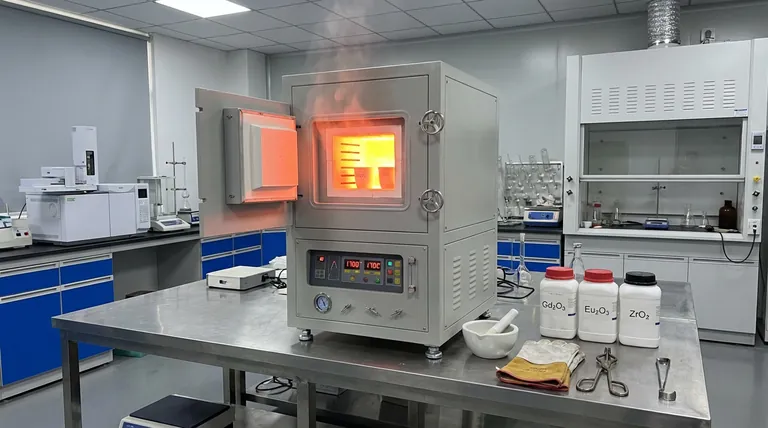
Critical Equipment Requirements
Extreme Temperature Capability
To initiate the necessary chemical changes, the furnace must be rated for temperatures exceeding 1973K (approx. 1700°C).
Standard laboratory ovens are insufficient for this task. The equipment must use specialized heating elements designed to operate reliably at these thermal extremes without degradation.
Furnace Configuration Options
The primary reference indicates that researchers typically employ either high-temperature box furnaces or tube furnaces.
Both configurations are valid choices. The selection often depends on sample size and specific atmospheric controls, but the defining requirement is the ability to reach the 1700°C threshold.
The Role of Time and Stability
Sustained Isothermal Environments
Achieving the target temperature is only the first step; the furnace must hold this heat in a stable, isothermal state.
Synthesis protocols typically require long-term heat soaking, often lasting for 20 hours or more. The furnace control system must ensure the temperature does not fluctuate during this extended dwell time.
Driving Atomic Diffusion
This extended heating period is the engine behind the solid-state reaction method.
It provides the energy needed for high-purity raw materials—specifically Gd2O3, Eu2O3, and ZrO2—to undergo atomic diffusion.
Without this sustained thermal drive, the precursors will not react sufficiently to form the desired stable pyrochlore or fluorite structures.
Operational Considerations and Trade-offs
Equipment Durability vs. Performance
Operating continuously at 1700°C places immense thermal stress on furnace components, particularly insulation and heating elements.
While these furnaces enable the synthesis of advanced ceramics, they often require significant power and frequent maintenance compared to lower-temperature units.
Process Consistency
The "solid-state" nature of the reaction means the materials remain solid throughout the process.
If the furnace fails to maintain a uniform temperature for the full 20 hours, diffusion may be incomplete. This leads to chemically inhomogeneous samples rather than the pure ceramic phase intended.
Making the Right Choice for Your Goal
To ensure successful synthesis of GdEuZrO ceramics, evaluate your equipment based on these priorities:
- If your primary focus is Phase Purity: Ensure your furnace controller allows for precise, programmable dwell times of at least 20 hours to guarantee complete diffusion into pyrochlore or fluorite structures.
- If your primary focus is Reliability: Select a furnace rated slightly higher than your target (e.g., 1800°C capacity) to run at 1700°C comfortably without pushing the elements to their absolute breaking point.
A robust high-temperature furnace capable of long-term stability is the foundational tool for converting raw oxides into advanced GdEuZrO ceramics.
Summary Table:
| Feature | Requirement for GdEuZrO Synthesis | Purpose |
|---|---|---|
| Temperature | >1973K (Approx. 1700°C) | Initiates chemical change in oxide precursors |
| Dwell Time | 20+ Hours (Isothermal) | Ensures complete atomic diffusion |
| Furnace Type | Box or Tube Furnace | Provides stable, high-thermal environment |
| Precursors | Gd2O3, Eu2O3, ZrO2 | Raw materials for pyrochlore/fluorite structures |
| Key Outcome | Phase Purity | Achieves stable chemical homogeneity |
Elevate Your Advanced Ceramic Synthesis with KINTEK
Precision and durability are non-negotiable when working at 1700°C. Backed by expert R&D and manufacturing, KINTEK offers high-performance Muffle, Tube, Rotary, Vacuum, and CVD systems designed to withstand the extreme demands of GdEuZrO ceramic production.
Whether you need customizable lab high-temp furnaces or industrial-scale solutions, our equipment ensures the stable, isothermal environments required for perfect solid-state reactions.
Ready to achieve superior phase purity? Contact KINTEK experts today to find the perfect furnace for your unique research needs.
References
- Zaoyu Shen, Rende Mu. Effects of europium doping on thermal property and failure behaviour of Gd2Zr2O7 thermal barrier coatings. DOI: 10.1038/s41529-025-00598-3
This article is also based on technical information from Kintek Furnace Knowledge Base .
Related Products
- 1700℃ High Temperature Laboratory Tube Furnace with Alumina Tube
- 1700℃ Controlled Inert Nitrogen Atmosphere Furnace
- 1700℃ High Temperature Muffle Oven Furnace for Laboratory
- 1800℃ High Temperature Muffle Oven Furnace for Laboratory
- 1400℃ High Temperature Laboratory Tube Furnace with Alumina Tube
People Also Ask
- How does zone-melting in tube furnaces synthesize bismuth micro-wires? Master Single-Crystal Thermoelectric Growth
- How are high-temp tube furnaces used to measure diffusion coefficients per Fick's law? Master Precision Annealing
- How are high-temperature laboratory tube furnaces applied in long-term vacuum homogenization heat treatments for intermetallic samples?
- How do high-temperature laboratory tube furnaces ensure environmental stability? Precision Thermal Reduction Tips
- How are high-temperature tube furnaces applied in testing ceramic-supported alloy membranes? Insights



















