
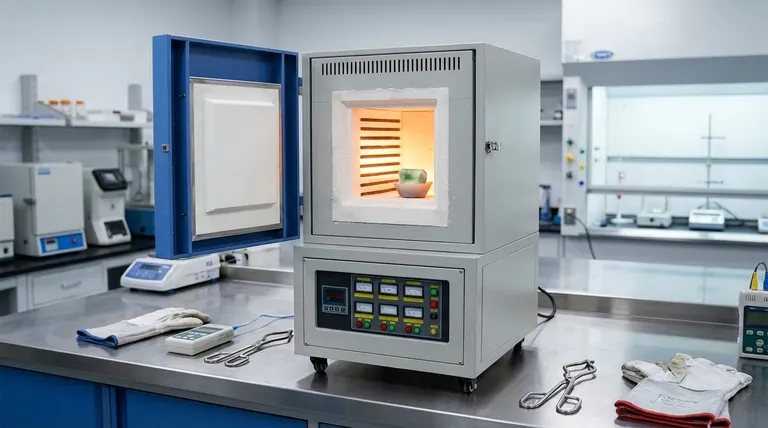
In the specific context of beryl heat treatment, the primary function of a Muffle Furnace is to create a controlled, oxidizing atmosphere using natural air. This apparatus allows researchers to heat the gemstone directly, ensuring it is exposed to sufficient oxygen to facilitate necessary chemical changes.
The Muffle Furnace serves as a catalyst for color modification by altering the valence state of iron ions within the beryl. This oxidation process is the fundamental mechanism used to manipulate and evaluate the gemstone's final aesthetic appearance.
The Mechanics of Color Modification
Creating an Oxidizing Environment
The Muffle Furnace is distinct in its ability to utilize air as an active participant in the treatment process.
Unlike vacuum furnaces that remove gases, this setup deliberately exposes the beryl to an oxygen-rich atmosphere.
This specific environment is critical because the desired reaction is chemical, not just thermal.
Altering Iron Valence States
The heat treatment targets the iron ions naturally present within the beryl's crystal structure.
Under the high-temperature, oxygenated conditions provided by the furnace, the valence states of these iron ions shift.
It is this specific change on the atomic level that directly influences the visible color of the gemstone.
Contextual Versatility of the Equipment
Contrasting Industrial Applications
While the Muffle Furnace provides oxidation for beryl, its function shifts entirely depending on the industry.
In semiconductor manufacturing, for example, similar furnaces are used to prevent oxidation during annealing to improve conductivity.
In pharmaceutical research, the focus shifts to incineration, using the furnace to "ash" organic materials for analysis.
This versatility highlights that the furnace's function is defined by the atmospheric control required by the specific material.
Understanding Operational Trade-offs
Atmosphere Specificity
The primary pitfall in using a Muffle Furnace is assuming heat alone is the variable.
For beryl, the presence of oxygen is a feature; however, for materials like silicon in ICs, that same oxygen would be a contaminant.
You must ensure the furnace's atmospheric settings—whether providing air or excluding it—align strictly with the chemical requirements of your sample.
Making the Right Choice for Your Goal
To ensure successful heat treatment, align your equipment use with your specific objective:
- If your primary focus is Beryl Coloration: Prioritize a setup that ensures direct exposure to air to facilitate iron oxidation.
- If your primary focus is Sample Purity (Ashing): Utilize the furnace's high temperatures to completely incinerate organic impurities.
- If your primary focus is Conductivity (Semiconductors): Ensure the furnace is configured to prevent oxidation, contrasting the method used for gemstones.
Success in heat treatment lies not just in reaching the right temperature, but in mastering the atmospheric chemistry of your specific material.
Summary Table:
| Feature | Beryl Treatment Application | Core Benefit |
|---|---|---|
| Atmosphere Control | Natural Air (Oxidizing) | Facilitates essential chemical reactions |
| Mechanism | Valence State Alteration | Shifts iron ions to modify gemstone color |
| Temperature Range | Uniform High Heat | Ensures consistent color saturation |
| Versatility | Multi-purpose Lab Tool | Also suitable for ashing and incineration |
Elevate Your Material Processing with KINTEK
Ready to achieve perfect color consistency and chemical precision? Backed by expert R&D and manufacturing, KINTEK offers high-performance Muffle, Tube, Rotary, Vacuum, and CVD systems designed for the rigorous demands of gemstone treatment and laboratory research. Our systems are fully customizable to provide the exact oxidizing or inert environments your unique applications require.
Contact us today to find the perfect high-temp furnace for your needs!
Visual Guide

References
- Bin Hao, Qingfeng Guo. The Effect of Heat Treatment on Yellow-Green Beryl Color and Its Enhancement Mechanism. DOI: 10.3390/cryst15080746
This article is also based on technical information from Kintek Furnace Knowledge Base .
Related Products
- 1400℃ Muffle Oven Furnace for Laboratory
- 1700℃ High Temperature Muffle Oven Furnace for Laboratory
- 1800℃ High Temperature Muffle Oven Furnace for Laboratory
- 1200℃ Muffle Oven Furnace for Laboratory
- High Temperature Muffle Oven Furnace for Laboratory Debinding and Pre Sintering
People Also Ask
- What is the primary function of a high-temperature laboratory muffle furnace in chemical synthesis? Achieve Precision.
- How does a high-temperature laboratory muffle furnace affect material properties? Transform Anodic Oxide Films Fast
- How is a laboratory high-temperature muffle furnace utilized in g-C3N4 synthesis? Optimize Your Thermal Polycondensation
- What role does a muffle furnace play in refractory bricks? Enhance Performance and Durability Testing
- How is a laboratory high-temperature muffle furnace utilized to achieve the specific crystalline structure of LaFeO3 catalysts?



















