
Precise thermal decomposition is the primary reason for utilizing an industrial muffle furnace in this process. By maintaining a steady temperature of 550 °C alongside sufficient air circulation, the furnace ensures the complete combustion of all organic matter within the sugar beet sample. This isolates the non-volatile inorganic residues, allowing you to accurately weigh the remaining ash to determine mineral content.
An industrial muffle furnace is the requisite tool for crude ash determination because it provides the specific environment—extreme heat and oxygen flow—needed to strip away organic components without losing the target mineral residues.
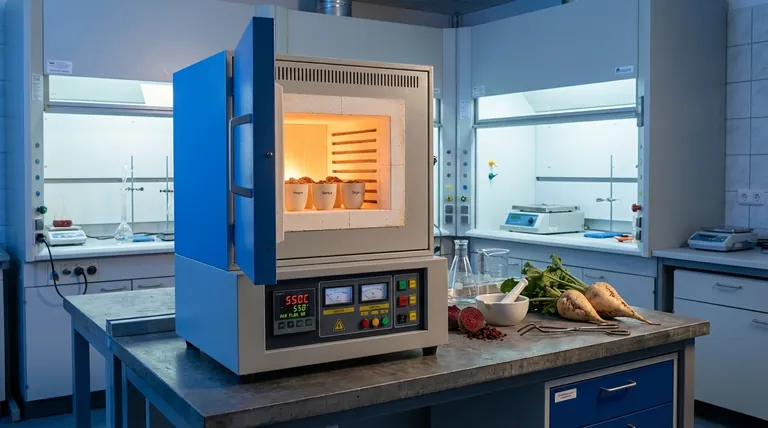
The Critical Role of Temperature and Airflow
To understand why this specific equipment is required, you must look at the physical requirements of combustion.
Reaching the Combustion Threshold
The primary function of the furnace is to generate extreme temperatures up to 550 °C. This specific thermal threshold is necessary to initiate and sustain the decomposition of the complex organic structures found in sugar beets. Lower temperatures would fail to fully burn off the organic material, leading to inaccurate results.
The Necessity of Air Circulation
Heat alone is insufficient for this process; accurate ash determination requires oxidation. The industrial muffle furnace provides sufficient air circulation within the chamber. This continuous supply of oxygen ensures that the organic matter actively combusts rather than simply charring, which is essential for total decomposition.
From Organic Matter to Inorganic Ash
The goal of this analysis is not just to burn the sample, but to isolate specific chemical components.
Total Decomposition of Organics
For the analysis to be valid, all organic matter must be removed from the sample. The furnace acts as a decomposition chamber, converting carbon-based compounds into gases that are vented away. Any remaining organic carbon would artificially inflate the weight of the ash, skewing the data.
Isolating Non-Volatile Residues
What remains after the process is the crude ash. This consists of non-volatile inorganic residues—essentially the mineral content of the sugar beet. Because the furnace operates at a controlled 550 °C, it removes the organics while preserving these inorganic minerals for accurate weighing.
Understanding the Trade-offs
While the muffle furnace is the standard for this application, distinct operational risks exist if the equipment capabilities are misunderstood.
The Risk of Incomplete Combustion
If the furnace fails to maintain adequate air circulation, the sample may not ash completely. This results in "black heart" or carbon residues remaining in the crucible, rendering the weight measurement invalid.
Temperature Stability vs. Volatilization
The furnace must hold 550 °C precisely. Deviating significantly higher risks volatilizing certain inorganic minerals, causing them to be lost to the atmosphere. Conversely, lower temperatures will leave organic matter behind. The "industrial" designation implies the ability to maintain this strict thermal stability.
Making the Right Choice for Your Goal
To ensure your ash determination yields valid data, align your process with these key principles:
- If your primary focus is Data Accuracy: Ensure your furnace calibration maintains exactly 550 °C; deviations will either leave organics behind or boil off minerals.
- If your primary focus is Process Verification: Inspect the final residue; it should be purely inorganic ash, confirming that the air circulation was sufficient to decompose all organic matter.
The muffle furnace is not just a heater; it is a precision instrument designed to chemically isolate mineral content through controlled oxidation.
Summary Table:
| Feature | Requirement for Ashing | Impact on Results |
|---|---|---|
| Temperature | Precisely 550 °C | Ensures total organic decomposition without mineral loss |
| Air Circulation | High / Constant | Facilitates complete oxidation of carbon-based matter |
| Environment | Controlled Muffle Chamber | Prevents sample contamination and ensures uniform heating |
| Residue Goal | Non-volatile Inorganic Ash | Provides accurate data for mineral content calculation |
Optimize Your Ash Determination with KINTEK Precision
Achieving accurate mineral analysis requires the perfect balance of thermal stability and controlled oxidation. KINTEK provides high-performance Muffle, Tube, and Vacuum systems designed specifically for rigorous laboratory standards. Backed by expert R&D and manufacturing, our industrial furnaces are fully customizable to meet your unique temperature and airflow requirements.
Enhance your lab's data accuracy today—Contact KINTEK for a custom furnace solution!
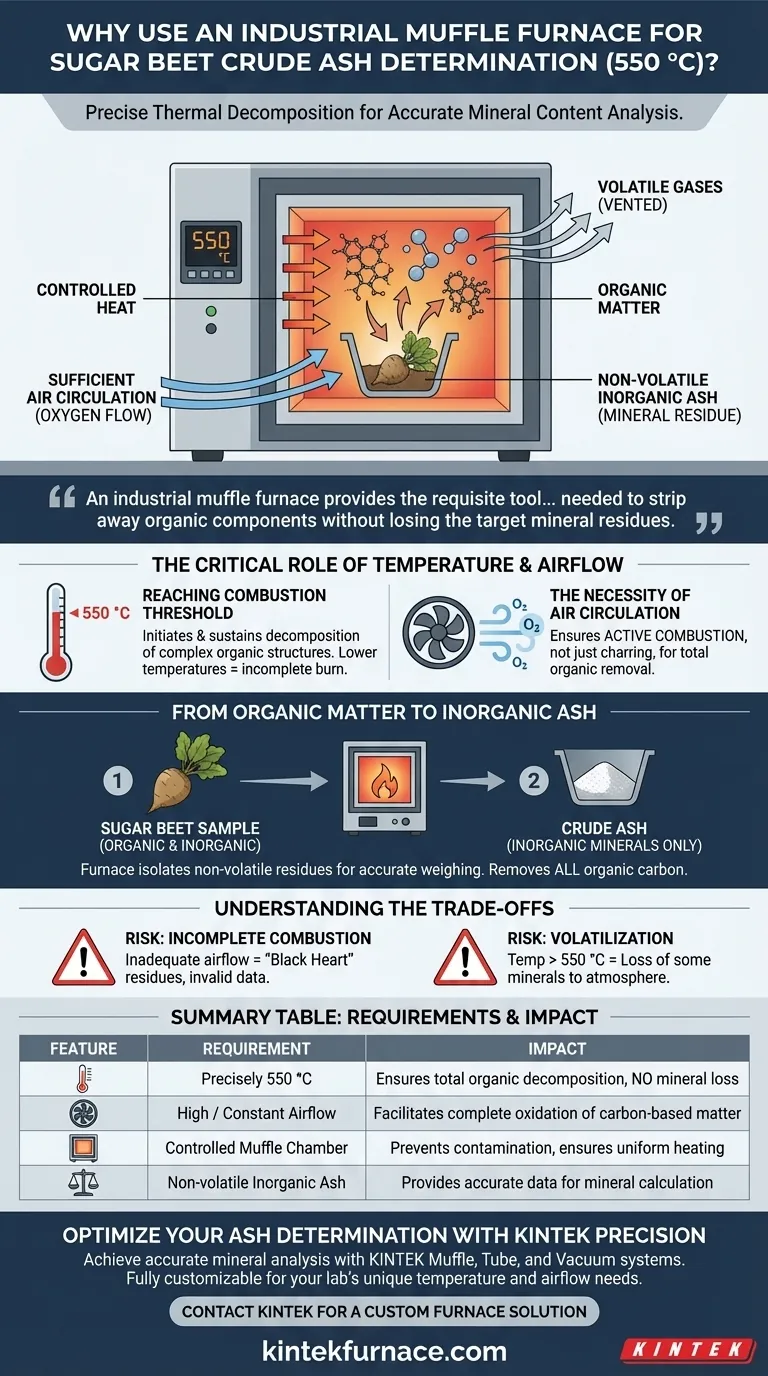
Visual Guide
References
- Sanja Ostojić, Anet Režek Jambrak. Thermal Characteristics and Kinetics of the Thermal Degradation of Sugar Beet Waste Leaves and Pulp in Relation to Chemical Composition. DOI: 10.3390/foods14020307
This article is also based on technical information from Kintek Furnace Knowledge Base .
Related Products
- High Temperature Muffle Oven Furnace for Laboratory Debinding and Pre Sintering
- 1700℃ High Temperature Muffle Oven Furnace for Laboratory
- Laboratory Muffle Oven Furnace with Bottom Lifting
- 1800℃ High Temperature Muffle Oven Furnace for Laboratory
- 1400℃ Muffle Oven Furnace for Laboratory
People Also Ask
- What thermal phenomena occur during polymer binder burnout in ceramic green bodies? Lab Furnace Guide
- What role does a high-temperature muffle furnace play in STFO synthesis? Achieve Pure Perovskite Results
- Why is controlled heat treatment in a muffle furnace necessary for calcined clay? Achieve Optimal Pozzolanic Activity
- How does a high-temperature muffle furnace facilitate the formation of LaNbxAl1−xO3+δ perovskite structures? Key Roles
- What role does a high-temperature muffle furnace play in the multi-stage synthesis of Li0.5MnFe1.5O4? Key to Pure Spinel







