
A laboratory-grade muffle furnace functions as the primary thermal reactor for the controlled carbonization of cotton mill waste. It maintains a precise high-temperature environment, specifically at 500 °C, while strictly limiting oxygen exposure to facilitate thermal decomposition. This process removes volatile components from the raw cotton and solidifies the initial carbon framework, which is the prerequisite for any further activation steps.
The furnace is not merely a heater; it is a tool for precision pyrolysis that converts raw biomass into a stable carbon skeleton by stripping away volatiles without incinerating the material into ash.
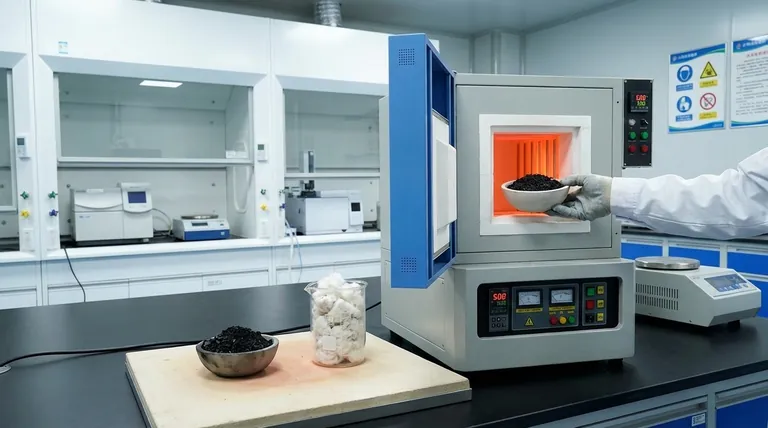
The Mechanism of Carbonization
Precise Thermal Decomposition
The muffle furnace provides the exact thermal energy required to break down the complex organic structures in cotton waste. By maintaining a steady temperature of 500 °C, the furnace ensures that the material undergoes consistent thermal decomposition.
Oxygen-Lean Processing
Unlike an incinerator, the muffle furnace operates under oxygen-lean conditions. This distinction is critical; it ensures the cotton waste undergoes pyrolysis (chemical change via heat) rather than combustion (burning).
Creating the Carbon Skeleton
As the furnace heats the cotton, it facilitates the construction of a preliminary carbon framework. This "skeleton" is the structural foundation that defines the biochar's physical integrity.
Preparing the Material for Activation
Removal of Volatiles
The high heat effectively drives off non-carbon elements and volatile organic compounds. This leaves behind a purified, carbon-rich solid that is chemically stable.
Establishing Porosity
While subsequent activation steps enhance porosity, the muffle furnace initiates the process. By eliminating volatiles, it creates the initial pore structure and surface area required for the biochar to function as an adsorbent.
Foundation for Activation
The output from the muffle furnace is not yet activated carbon, but it is the essential precursor. The quality of this initial carbonization step directly dictates the success of any subsequent chemical or physical activation processes.
Understanding the Trade-offs
The Risk of Oxidation
If the furnace environment is not sufficiently oxygen-lean, the cotton waste will combust rather than carbonize. This results in ash formation rather than biochar, destroying the carbon structure and rendering the sample useless for adsorption applications.
Temperature Sensitivity
Precision is paramount. If the temperature drops significantly below 500 °C, decomposition may be incomplete, leaving volatile residues. Conversely, excessive temperatures without proper control can damage the pore structure or alter the surface functional groups negatively.
Making the Right Choice for Your Goal
To ensure the success of your cotton-to-biochar conversion, consider the following recommendations based on your specific objectives:
- If your primary focus is fundamental research: Prioritize a furnace with high-precision digital temperature control to ensure the 500 °C setpoint is maintained within a tight tolerance for reproducible results.
- If your primary focus is material quality: Ensure your setup includes a gas-tight retort or inert gas flow (like Nitrogen) within the furnace to strictly minimize oxygen exposure and maximize carbon yield.
- If your primary focus is subsequent activation: Verify that the furnace can hold the target temperature consistently for the full duration (e.g., 30 minutes to 4 hours) to guarantee a completely carbonized framework before activation.
The muffle furnace is the gatekeeper of quality, transforming raw waste into a structured carbon canvas ready for high-performance applications.
Summary Table:
| Stage | Process | Role of Muffle Furnace |
|---|---|---|
| Initial Stage | Thermal Decomposition | Provides precise 500 °C heat to break down organic structures. |
| Environment | Oxygen-Lean Control | Prevents combustion/ashing; facilitates pyrolysis over incineration. |
| Structural | Skeleton Formation | Removes volatiles to create the preliminary carbon framework. |
| Output | Pre-Activation Prep | Delivers a purified, carbon-rich precursor for chemical activation. |
Maximize Your Biochar Yield with KINTEK Precision
Transitioning from cotton waste to high-performance biochar requires absolute thermal control. Backed by expert R&D and manufacturing, KINTEK offers high-performance Muffle, Tube, and Vacuum furnace systems designed to maintain oxygen-lean environments and precise temperature tolerances for consistent pyrolysis.
Whether you are conducting fundamental research or developing industrial precursors, our customizable lab high-temp furnaces ensure you avoid ash formation and achieve a perfect carbon skeleton every time.
Ready to optimize your carbonization process? Contact KINTEK today for a customized furnace solution!
Visual Guide

References
- Chaiyan Chaiya, Piyaporn Kampeerapappun. Enhancing the Sustainability of Cotton Spinning Mill Waste Through Thermochemical Processes: Converting Waste into Carbon Materials. DOI: 10.1021/acsomega.5c05007
This article is also based on technical information from Kintek Furnace Knowledge Base .
Related Products
- 1400℃ Muffle Oven Furnace for Laboratory
- 1700℃ High Temperature Muffle Oven Furnace for Laboratory
- 1800℃ High Temperature Muffle Oven Furnace for Laboratory
- 1200℃ Muffle Oven Furnace for Laboratory
- High Temperature Muffle Oven Furnace for Laboratory Debinding and Pre Sintering
People Also Ask
- What is the primary function of a high-temperature laboratory muffle furnace in chemical synthesis? Achieve Precision.
- How does a high-temperature laboratory muffle furnace affect material properties? Transform Anodic Oxide Films Fast
- What are the primary objectives of using a muffle furnace in zirconia synthesis? Achieve precision phase control.
- How does a muffle furnace facilitate Ag/ATP catalyst preparation? Optimize Calcination for Superior Performance
- What is the role of a laboratory high-temperature muffle furnace in H13 steel treatment? Optimize Tool Performance



















