
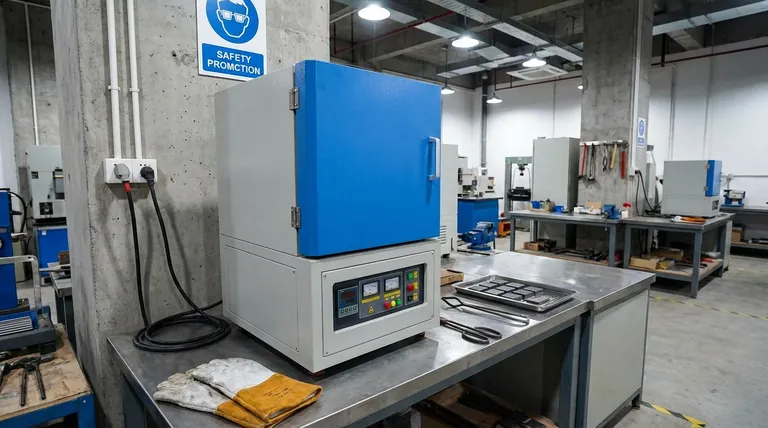
The industrial High-temperature Electric Furnace functions as the definitive stabilization tool for ensuring the reliability of carbon steel material studies. It provides the precise thermal environment required to drive specific phase transformations—specifically austenitization and tempering—ensuring that steel samples achieve a uniform internal structure before testing.
The core value of this furnace lies in its ability to eliminate microstructural variables. By strictly controlling temperature compensation and holding times, it creates a standardized tempered sorbite matrix, allowing engineers to isolate and study the specific effects of inclusions on fatigue strength without interference from irregular material structures.
Mechanisms of Structural Standardization
Precise Austenitization Control
To standardize carbon steel, the material must first be reset to a uniform state. The High-temperature Electric Furnace creates a highly stable thermal environment capable of maintaining critical temperatures, such as 880°C, for austenitization.
This stability ensures that the steel's crystal structure transforms completely and uniformly. Without this precise thermal floor, the resulting microstructure would vary across samples, rendering comparative data useless.
The Role of Precision Tempering
Following austenitization, the furnace facilitates a controlled tempering process. The primary reference highlights a specific 120-minute tempering cycle used to modify the steel's properties.
During this phase, the furnace's ability to manage temperature compensation is critical. It prevents thermal fluctuations that could lead to uneven hardness or ductility within the sample batch.
Achieving the Target Microstructure
Transformation to Tempered Sorbite
The ultimate goal of using this specific furnace is to drive a consistent phase transformation. The process converts low-temperature tempered martensite into tempered sorbite.
Tempered sorbite provides a predictable balance of strength and toughness. By ensuring every sample reaches this specific state, the furnace creates a "blank canvas" for researchers.
Establishing a Fatigue Baseline
Standardization is essential for studying fatigue strength. Researchers use this furnace to ensure that the steel matrix is identical across all samples.
With the matrix standardized, any failure in the steel can be accurately attributed to inclusions (impurities) rather than inconsistencies in the heat treatment process.
Distinguishing Heat Treatment from Melting
Chemical vs. Structural Standardization
It is vital to distinguish between the High-temperature Electric Furnace used for heat treatment and the Electric Arc Furnace (EAF) used for melting.
While the High-temperature Electric Furnace standardizes the microstructure (solid state), the EAF standardizes the chemical composition (liquid state).
The Role of the Electric Arc Furnace
As noted in the supplementary references, the EAF handles large-scale loads (e.g., 140 tons) and controls the ratio of scrap steel to pig iron.
Its role is to ensure chemical composition stability and reduce exogenous inclusions before the steel ever reaches the heat treatment stage. It provides the pure raw material that the High-temperature Electric Furnace subsequently refines structurally.
Common Pitfalls in Furnace Selection
Scale vs. Precision
A common error is confusing production-scale melting equipment with precision heat treatment equipment. Large-scale furnaces are designed for energy input efficiency and volume, not the micro-degree precision required for tempering studies.
Thermal Hysteresis
If the furnace lacks advanced temperature compensation, "thermal lag" can occur. This results in the core of the sample not reaching the target temperature for the full 120 minutes, leading to incomplete transformation to tempered sorbite.
Making the Right Choice for Your Goal
To achieve valid results in steel standardization, you must select the equipment that aligns with your specific processing stage.
- If your primary focus is Structural Analysis: Prioritize the High-temperature Electric Furnace to ensure a consistent transformation to tempered sorbite for fatigue benchmarking.
- If your primary focus is Material Purity: Focus on the Electric Arc Furnace parameters to control the scrap-to-pig-iron ratio and minimize non-metallic inclusions during the melt.
Ultimately, the High-temperature Electric Furnace acts as a calibrator, removing structural variance so that performance data reflects the material's true quality rather than its processing history.
Summary Table:
| Process Phase | Target Temperature/Time | Key Transformation | Structural Outcome |
|---|---|---|---|
| Austenitization | ~880°C | Phase Reset | Uniform Crystal Structure |
| Tempering | 120-Minute Cycle | Martensite to Sorbite | Balanced Strength & Toughness |
| Standardization | Precise Holding Time | Matrix Homogenization | Fatigue Strength Baseline |
Elevate Your Material Testing Precision with KINTEK
Don't let microstructural variables compromise your research. Backed by expert R&D and manufacturing, KINTEK offers high-precision Muffle, Tube, Rotary, Vacuum, and CVD systems designed to eliminate thermal hysteresis and ensure total standardization. Whether you need a standard laboratory furnace or a fully customizable high-temperature system for unique industrial needs, our equipment provides the stability required for rigorous carbon steel analysis.
Ready to achieve a flawless tempered sorbite matrix? Contact our thermal processing experts today to find the perfect solution for your lab.
References
- Tomasz Lipiński. Analysis of the Distribution of Non-Metallic Inclusions and Its Impact on the Fatigue Strength Parameters of Carbon Steel Melted in an Electric Furnace. DOI: 10.3390/ma17246151
This article is also based on technical information from Kintek Furnace Knowledge Base .
Related Products
- 1700℃ High Temperature Muffle Oven Furnace for Laboratory
- 1800℃ High Temperature Muffle Oven Furnace for Laboratory
- 1400℃ High Temperature Laboratory Tube Furnace with Alumina Tube
- 1700℃ High Temperature Laboratory Tube Furnace with Alumina Tube
- 1200℃ Muffle Oven Furnace for Laboratory
People Also Ask
- What is the primary function of a high-temperature laboratory muffle furnace in chemical synthesis? Achieve Precision.
- How does a high-temperature laboratory muffle furnace affect material properties? Transform Anodic Oxide Films Fast
- What role does a muffle furnace play in BCZY712 electrolyte powder production? Achieve Perfect Phase Purity
- What is the role of a high-temperature muffle furnace in guava leaf carbonization? Master Precise Pyrolysis Control
- What role does a muffle furnace play in sintering photocathodes? Enhance Electrode Conductivity & Catalytic Activity



















