
The primary purpose of using a high-temperature muffle furnace for post-annealing is to drive a critical phase transformation that improves electrical performance. Specifically, for metal oxide electron transport layers like Titanium Dioxide ($TiO_2$), this process involves high-temperature sintering at approximately 500°C. This thermal treatment converts low-efficiency amorphous precursors into high-mobility crystalline phases and establishes a robust electrical connection with the substrate.
Core Takeaway The muffle furnace is not merely a drying tool; it is a phase-engineering instrument. Its function is to convert amorphous metal oxides into highly conductive crystalline structures while simultaneously optimizing the electrical interface with the conductive glass substrate.
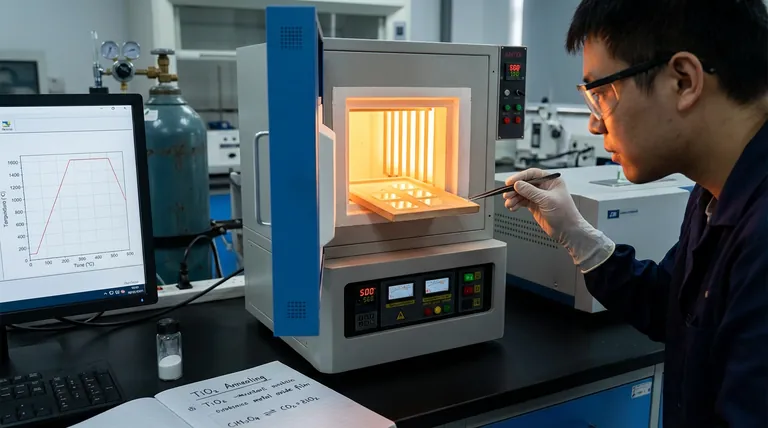
The Physics of Phase Transformation
Converting Structure for Mobility
Freshly prepared metal oxide layers, such as those made via spin coating or chemical bath deposition, often exist in an amorphous state.
In this disordered state, electron transport is inefficient. The high thermal energy provided by the muffle furnace drives the atomic rearrangement necessary to form crystalline phases, such as the anatase phase in $TiO_2$.
This structural organization significantly increases charge mobility, allowing electrons to move through the layer with minimal resistance.
Establishing Ohmic Contact
The performance of an electron transport layer is defined not just by its bulk properties, but by its interface.
Sintering facilitates a chemical and physical bonding process between the metal oxide layer and the underlying conductive glass substrate.
This results in an enhanced ohmic contact, which is essential for the efficient extraction of electrons from the device without creating energy barriers that impede current flow.
Precision and Structural Integrity
Eliminating Internal Stress
Beyond phase changes, the stability of the muffle furnace plays a crucial role in mechanical reliability.
The sintering process typically generates internal stresses within the material. A high-quality muffle furnace provides precisely controllable heating and cooling curves.
By strictly regulating these thermal ramp rates, you can effectively eliminate residual stresses, preventing the film from cracking or delaminating during operation.
Optimizing Optical and Defect Properties
The controlled environment of the furnace allows for the optimization of grain boundary structures.
Proper annealing parameters help eliminate point defects, such as oxygen vacancies, which can act as recombination centers that trap electrons and reduce efficiency.
Furthermore, reducing these defects and optimizing crystallinity often improves the optical transparency of the ceramic material, a critical factor for optoelectronic devices that require light to pass through the transport layer.
Understanding the Trade-offs
Thermal Budget Constraints
While high-temperature sintering (500°C) is excellent for crystallinity, it severely limits your substrate options.
This process is generally incompatible with flexible polymer substrates, which have much lower melting points. You are effectively locked into using rigid, heat-resistant materials like conductive glass or ceramics.
The Risk of Thermal Shock
While the furnace can provide stable cooling, improper operation poses a risk.
If the cooling ramp is too aggressive, the difference in thermal expansion coefficients between the metal oxide and the glass substrate can induce new stresses. This defeats the purpose of stress-relief annealing and can lead to immediate or latent structural failure.
Making the Right Choice for Your Goal
To maximize the effectiveness of your post-annealing process, align your furnace parameters with your specific device requirements:
- If your primary focus is Maximum Conductivity: Prioritize holding the temperature at the specific crystallization point (e.g., 500°C for anatase $TiO_2$) to ensure complete phase transformation.
- If your primary focus is Mechanical Reliability: Focus heavily on the cooling curve; a slower ramp-down rate is essential to minimize residual stress and prevent delamination.
- If your primary focus is Optical Transparency: Ensure precise atmosphere and temperature control to minimize oxygen vacancies and grain boundary scattering.
By mastering the thermal profile of your muffle furnace, you turn a simple heating step into a critical tool for defining the ultimate efficiency of your electronic device.
Summary Table:
| Process Objective | Mechanism | Key Outcome |
|---|---|---|
| Phase Transformation | High-temp sintering (~500°C) | Amorphous to crystalline (e.g., Anatase $TiO_2$) |
| Interface Quality | Thermal bonding with substrate | Enhanced ohmic contact and electron extraction |
| Mechanical Stability | Controlled ramp rates | Elimination of internal stress and cracking prevention |
| Defect Management | Optimization of grain boundaries | Reduced oxygen vacancies and improved transparency |
Elevate Your Material Research with KINTEK Precision
Unlock the full potential of your thin-film applications through superior thermal engineering. Backed by expert R&D and manufacturing, KINTEK offers high-performance Muffle, Tube, Rotary, Vacuum, and CVD systems—all fully customizable to meet the rigorous demands of your laboratory.
Whether you are optimizing $TiO_2$ crystallinity or developing next-generation optoelectronics, our furnaces provide the precise temperature control and cooling curves necessary for peak efficiency.
Ready to achieve superior phase transformation? Contact KINTEK today to find the perfect high-temperature solution for your lab.
References
- Maoding Cheng, Qinglong Jiang. Progress and Application of Halide Perovskite Materials for Solar Cells and Light Emitting Devices. DOI: 10.3390/nano14050391
This article is also based on technical information from Kintek Furnace Knowledge Base .
Related Products
- 1700℃ High Temperature Muffle Oven Furnace for Laboratory
- High Temperature Muffle Oven Furnace for Laboratory Debinding and Pre Sintering
- 1800℃ High Temperature Muffle Oven Furnace for Laboratory
- 1200℃ Muffle Oven Furnace for Laboratory
- 1400℃ Muffle Oven Furnace for Laboratory
People Also Ask
- What is the primary function of a high-temperature laboratory muffle furnace in chemical synthesis? Achieve Precision.
- How does a high-temperature laboratory muffle furnace affect material properties? Transform Anodic Oxide Films Fast
- What role does a muffle furnace play in BCZY712 electrolyte powder production? Achieve Perfect Phase Purity
- What is the role of a high-temperature muffle furnace in guava leaf carbonization? Master Precise Pyrolysis Control
- What role does a muffle furnace play in sintering photocathodes? Enhance Electrode Conductivity & Catalytic Activity



















