
The primary function of an industrial box furnace during the heat treatment of 60Si2CrV spring steel is to heat the material to a precise austenitizing temperature of 880°C. It creates a controlled thermal environment using an oxidation (air) atmosphere to facilitate a complete internal structural transformation, preparing the alloy for subsequent hardening.
The furnace serves as a precision instrument, ensuring the steel achieves a uniform austenitic structure before quenching. Without this exact thermal control, the material cannot develop the martensitic strength required for high-performance springs.
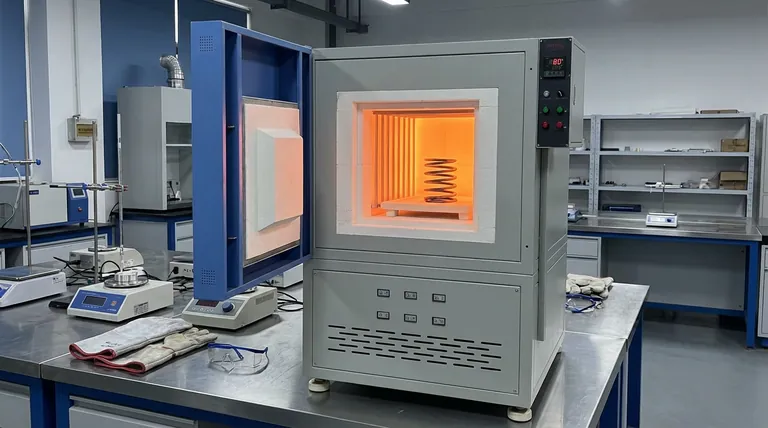
Critical Parameters of the Heating Stage
To ensure the 60Si2CrV steel reaches its potential, the furnace must manage three distinct variables: temperature, atmosphere, and time.
Achieving the Austenitizing Temperature
The furnace must reliably bring the specimen to 880°C.
At this specific temperature, the internal crystal lattice of the steel shifts. This phase change is necessary to dissolve carbides and form austenite, which acts as the foundation for the steel's final hardness.
Managing the Oxidation Atmosphere
According to the established process for this alloy, the furnace operates with an oxidation (air) atmosphere.
While many treatments utilize inert gases, this specific method utilizes a stable air environment. This approach simplifies the atmospheric requirements while still maintaining the thermal consistency needed for the phase transformation.
Calculating the Holding Time
The furnace is not just a heater; it is a timer for thermal penetration.
To ensure the heat reaches the core of the steel, a specific holding time is enforced. This is typically calculated at one minute for every 1mm of the hardening zone. This rule prevents the formation of a thermal gradient where the surface is hot but the core remains cool.
The Goal: Structural Uniformity
The ultimate objective of the box furnace in this stage is preparation for martensitic strengthening.
Ensuring Thorough Transformation
If the steel is not heated uniformly, the internal structure will be a mix of different phases.
The furnace's ability to hold the temperature ensures that the transformation to austenite is thorough and complete. Any remaining untransformed sections would become weak points in the finished spring.
Stabilizing the Environment
Spring steel requires high consistency to resist fatigue.
The "box" design of the furnace isolates the workpiece from external fluctuations. This stability is critical for ensuring that every part of the batch receives identical thermal treatment.
Understanding the Trade-offs
While the industrial box furnace is effective, understanding the limitations of the specific parameters used is vital for quality control.
The Implications of an Air Atmosphere
The process utilizes an oxidation atmosphere, which simplifies operation but introduces chemical reactions at the surface.
At 880°C, oxygen reacts with iron to form scale or oxide layers. While the internal structure transforms correctly, the surface may require post-treatment cleaning to remove this oxidation, unlike processes that use protective inert atmospheres.
Precision vs. Throughput
Adhering to the strict 1 minute per 1mm rule acts as a bottleneck for production speed.
Cutting this time short to increase throughput is a common error. Doing so risks incomplete austenitization, which leads to soft spots in the spring and eventual mechanical failure under load.
Making the Right Choice for Your Goal
When configuring your heat treatment process for 60Si2CrV, your decisions should be driven by the specific mechanical requirements of the final spring.
- If your primary focus is Structural Integrity: Adhere strictly to the 1 min/1mm holding time, ensuring the core temperature matches the surface temperature before quenching.
- If your primary focus is Hardness Consistency: Verify that the furnace maintains the 880°C setpoint without significant fluctuation, as deviations can alter the grain structure.
Success in treating spring steel is not just about getting it hot; it is about precise control over how long and how evenly that heat is applied.
Summary Table:
| Parameter | Specification | Purpose |
|---|---|---|
| Target Temperature | 880°C | Complete austenitization & carbide dissolution |
| Atmosphere | Oxidation (Air) | Stable thermal environment for phase change |
| Holding Time | 1 min / 1mm | Ensures core-to-surface thermal uniformity |
| Primary Goal | Structural Uniformity | Preparation for martensitic hardening & fatigue resistance |
Elevate Your Heat Treatment Precision with KINTEK
Achieving the perfect martensitic structure in high-performance alloys like 60Si2CrV requires more than just heat—it requires absolute control. KINTEK provides industry-leading thermal solutions backed by expert R&D and precision manufacturing.
Whether you need Muffle, Tube, Rotary, Vacuum, or CVD systems, our lab high-temperature furnaces are fully customizable to meet your unique metallurgical requirements. Don't compromise on structural integrity or hardness consistency.
Contact us today to optimize your lab's thermal processing and discover how our advanced furnace technology can enhance your production quality.
Visual Guide

References
- Analysis of heat treatment parameters of 60Si2CrV steel to enhance the mechanical properties of elastic structural elements. DOI: 10.21595/vp.2025.24991
This article is also based on technical information from Kintek Furnace Knowledge Base .
Related Products
- High Pressure Laboratory Vacuum Tube Furnace
- Vacuum Hot Press Furnace Machine Heated Vacuum Press Tube Furnace
- Mesh Belt Controlled Atmosphere Furnace Inert Nitrogen Atmosphere Furnace
- Vacuum Heat Treat Sintering Furnace with Pressure for Vacuum Sintering
- 1700℃ High Temperature Laboratory Tube Furnace with Alumina Tube
People Also Ask
- What role does a high vacuum tube furnace play in Co-Al sintering? Master High-Purity Porous Material Synthesis
- What are the different types of tube furnaces available? Find the Perfect Fit for Your Lab's Needs
- What are the main advantages of vacuum tube furnaces in the market? Achieve Purity and Precision in Material Processing
- What is the role of a vacuum tube furnace during the final thermal treatment stage of Fe3O4@CSAC catalysts?
- What role does a laboratory tube furnace play in geological and mineralogical research? Unlock Earth's Secrets with Precision



















