
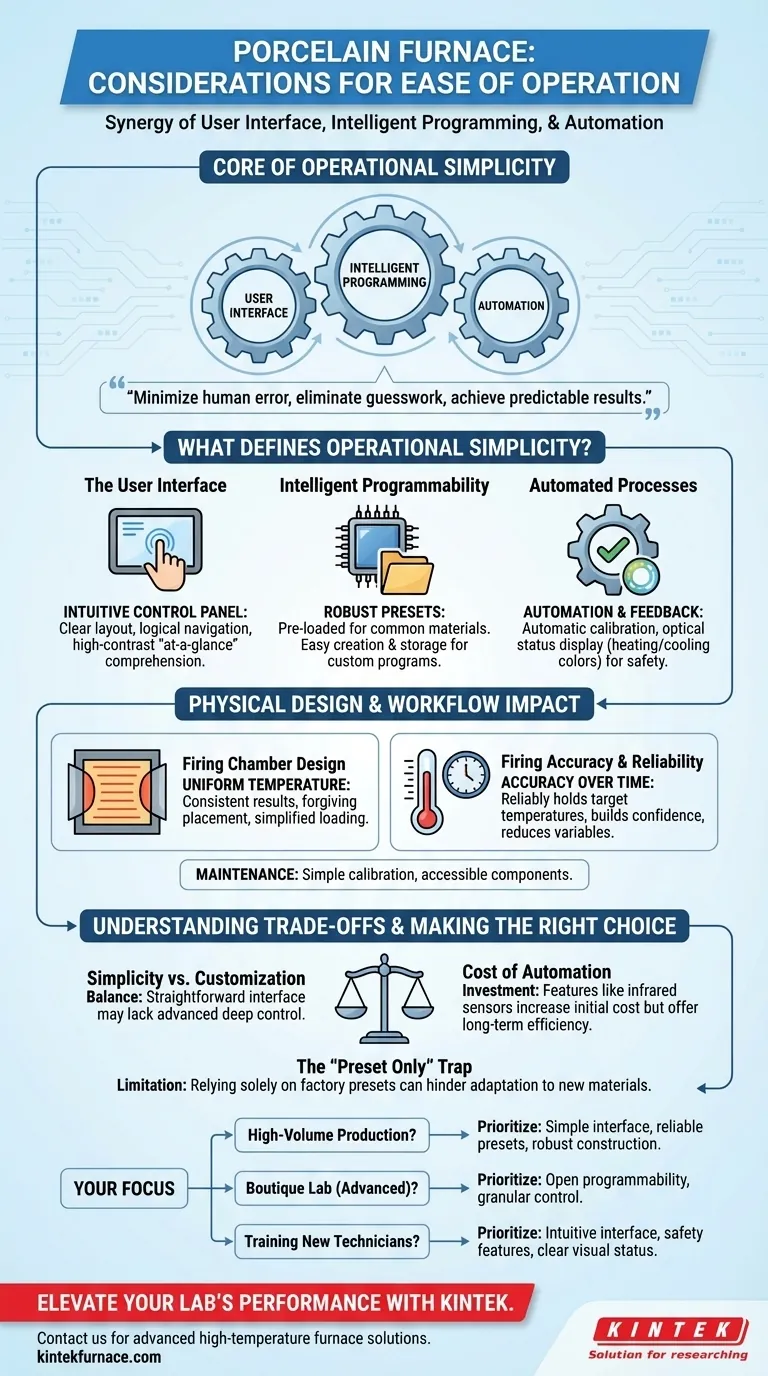
At its core, the ease of operation of a porcelain furnace is determined by the synergy between its user interface, the intelligence of its programming, and its ability to automate critical functions. A truly user-friendly furnace minimizes the potential for human error through a straightforward control panel, reliable pre-set programs, and clear, real-time feedback that allows technicians of any skill level to produce consistent results.
True ease of operation goes beyond a simple touchscreen. It's about how the furnace's design and software work together to reduce procedural complexity, eliminate guesswork, and empower the technician to achieve predictable, high-quality restorations with every cycle.
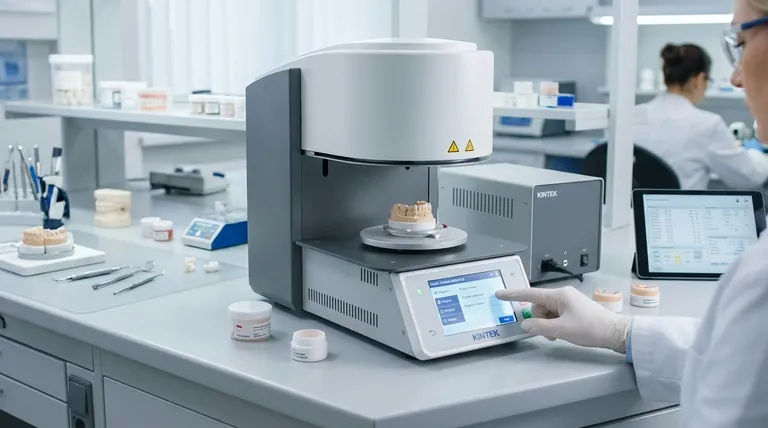
Beyond the Screen: What Defines Operational Simplicity?
A furnace that is easy to operate simplifies the technician's workflow from start to finish. This is achieved through a combination of thoughtful interface design and intelligent automation that handles the complexities of the firing process.
The User Interface and Control Panel
The most immediate factor is the control panel. It should be intuitive, with a clear layout and logical navigation that doesn't require constant reference to a manual.
Look for a high-contrast display that is easily readable from a distance. The goal is "at-a-glance" comprehension, allowing a technician to quickly verify the furnace's status while managing other tasks.
Intelligent Programmability and Presets
Modern labs work with a wide array of ceramic materials, each with unique firing parameters. An easy-to-use furnace accommodates this through robust programming.
The system should come with reliable, pre-loaded programs for common materials. More importantly, it must allow for the easy creation, modification, and storage of custom programs for new or specialized materials.
Automated Processes and Real-Time Feedback
Automation is key to minimizing errors. Features like automatic temperature calibration and adjustment ensure that the firing cycle is accurate without manual intervention.
An optical status display (e.g., a light ring that changes color) provides immediate, non-disruptive feedback on the current stage of the firing cycle—heating, holding, or cooling. This simple feature prevents premature opening of the chamber and improves lab safety and efficiency.
How Physical Design Impacts Your Daily Workflow
Operational ease is not just about software. The physical construction of the furnace plays a critical role in the daily efficiency and consistency of your lab's output.
Firing Chamber Design and Loading
The design of the firing chamber directly impacts the consistency of results. Well-placed heating elements ensure uniform temperature distribution throughout the chamber.
This uniformity makes the furnace more forgiving. It reduces the need for technicians to obsess over the precise placement and spacing of restorations, simplifying the loading process and leading to more predictable outcomes.
Firing Accuracy and Reliability
A furnace that cannot maintain a consistent temperature is, by definition, difficult to work with because its results are unpredictable. Temperature accuracy and reliability over time are foundational to ease of use.
The furnace should reliably hit and hold target temperatures with minimal deviation. This removes a significant variable from the quality control process and builds the technician's confidence in the equipment.
Maintenance and Calibration
A furnace that requires frequent, complex maintenance is not easy to operate in the long term. Look for systems with simple, guided calibration procedures and easily accessible components for cleaning.
Understanding the Trade-offs
Choosing a furnace involves balancing competing priorities. What makes a furnace "easy" for one lab may be a limitation for another.
Simplicity vs. Advanced Customization
The most straightforward interfaces may lack the deep customization options that an expert ceramist needs for highly specialized or experimental cases. A "simple" furnace might restrict access to parameters like fine-tuning heating rates or cooling steps.
Cost of Automation
Features that deliver the greatest ease of use—such as fully automatic calibration, infrared temperature sensors, and advanced diagnostic systems—invariably increase the initial cost of the unit. You must weigh the upfront investment against the long-term savings from fewer remakes and increased efficiency.
The "Preset Only" Trap
While factory presets are a valuable starting point, relying on them exclusively can be a pitfall. As new dental materials enter the market, a furnace that doesn't allow for easy and open programming will quickly become a frustrating limitation rather than an operational asset.
Making the Right Choice for Your Lab
Your final decision should be guided by the specific goals and workflow of your dental laboratory.
- If your primary focus is high-volume production with standard materials: Prioritize a furnace with a dead-simple interface, a large library of reliable presets, and robust construction for all-day reliability.
- If your primary focus is a boutique lab working with diverse, advanced ceramics: You need a furnace with open programmability that provides granular control over every parameter of the firing cycle.
- If your primary focus is training new technicians quickly: Choose a furnace with an exceptionally intuitive user interface, extensive safety features, and clear visual status indicators to minimize the learning curve.
Ultimately, the right furnace is a tool that enhances the skill of the technician, ensuring their craft and expertise are reflected in the final restoration, not lost to operational complexity.
Summary Table:
| Factor | Key Consideration |
|---|---|
| User Interface | Intuitive control panel with clear navigation and high-contrast display for easy status checks |
| Programmability | Pre-loaded and customizable programs for various ceramic materials to reduce errors |
| Automation | Automatic calibration and optical status displays for real-time feedback and safety |
| Physical Design | Uniform temperature distribution and easy loading for consistent results |
| Maintenance | Simple calibration and accessible components for long-term reliability |
| Trade-offs | Balance between simplicity and customization, cost vs. efficiency gains |
Ready to elevate your dental lab's performance? At KINTEK, we specialize in high-temperature furnace solutions tailored to your needs. Leveraging exceptional R&D and in-house manufacturing, we offer advanced products like Muffle, Tube, Rotary Furnaces, Vacuum & Atmosphere Furnaces, and CVD/PECVD Systems. Our strong deep customization capability ensures precise alignment with your unique experimental requirements, whether you're in high-volume production or a boutique lab. Don't let operational complexity hold you back—contact us today to discover how our furnaces can enhance your efficiency, reduce errors, and deliver superior restorations consistently!
Visual Guide
Related Products
- Dental Porcelain Zirconia Sintering Ceramic Vacuum Press Furnace
- Chairside Dental Porcelain Zirconia Sintering Furnace with Transformer for Ceramic Restorations
- Vacuum Dental Porcelain Sintering Furnace for Dental Laboratories
- High Temperature Muffle Oven Furnace for Laboratory Debinding and Pre Sintering
- 2200 ℃ Graphite Vacuum Heat Treat Furnace
People Also Ask
- What factors determine the quality of sintered zirconia restorations? Master Material, Equipment, and Technique
- How do conventional vs rapid sintering in dental furnaces affect zirconia? Optimize Efficiency Without Sacrificing Strength
- What is the purpose of dental sintering furnaces? Transform Zirconia into Durable, High-Quality Dental Restorations
- What precautions should be taken when sintering zirconia in the Fast Slow Dental Sintering Furnace? Master Key Steps for Perfect Results
- What temperature range is used for sintering zirconia ceramics? Achieve Optimal Strength and Translucency



















