
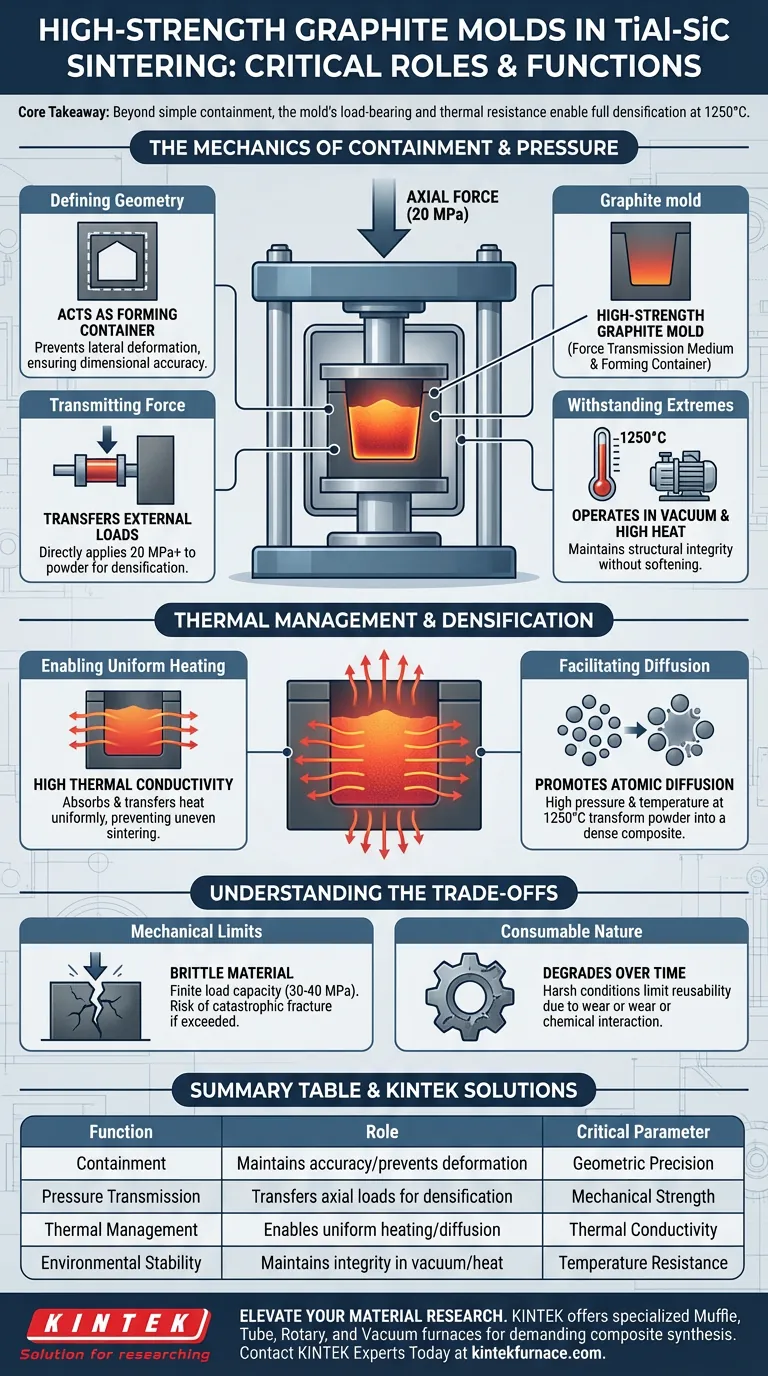
High-strength graphite molds serve as the critical mechanical interface between the raw composite materials and the sintering equipment. Their primary function is dual-purpose: they act as a rigid geometric container to hold the mixed TiAl-SiC powder and function as a transmission medium to apply significant axial pressure (typically around 20 MPa) within a vacuum environment.
Core Takeaway Beyond simple containment, the mold’s unique combination of load-bearing capacity and thermal resistance enables the powder to achieve full densification through atomic diffusion and reaction at temperatures reaching 1250°C.
The Mechanics of Containment and Pressure
Defining Geometry Under Load
The most immediate role of the graphite mold is to act as a forming container. It confines the loose mixed powder, preventing lateral deformation.
This confinement allows the powder to maintain a specific shape while transitioning from a loose aggregate to a solid composite. The mold ensures the final sintered body retains the necessary dimensional accuracy.
Transmitting Axial Force
In a hot-pressing setup, the hydraulic ram does not touch the powder directly. The graphite mold acts as the force transmission medium.
It must transfer external loads—often 20 MPa or higher—directly to the powder. This pressure is essential for closing voids between particles and driving the densification process.
Withstanding Extreme Environments
The mold operates within a vacuum to prevent oxidation, but it must withstand intense heat.
Primary densification for TiAl-SiC composites occurs via diffusion and reaction at temperatures around 1250°C. The graphite must maintain its structural integrity and not soften or deform under these extreme thermal conditions.
Thermal Management and Densification
Enabling Uniform Heating
While the primary reference highlights temperature resistance, supplementary data indicates that graphite’s thermal conductivity is equally vital.
The mold absorbs heat from the furnace elements and transfers it uniformly to the powder interior. This ensures that the temperature gradient across the sample is minimized, preventing uneven sintering or internal stresses.
Facilitating Atomic Diffusion
The combination of high pressure and high temperature created by the mold facilitates diffusion and reaction.
By holding the powder particles in close contact under pressure at 1250°C, the mold creates the environment necessary for atoms to migrate. This transforms the porous powder mixture into a dense, solid composite.
Understanding the Trade-offs
Mechanical Limits and Fractures
While described as "high-strength," graphite is a brittle material compared to metals.
It has a finite load-bearing capacity. If the applied pressure exceeds the mold's specific strength limit (typically between 30 and 40 MPa depending on the grade), the mold will undergo catastrophic fracture rather than plastic deformation.
Consumable Nature
Graphite molds are generally considered consumables in this process.
Despite their self-lubricating properties which aid in demolding, the harsh environment of high pressure and temperature eventually degrades the mold. Surface wear or chemical interactions with the metal melt can limit the reusability of the mold over time.
Making the Right Choice for Your Goal
To maximize the effectiveness of the hot-pressing process, consider your specific sintering objectives:
- If your primary focus is Densification: Ensure your graphite grade is rated for pressures slightly above your target (e.g., capable of 35+ MPa) to safely maximize the force applied at 1250°C.
- If your primary focus is Dimensional Accuracy: Prioritize molds with high thermal stability to prevent expansion or warping that could distort the final composite shape.
The success of TiAl-SiC sintering relies not just on the powder chemistry, but on the graphite mold's ability to maintain a stable, pressurized, and thermally uniform reactor vessel.
Summary Table:
| Function | Role in Sintering Process | Critical Parameter |
|---|---|---|
| Containment | Maintains dimensional accuracy and prevents lateral deformation | Geometric Precision |
| Pressure Transmission | Transfers axial loads (e.g., 20 MPa) to drive densification | Mechanical Strength |
| Thermal Management | Enables uniform heating and atomic diffusion at 1250°C | Thermal Conductivity |
| Environmental Stability | Maintains structural integrity in vacuum and high-heat states | Temperature Resistance |
Elevate Your Material Research with KINTEK
Precision in hot-pressing sintering requires more than just high temperatures; it demands equipment that can withstand extreme mechanical and thermal loads. KINTEK provides world-class laboratory solutions, including specialized Muffle, Tube, Rotary, and Vacuum furnaces, alongside advanced CVD systems designed for the most demanding composite synthesis.
Whether you are sintering TiAl-SiC composites or developing new aerospace alloys, our expert R&D and manufacturing teams offer fully customizable systems tailored to your unique pressure and temperature requirements.
Ready to achieve full densification and superior material performance?
Visual Guide
References
- Microstructure and High-Temperature Compressive Properties of a Core-Shell Structure Dual-MAX-Phases-Reinforced TiAl Matrix Composite. DOI: 10.3390/cryst15040363
This article is also based on technical information from Kintek Furnace Knowledge Base .
Related Products
People Also Ask
- Why are vacuum heat treating furnaces essential for aerospace? Ensure Superior Material Integrity for High-Stakes Applications
- What is the primary application of vacuum heat treating furnaces in aerospace? Enhance Component Performance with Precision
- How does a vacuum heat treating furnace improve the condition of metal alloys? Achieve Superior Metal Performance
- How does vacuum heat treating work in terms of temperature and time control? Master Precise Material Transformations
- What is the process of vacuum heat treating? Achieve Superior Metallurgical Properties
