
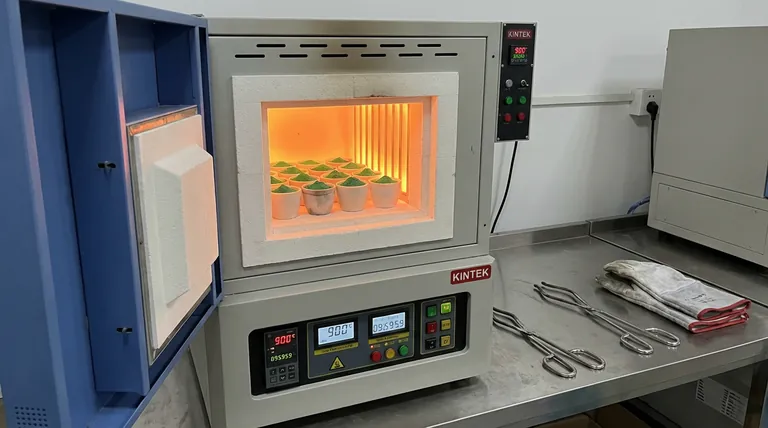
The industrial muffle furnace serves as the precise thermal reactor required to convert raw precursor mixtures into the stable Y2BaCuO5 (Y211) phase. By sustaining a strictly controlled environment of 900 degrees Celsius for a duration of 10 hours, the furnace drives the thermal decomposition of oxalate precursors and facilitates the nucleation necessary to form the characteristic green crystalline material.
Core Takeaway The muffle furnace is not merely a heating device; it is a phase-control instrument. Its ability to maintain a uniform thermal field at 900°C ensures the complete removal of organic residuals and prevents the formation of secondary phases, guaranteeing a pure, single-phase Y211 product.
The Physiology of the Calcination Process
The conversion of Y211 precursors is a multi-stage physiochemical reaction. The muffle furnace orchestrates this process through precise thermal management.
Decomposition of Oxalate Precursors
The initial role of the furnace is to provide the energy required to break down chemical bonds. The raw material often consists of oxalate precursors which are thermally unstable.
Under the furnace's consistent heat, these precursors decompose completely. This step is critical for eliminating the carbon and oxygen components bound in the oxalates, preparing the cation mixture for rearrangement.
Driving Phase Transformation
Once the precursors decompose, the material enters a transition state. The furnace maintains the 900°C setpoint to supply the activation energy needed for solid-state diffusion.
This sustained thermal energy forces the yttrium, barium, and copper atoms to arrange themselves into the specific crystal lattice of Y2BaCuO5. This is the moment the material transforms from a mixture of raw oxides or salts into the definitive "green phase" ceramic.
Critical Control Parameters
Achieving a high-quality Y211 powder depends on the furnace's ability to control specific variables.
Thermal Field Uniformity
Temperature gradients within a furnace chamber are the enemy of phase purity. The industrial muffle furnace is designed to provide a uniform thermal field.
If the temperature varies across the chamber, some powder may under-react while other sections over-fire. Uniformity ensures that every gram of the batch undergoes the exact same nucleation and growth process, resulting in a homogenous single-phase material.
Elimination of Residual Organics
Beyond the primary chemical reaction, the furnace acts as a purification tool. The high-temperature environment effectively burns off residual organic components.
This includes any remaining ligands or processing aids used in earlier synthesis steps. Complete removal is essential, as residual carbon can act as an impurity that degrades the superconducting properties of the final application.
Understanding the Trade-offs
While the muffle furnace is the standard tool for this process, operators must navigate inherent trade-offs to optimize results.
Dwell Time vs. Grain Coarsening
The prescribed 10-hour dwell time is necessary for complete phase formation, but it presents a risk. Extended exposure to high heat promotes grain growth.
If the material is held at temperature too long, the crystals may grow too large (coarsening). This can negatively impact the sintering activity of the powder later in the manufacturing process.
Batch Size vs. Thermal Consistency
Industrial furnaces allow for larger batch processing, which improves throughput. However, increasing the powder load can impede heat transfer.
A densely packed crucible may experience thermal lag in the center of the powder bed. This trade-off requires careful loading protocols to ensure the center of the batch reaches the target 900°C simultaneously with the exterior.
Making the Right Choice for Your Goal
When configuring your calcination process for Y2BaCuO5, your specific end-goal should dictate your furnace parameters.
- If your primary focus is Phase Purity: Prioritize thermal uniformity and adhere strictly to the 900°C setpoint to prevent the formation of secondary impurity phases.
- If your primary focus is Sinterability (Particle Size): Monitor the dwell time closely; ensure it is long enough for reaction completion (10 hours) but avoid extending it further to prevent excessive grain coarsening.
The muffle furnace provides the stable, high-energy environment required to turn unstable chemical precursors into a robust, single-phase engineering material.
Summary Table:
| Parameter | Specification/Role | Impact on Y211 Product |
|---|---|---|
| Target Temp | 900°C | Facilitates solid-state diffusion and phase transition |
| Dwell Time | 10 Hours | Ensures complete decomposition of oxalate precursors |
| Uniformity | High Thermal Field | Prevents secondary phase formation and impurities |
| Process Goal | Calcination | Converts raw precursors into stable 'green phase' ceramic |
| Atmosphere | High-Temp Air/Oxidation | Eliminates residual organics and carbon ligands |
Elevate Your Material Synthesis with KINTEK Precision
Achieving the perfect single-phase Y2BaCuO5 requires more than just heat—it requires the absolute thermal stability and customizable control of KINTEK's industrial solutions. Backed by expert R&D and manufacturing, KINTEK offers Muffle, Tube, Rotary, Vacuum, and CVD systems tailored specifically for lab and high-temp industrial applications.
Whether you are scaling up Y211 precursor production or refining specialized ceramics, our customizable furnaces ensure the uniform thermal fields your research demands. Contact KINTEK today to discuss your unique project needs and see how our advanced heating technology brings consistency to your calcination process.
References
- Exploring the Tribological Potential of Y2BaCuO5 Precursor Powders as a Novel Lubricant Additive. DOI: 10.3390/lubricants13070315
This article is also based on technical information from Kintek Furnace Knowledge Base .
Related Products
- High Temperature Muffle Oven Furnace for Laboratory Debinding and Pre Sintering
- Laboratory Muffle Oven Furnace with Bottom Lifting
- 1200℃ Muffle Oven Furnace for Laboratory
- 1400℃ Muffle Oven Furnace for Laboratory
- 1800℃ High Temperature Muffle Oven Furnace for Laboratory
People Also Ask
- What thermal phenomena occur during polymer binder burnout in ceramic green bodies? Lab Furnace Guide
- What role does a high-temperature muffle furnace play in STFO synthesis? Achieve Pure Perovskite Results
- Why is controlled heat treatment in a muffle furnace necessary for calcined clay? Achieve Optimal Pozzolanic Activity
- How does a high-temperature muffle furnace facilitate the formation of LaNbxAl1−xO3+δ perovskite structures? Key Roles
- What role does a high-temperature muffle furnace play in the formation of biochar catalysts? Master Catalyst Synthesis











