
In short, a box furnace is a high-temperature oven used to fundamentally change the properties of materials. Its primary function is to execute precise thermal processes like heat treatment, sintering, and curing for components used in industries ranging from aerospace and automotive to scientific research.
The true purpose of a box furnace goes beyond simple heating. It is a tool for precisely controlling a material's thermal environment to intentionally alter its internal structure, thereby achieving specific, enhanced properties like increased hardness, strength, or chemical stability.
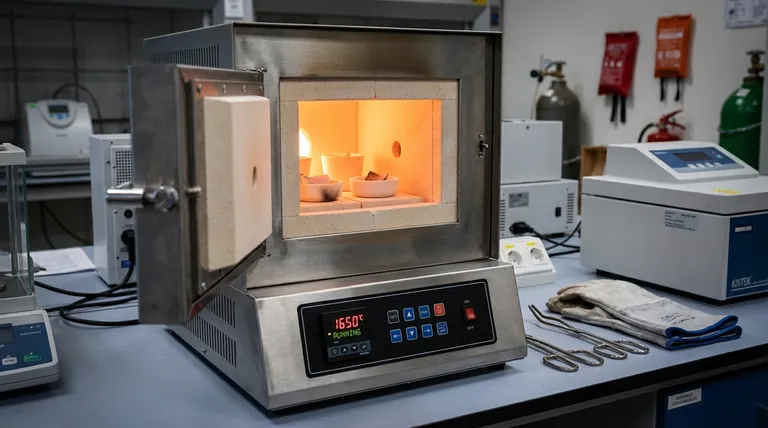
How a Box Furnace Transforms Materials
A box furnace isn't just about making things hot; it's about making them better. The controlled application of heat is a powerful method for manipulating a material at a microscopic level to achieve a desired macroscopic result.
Achieving Specific Material Properties
The core goal of most box furnace processes is to enhance a material's characteristics. By carefully managing temperature and time, you can induce specific structural changes.
This results in improved hardness, strength, and corrosion resistance, making a component suitable for its demanding final application.
The Critical Role of Temperature Control
This level of precision is only possible with sophisticated control systems. Modern box furnaces use an integrated system to ensure accuracy and repeatability.
This typically includes temperature sensors (like thermocouples), PID controllers that intelligently manage power output to prevent overshooting, and user interfaces that allow for complex heating profiles.
Preparing Materials for Analysis and Processing
Beyond enhancement, box furnaces are used to prepare materials. This can involve simple preheating to ready a part for a subsequent manufacturing step.
In laboratory settings, they are essential for element analysis or high-temperature dissolution, where a sample must be brought to a specific state before it can be accurately measured.
Key Processes Enabled by a Box Furnace
The versatility of a box furnace comes from the wide range of thermal processes it can perform. These applications can be grouped by their primary objective.
Heat Treatment for Metals
This is one of the most common uses, especially for small steel parts.
- Annealing: Heating and slowly cooling a metal to soften it and improve its ductility.
- Tempering: Heating a previously hardened metal to a lower temperature to reduce brittleness and increase toughness.
- Quenching: Rapidly cooling a metal to lock in a specific crystalline structure, often to increase hardness.
Sintering and Calcination
These processes are vital for creating solid materials from powders, particularly in ceramics and metallurgy.
- Sintering: Heating powdered material below its melting point until its particles bond together, forming a solid or porous mass.
- Calcination: Heating a solid material to drive off volatile substances, such as removing water or carbon dioxide.
Curing and Drying
Many industrial processes rely on curing to finalize a material's properties. A box furnace provides the stable, uniform heat needed for curing polymers, adhesives, and coatings.
Understanding the Trade-offs: Box vs. Tube Furnaces
While versatile, a box furnace is not the only option. Understanding its design helps clarify when it is the right choice over a more specialized tool like a tube furnace.
The Advantage of Capacity and Accessibility
The primary advantage of a box furnace is its chamber design. The front-loading "box" shape is ideal for batch processing multiple parts at once or handling components with irregular shapes and sizes. Its design prioritizes general-purpose flexibility and ease of use.
When a Tube Furnace Is a Better Fit
A tube furnace excels in applications requiring a highly controlled atmosphere or a continuous flow. Its tubular chamber is perfect for processes involving reactive gases, performing chemical vapor deposition, or for experiments where samples must be dropped in from the top.
Making the Right Choice for Your Application
Selecting the correct furnace requires matching the tool to the specific thermal process and material requirements.
- If your primary focus is batch processing various parts for heat treatment: The accessible chamber and versatile control of a box furnace make it the ideal choice.
- If your primary focus is material research and property testing: A box furnace provides the precise, repeatable heating needed for analyzing and developing new materials.
- If your primary focus is a continuous process or requires a controlled gas atmosphere: You should evaluate a tube furnace, as its design is better suited for specialized syntheses and gas-based reactions.
Ultimately, selecting the right furnace depends on a clear understanding of your material, process, and desired outcome.
Summary Table:
| Key Application | Primary Function | Common Industries |
|---|---|---|
| Heat Treatment | Annealing, Tempering, Hardening | Aerospace, Automotive |
| Sintering/Calcination | Bonding powders, Removing volatiles | Ceramics, Metallurgy |
| Curing & Drying | Finalizing polymer/adhesive properties | Manufacturing, R&D |
| Material Prep & Analysis | Preheating, Sample preparation | Laboratories, Research |
Ready to Enhance Your Material Properties with Precision?
At KINTEK, we understand that achieving the perfect hardness, strength, or thermal stability requires more than just heat—it demands a furnace built for precision and reliability. Our advanced box furnaces are engineered with sophisticated PID control and uniform heating chambers to deliver the exact thermal environment your materials need.
Leveraging our exceptional in-house R&D and manufacturing, we offer deep customization to tailor a high-temperature furnace solution—whether it's a Muffle, Tube, Vacuum, or Atmosphere Furnace—to your unique experimental and production requirements.
Let's discuss how a KINTEK box furnace can transform your processes. Contact our experts today for a solution that fits your specific application.
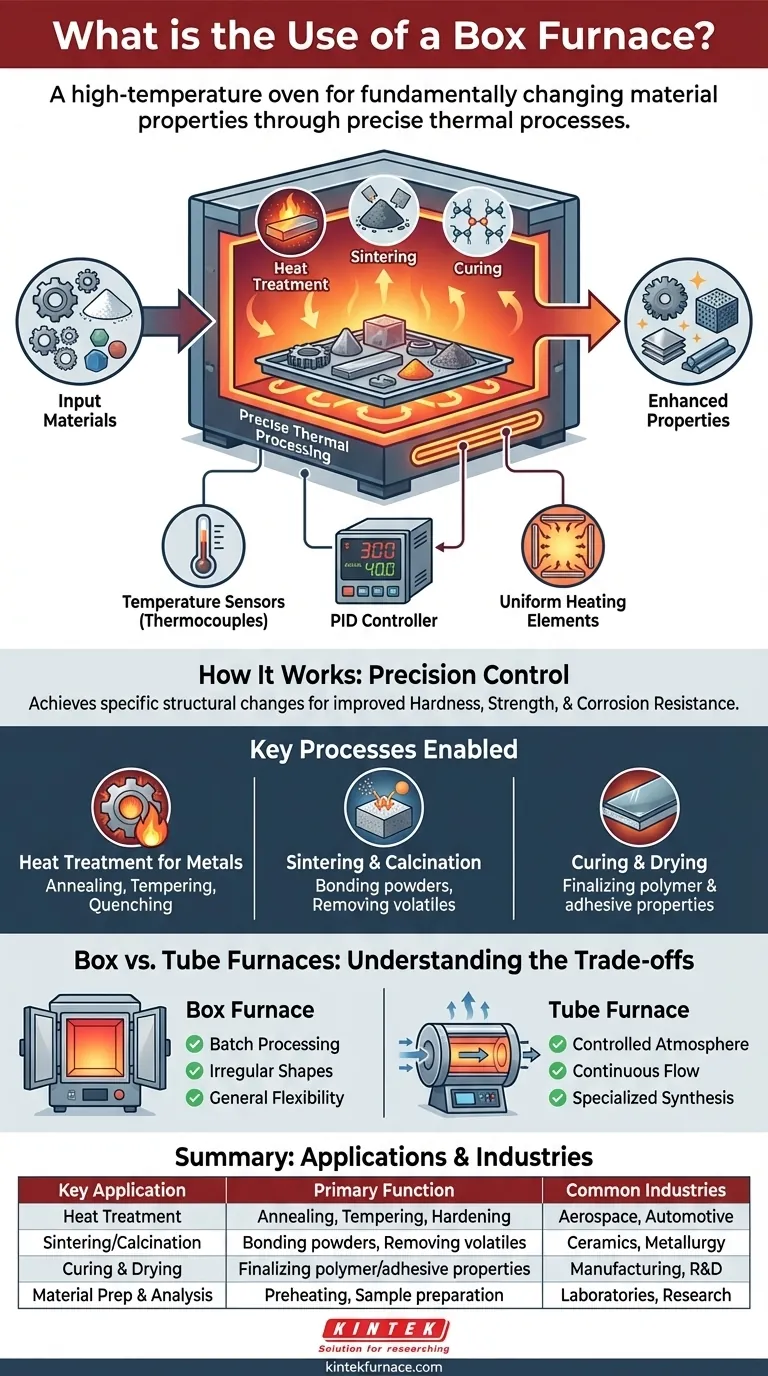
Visual Guide
Related Products
- Vacuum Hot Press Furnace Machine Heated Vacuum Press Tube Furnace
- Mesh Belt Controlled Atmosphere Furnace Inert Nitrogen Atmosphere Furnace
- Vacuum Heat Treat Sintering Furnace with Pressure for Vacuum Sintering
- 600T Vacuum Induction Hot Press Vacuum Heat Treat and Sintering Furnace
- Vacuum Hot Press Furnace Machine Heated Vacuum Press
People Also Ask
- Why use Vacuum Hot Press (VHP) for ZnS Ceramics? Achieve Superior IR Transparency and Mechanical Strength
- What are the benefits of the vacuum environment system in a vacuum hot press furnace? Unlock High-Density Sintering
- What safety features are incorporated in vacuum hot press furnaces? Ensure Operator and Equipment Protection
- What temperature control features do vacuum hot press furnaces have? Achieve Precision in High-Temp Material Processing
- How does the uniaxial pressure applied by a vacuum hot press furnace affect the microstructure of ZrC-SiC materials?



















