
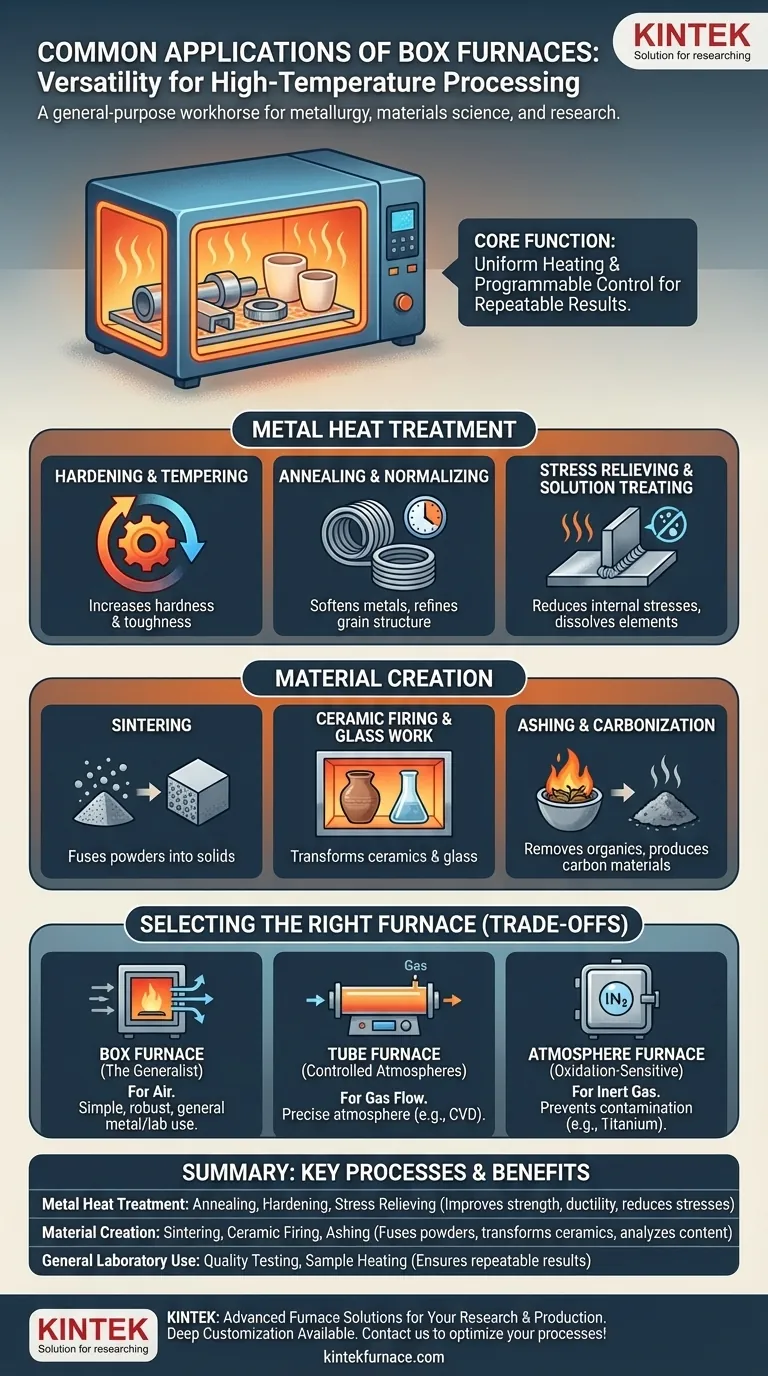
At its core, a box furnace is a versatile tool for high-temperature thermal processing used across a vast range of industrial and laboratory settings. Its common applications include metal heat treatments like annealing, hardening, and stress relieving, as well as material creation processes such as sintering, ceramic firing, and ashing.
A box furnace serves as a general-purpose workhorse for heating materials in a controlled chamber. Its value lies not in specialization, but in its simplicity, reliability, and adaptability to the most common high-temperature tasks found in metallurgy, materials science, and research.
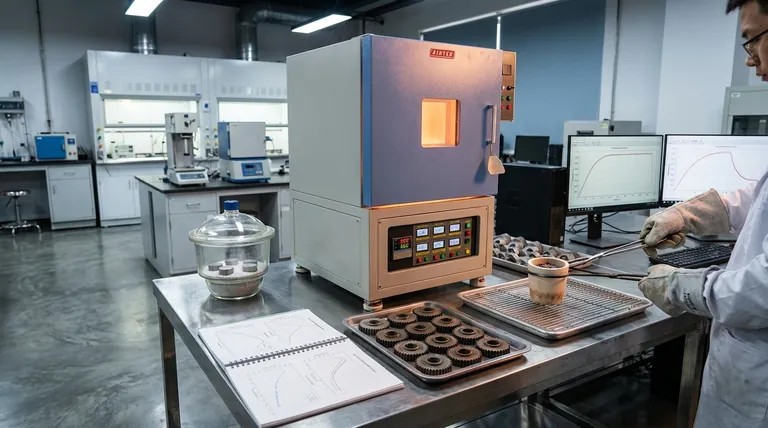
The Core Function: High-Temperature Thermal Processing
Before diving into specific applications, it's crucial to understand what a box furnace does. Its fundamental purpose is to provide a highly uniform and stable temperature environment for thermally processing materials.
Uniform Heating in a Controlled Chamber
A box furnace, true to its name, is an insulated chamber with internal heating elements. Its design ensures that the entire volume reaches and maintains a set temperature with high uniformity.
This consistency is critical for achieving predictable and repeatable results, whether you are hardening a steel part or firing a ceramic sample.
Programmable Control for Repeatable Results
Modern box furnaces feature programmable controllers that allow users to precisely manage heating rates, soak times (how long the furnace stays at a specific temperature), and cooling rates.
This automation is essential for complex heat treatment cycles and ensures that every batch is processed identically, a key requirement for quality control in both production and research.
Key Applications in Metal Heat Treatment
A primary use for box furnaces is altering the physical and mechanical properties of metals. These processes are fundamental to manufacturing in the aerospace, automotive, and electronics industries.
Hardening and Tempering
Hardening involves heating steel to a high temperature and then cooling it rapidly to increase its hardness and wear resistance.
Following hardening, tempering is often performed by heating the part to a lower temperature. This process reduces brittleness and improves the metal's overall toughness.
Annealing and Normalizing
Annealing is a process of heating and slow cooling used to soften metals, relieve internal stresses, and make them easier to work with.
Normalizing is a similar process but with a different cooling rate (air cooling) that refines the metal's grain structure, improving its strength and ductility.
Stress Relieving and Solution Treating
Machining, welding, and other fabrication processes can introduce internal stresses into a metal part. Stress relieving involves heating the part to a temperature below its critical point to reduce these stresses without changing its core properties.
Solution treating is a high-temperature process used on specific alloys to dissolve alloying elements into a solid solution, preparing them for subsequent hardening.
Material Processing and Creation
Beyond treating existing metal parts, box furnaces are instrumental in creating new materials from raw components.
Sintering: Fusing Powders into Solids
Sintering is the process of taking a compacted powder—metal or ceramic—and heating it to just below its melting point. At this temperature, the particles fuse together, forming a solid, dense object.
This is a cornerstone of powder metallurgy and the manufacturing of many advanced ceramic components.
Ceramic Firing and Glass Work
In laboratories, art studios, and small-scale production, box furnaces are used for firing ceramics, pottery, and glass. The precise temperature control is essential for achieving the desired chemical and physical transformations during the firing cycle.
Ashing and Carbonization
Ashing is a laboratory process where a box furnace is used to burn off all organic matter from a sample, leaving only the inorganic ash for analysis.
Conversely, carbonization involves heating organic material in a low-oxygen environment to produce specialized carbon-based materials for research and industrial use.
Understanding the Trade-offs: Box Furnace vs. Specialized Furnaces
While incredibly versatile, a standard box furnace is not the ideal tool for every thermal process. Understanding its limitations helps clarify when a more specialized furnace is required.
The Box Furnace: The Generalist
The standard box furnace is the go-to for basic scenarios in air. Its simple operation, robust construction, and lower maintenance costs make it perfect for general metal heat treatment, quality testing, and sample heating in a lab.
The Tube Furnace: For Controlled Atmospheres
A tube furnace is used when a precisely controlled atmosphere is critical. Samples are placed inside a narrow tube, which can be easily purged and filled with inert or reactive gases. This is essential for processes like chemical vapor deposition (CVD) or syntheses that require a specific gaseous environment.
The Atmosphere Furnace: For Oxidation-Sensitive Materials
An atmosphere furnace is a specialized type of box furnace designed for processing materials that cannot be exposed to oxygen at high temperatures, such as titanium alloys or certain metal powders. These furnaces can be purged and backfilled with inert gases like argon or nitrogen to create a protective, non-oxidizing environment.
Selecting the Right Furnace for Your Process
Your choice of furnace should be driven entirely by the requirements of your material and your process.
- If your primary focus is general metal heat treatment, lab testing, or ceramic firing in air: A standard box furnace is your most versatile and cost-effective solution.
- If your primary focus is processing oxidation-sensitive materials like titanium or advanced metal powders: You require a specialized atmosphere furnace to prevent contamination and ensure material integrity.
- If your primary focus is material synthesis requiring a highly uniform, controlled gas flow (like CVD): A tube furnace is specifically designed for this purpose and offers superior atmospheric control.
Ultimately, understanding the strengths of each furnace type empowers you to select the right tool for the job.
Summary Table:
| Application Category | Key Processes | Benefits |
|---|---|---|
| Metal Heat Treatment | Annealing, Hardening, Stress Relieving | Improves strength, ductility, and reduces internal stresses |
| Material Creation | Sintering, Ceramic Firing, Ashing | Fuses powders, transforms ceramics, and analyzes inorganic content |
| General Laboratory Use | Quality Testing, Sample Heating | Ensures repeatable results with programmable temperature control |
Ready to enhance your thermal processing with a reliable box furnace? Leveraging exceptional R&D and in-house manufacturing, KINTEK provides diverse laboratories with advanced high-temperature furnace solutions. Our product line, including Muffle, Tube, Rotary Furnaces, Vacuum & Atmosphere Furnaces, and CVD/PECVD Systems, is complemented by our strong deep customization capability to precisely meet unique experimental requirements. Whether you need general-purpose heating or specialized atmospheres, we can tailor a solution for you. Contact us today to discuss how our furnaces can optimize your metal heat treatment, material creation, and research processes!
Visual Guide
Related Products
- Vacuum Hot Press Furnace Machine Heated Vacuum Press Tube Furnace
- Mesh Belt Controlled Atmosphere Furnace Inert Nitrogen Atmosphere Furnace
- Vacuum Heat Treat Sintering Furnace with Pressure for Vacuum Sintering
- 600T Vacuum Induction Hot Press Vacuum Heat Treat and Sintering Furnace
- High Temperature Muffle Oven Furnace for Laboratory Debinding and Pre Sintering
People Also Ask
- Why use Vacuum Hot Press (VHP) for ZnS Ceramics? Achieve Superior IR Transparency and Mechanical Strength
- What safety features are incorporated in vacuum hot press furnaces? Ensure Operator and Equipment Protection
- What are the benefits of the vacuum environment system in a vacuum hot press furnace? Unlock High-Density Sintering
- What is a vacuum hot press furnace? Unlock Superior Material Performance
- What is the significance of the vacuum environment for sintering stainless steel? Unlock High-Density Purity



















