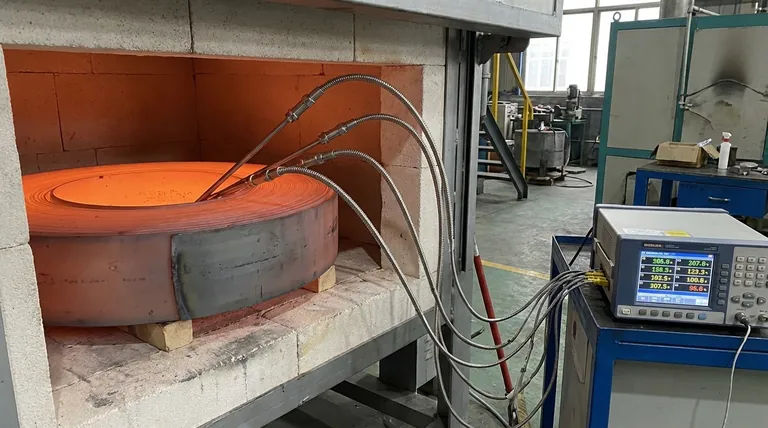
The primary role of an industrial K-type armored thermocouple in an annealing furnace is to perform embedded, real-time temperature testing. By being inserted directly into preset measurement points within steel coils, these sensors capture precise thermal data throughout the entire heating, soaking, and cooling process.
Core Takeaway While measuring furnace air temperature is common, the specific value of the K-type armored thermocouple lies in embedded validation. It provides the high-fidelity data needed to verify that the internal temperature of the steel matches the theoretical predictions of your heat transfer models.
The Mechanics of Embedded Testing
Targeted Measurement Points
To ensure accuracy, these thermocouples are not simply placed near the product; they are utilized for embedded testing.
The sensors are inserted into specific, preset locations within the steel coils. This allows operators to measure the actual material temperature rather than just the ambient environment.
Full-Cycle Monitoring
Annealing is a multi-stage process, and consistent monitoring is required across all phases.
These thermocouples capture real-time temperature changes during the heating, soaking, and cooling phases. This continuous stream of data ensures that the steel undergoes the correct thermal profile from start to finish.
Why the "Armored" Design is Critical
High Mechanical Strength
The interior of an annealing furnace is a physically demanding environment.
The armored structure of the K-type thermocouple provides the mechanical strength necessary to withstand the pressures of being embedded within heavy steel coils. This prevents physical damage to the sensor element during the loading and heating process.
Resistance to Corrosion
Furnace environments often contain complex atmospheres that can degrade standard sensors.
The armor offers vital corrosion resistance, protecting the internal wires from chemical attack. This protection ensures the feedback remains reliable and precise over the duration of the cycle.
From Data to Process Validation
Validating Heat Transfer Models
The ultimate purpose of collecting this data is often to bridge the gap between theory and reality.
The precise feedback provided by these sensors serves as the critical dataset for validating heat transfer models. It confirms whether the mathematical models used to predict furnace performance accurately reflect what is happening inside the steel.
Ensuring Data Reliability
In complex furnace environments, interference or sensor failure can lead to quality control issues.
By combining the K-type sensor's range with an armored shell, the system ensures precise and reliable temperature feedback. This reliability is essential for making data-driven adjustments to the annealing process.
Understanding the Trade-offs
Installation Complexity
Because these sensors are designed for embedded testing, the setup process is more involved than using non-contact methods.
It requires precise insertion into preset points within the coils. This increases the setup time and requires careful handling to ensure the sensor is positioned correctly for valid data collection.
Thermal Response vs. Protection
While the armored structure is essential for survival, it introduces a physical barrier between the sensor and the heat source.
This can theoretically introduce a slight thermal lag compared to exposed sensors. However, in the context of massive steel coils and long annealing cycles, this trade-off is necessary to gain the mechanical strength required for survival.
Making the Right Choice for Your Goal
To maximize the value of K-type armored thermocouples in your specific application:
- If your primary focus is Model Validation: Ensure the thermocouples are placed exactly at the preset measurement points used in your theoretical calculations to minimize data discrepancies.
- If your primary focus is Sensor Longevity: Prioritize the integrity of the armored structure to prevent corrosion and mechanical failure during the heating and soaking phases.
By leveraging the durability and precision of armored thermocouples, you transform raw temperature readings into actionable insights that guarantee process integrity.
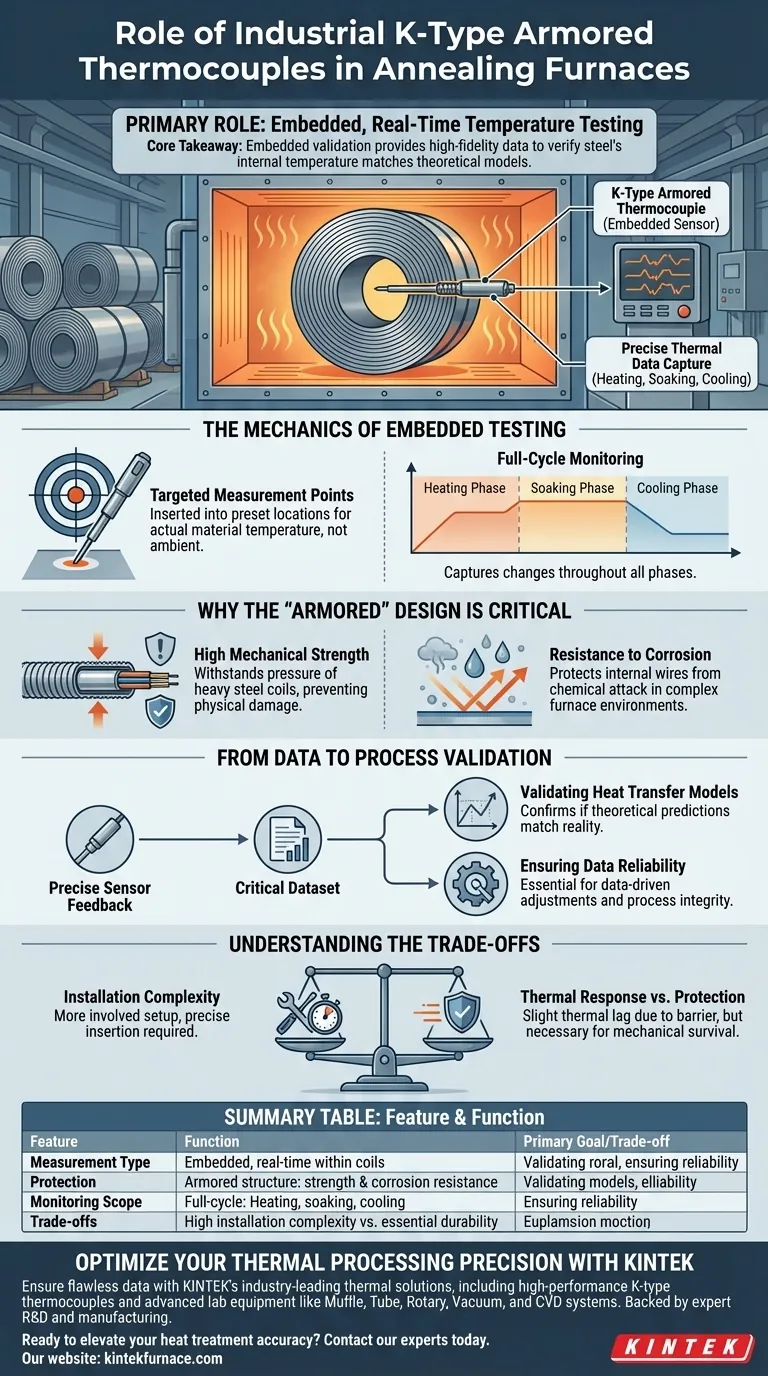
Summary Table:
| Feature | Function in Annealing Furnace |
|---|---|
| Measurement Type | Embedded, real-time testing within steel coils |
| Protection | Armored structure provides high mechanical strength and corrosion resistance |
| Monitoring Scope | Full-cycle tracking: Heating, soaking, and cooling phases |
| Primary Goal | Validating heat transfer models and ensuring data reliability |
| Trade-offs | High installation complexity vs. essential sensor durability |
Optimize Your Thermal Processing Precision with KINTEK
Ensure your annealing cycles are backed by flawless data. KINTEK provides industry-leading thermal solutions, including high-performance K-type thermocouples and advanced laboratory equipment. Backed by expert R&D and manufacturing, KINTEK offers Muffle, Tube, Rotary, Vacuum, and CVD systems, along with other lab high-temp furnaces—all fully customizable to meet your unique industrial needs.
Ready to elevate your heat treatment accuracy? Contact our experts today to discuss your custom furnace and sensing requirements.
Visual Guide
References
- Yang Xiao-jing, Yu-Ren Li. Study of heat transfer model and buried thermocouple test of bell-type annealing furnace based on thermal equilibrium. DOI: 10.1038/s41598-025-97422-4
This article is also based on technical information from Kintek Furnace Knowledge Base .
Related Products
- Controlled Inert Nitrogen Hydrogen Atmosphere Furnace
- Silicon Carbide SiC Thermal Heating Elements for Electric Furnace
- 1700℃ Controlled Inert Nitrogen Atmosphere Furnace
- High Temperature Muffle Oven Furnace for Laboratory Debinding and Pre Sintering
- Mesh Belt Controlled Atmosphere Furnace Inert Nitrogen Atmosphere Furnace
People Also Ask
- How does hydrogen furnace annealing assist in preparing mechanically alloyed powders for compaction?
- How does atmospheric annealing in a controlled hydrogen furnace affect the cold compaction behavior of metal powders?
- What are the characteristics and uses of hydrogen atmosphere in furnaces? Achieve Superior Surface Purity and Bonding
- What are the characteristics and uses of hydrogen atmospheres in furnaces? Unlock Clean Metal Processing
- What controlled-atmosphere furnace conditions are required for sintering powder metallurgy copper alloy compacts? Ideal Setup