
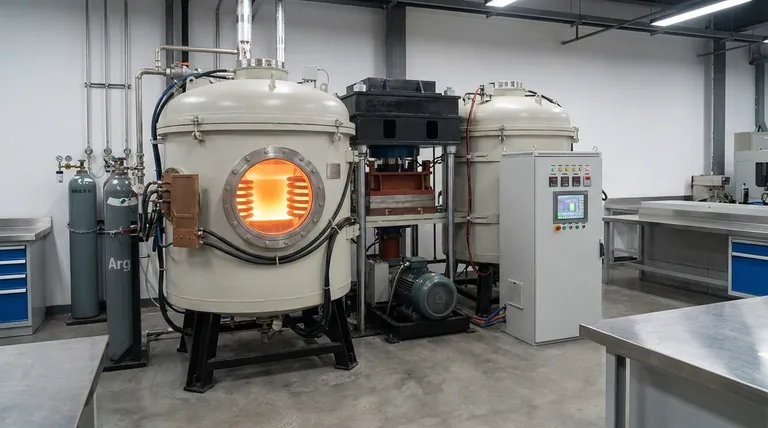
The vacuum induction furnace serves as the foundational processing tool for synthesizing high-integrity Cu-Ni-P alloys. By utilizing induction heating within a strictly controlled argon-protected environment, it solves the critical challenge of preventing oxidation while simultaneously purifying the melt.
Core Takeaway The vacuum induction furnace is not merely a heating source; it is a purification and homogenization system. Its primary function is to eliminate gaseous impurities and prevent oxidation, ensuring the Copper-Nickel-Phosphorus matrix achieves the precise chemical composition and uniformity required for high-performance applications.
Protecting the Melt Integrity
The Role of the Argon Shield
At melting temperatures, copper alloys are highly susceptible to reacting with oxygen in the atmosphere. The vacuum induction furnace utilizes an argon-protected environment to create an inert barrier around the melt.
This shield effectively prevents the rapid oxidation that would otherwise degrade the material properties. By isolating the molten pool from ambient air, the furnace ensures the base copper retains its metallic integrity.
Removal of Gaseous Impurities
Beyond simple shielding, the furnace leverages a vacuum environment to actively refine the alloy. This process facilitates the removal of gaseous impurities trapped within the raw materials.
By lowering the pressure, volatile gases and interstitial impurities are drawn out of the melt pool. This results in alloy ingots with exceptionally high purity, free from the gas porosity that often plagues standard melting processes.
Ensuring Compositional Precision
Exact Element Control
Developing Cu-Ni-P alloys requires strict adherence to specific chemical formulas. The vacuum induction furnace allows for the precise control of element ratios, specifically Nickel (Ni) and Phosphorus (P).
Because the environment is closed and controlled, there is minimal unpredictable loss of alloying elements due to oxidation or evaporation. This stability allows metallurgists to hit exact target compositions consistently.
Homogeneity via Induction Stirring
Achieving a uniform distribution of Nickel and Phosphorus throughout the Copper matrix is critical for material performance. Vacuum induction furnaces inherently provide an electromagnetic stirring effect.
Generated by the induction field, this stirring action constantly mixes the molten metal. This ensures high compositional uniformity and prevents segregation, where heavier or lighter elements might otherwise separate within the ingot.
Understanding the Trade-offs
Process Complexity vs. Material Quality
While a vacuum induction furnace ensures superior quality, it introduces operational complexity. Managing high-vacuum systems and precise argon back-filling requires more sophisticated equipment and monitoring than open-air induction melting.
Volume Limitations
Vacuum induction processes are typically batch-oriented. This allows for extreme precision but may limit throughput compared to continuous casting methods used for lower-grade copper products. The trade-off is a sacrifice in sheer volume for the sake of microstructural integrity.
Making the Right Choice for Your Goal
When preparing Cu-Ni-P alloys, the use of vacuum induction technology is dictated by your specific end-use requirements:
- If your primary focus is mechanical reliability: The furnace is essential for eliminating gas porosity, which is a leading cause of cracking and structural failure in finished parts.
- If your primary focus is electrical or thermal consistency: The induction stirring capability ensures the Nickel and Phosphorus are perfectly distributed, preventing localized variations in conductivity.
Ultimately, the vacuum induction furnace transforms Cu-Ni-P preparation from a simple melting task into a precise chemical engineering process.
Summary Table:
| Feature | Function in Cu-Ni-P Preparation | Impact on Material Quality |
|---|---|---|
| Argon Shielding | Prevents atmospheric oxidation | Maintains metallic integrity and base copper purity |
| Vacuum Environment | Degassing and impurity removal | Eliminates gas porosity and structural defects |
| Induction Stirring | Electromagnetic melt mixing | Ensures uniform distribution of Ni and P elements |
| Precise Control | Stable environment for alloying | Guarantees exact chemical composition ratios |
Elevate Your Metallurgical Precision with KINTEK
Unlock the full potential of your alloy development with KINTEK’s industry-leading thermal solutions. Backed by expert R&D and world-class manufacturing, we provide high-performance Muffle, Tube, Rotary, Vacuum, and CVD systems—all fully customizable to meet your unique laboratory or industrial requirements.
Whether you are synthesizing high-integrity Cu-Ni-P alloys or exploring advanced material science, our furnaces deliver the precise temperature control and atmospheric stability you need to ensure microstructural integrity and mechanical reliability.
Ready to optimize your melting process? Contact KINTEK today to consult with our experts!
References
- Wendi Yang, Jilin He. Microstructure and Texture Evolution of Cu-Ni-P Alloy after Cold Rolling and Annealing. DOI: 10.3390/ma17112696
This article is also based on technical information from Kintek Furnace Knowledge Base .
Related Products
- 600T Vacuum Induction Hot Press Vacuum Heat Treat and Sintering Furnace
- Vacuum Induction Melting Furnace
- High Pressure Laboratory Vacuum Tube Furnace
- Small Vacuum Heat Treat and Tungsten Wire Sintering Furnace
- Vacuum Hot Press Furnace Machine Heated Vacuum Press Tube Furnace
People Also Ask
- Why use Vacuum Hot Press (VHP) for ZnS Ceramics? Achieve Superior IR Transparency and Mechanical Strength
- How does a vacuum hot press sintering furnace mitigate copper sintering swelling? Solve Fe-Cu Expansion Issues
- What are the benefits of using a vacuum hot press sintering furnace for the preparation of SiCw/2024 aluminum matrix composites? Achieve High-Performance Aerospace Materials
- How does the vacuum environment in a vacuum hot press sintering furnace protect chromium-containing ceramics? Find out.
- What are the key advantages of vacuum hot press sintering furnaces? Achieve Superior Density and Purity in Materials



















