
A Vacuum Induction Melting (VIM) Furnace acts as the critical control mechanism for defining the chemical integrity of weather-resistant steel. It utilizes electromagnetic induction to heat raw materials within a vacuum environment, allowing for the precise fine-tuning of essential alloying elements like chromium, nickel, and copper while actively removing impurities.
Core Takeaway By melting steel in a controlled vacuum environment, VIM technology eliminates volatile impurities and prevents oxidation, ensuring the high purity and compositional uniformity required for weather-resistant steel to perform effectively.
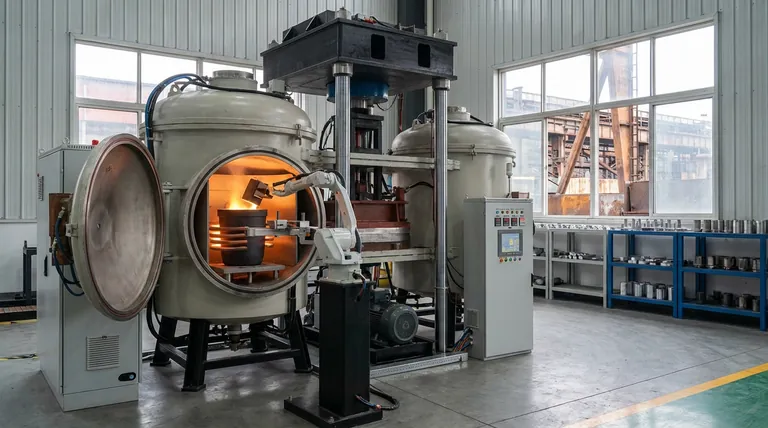
The Mechanics of Precision Alloying
To produce steel that can withstand the elements, the chemical composition must be exact. VIM furnaces provide the environment necessary to achieve this specificity.
Fine-Tuning Key Elements
Weather-resistant steel relies on specific alloying elements to create its protective "patina." The VIM process allows for the precise control of these ingredients, specifically chromium, nickel, and copper. By isolating the melt, metallurgists can adjust these ratios with high accuracy without interference from atmospheric gases.
Ensuring Homogeneity
Consistency is vital for high-performance materials. The VIM furnace uses a water-cooled induction coil to generate heat, which naturally stirs the molten metal. This electromagnetic stirring creates a homogenous melt, ensuring that the alloying elements are evenly distributed throughout the steel ingot rather than clustered in specific areas.
Achieving Material Purity
The durability of weather-resistant steel is directly linked to its purity. Impurities can create weak points where corrosion accelerates rather than stabilizes.
Removing Gaseous Impurities
The vacuum environment is the most critical feature of this furnace type. It effectively degasses the molten steel, removing dissolved gases such as hydrogen, oxygen, and nitrogen. Reducing these elements minimizes the formation of non-metallic inclusions, which can compromise the steel's structural integrity.
Preventing Oxidation
In standard melting processes, molten metal reacts with the air, leading to oxidation. The VIM furnace prevents the metal from being easily oxidized by completely removing the air from the equation. This results in a cleaner final product with low slag pollution and superior compositional tolerance.
Operational Considerations and Trade-offs
While VIM furnaces offer superior quality control, understanding their operational context is essential for efficient production.
Specialized Batch Processing
VIM furnaces are highly flexible regarding batch size, making them ideal for experimental steel ingots or specialized production runs. However, they are distinct from high-volume blast furnaces; they are specialized equipment designed for high-quality, high-value alloys where precision outweighs raw tonnage.
Refractory Interactions
The process involves a refractory-lined crucible. While the vacuum reduces atmospheric contamination, the interaction between the molten metal and the crucible lining must still be managed to maintain the accurate chemical composition ratio required for subsequent research or application.
Making the Right Choice for Your Project
The use of a Vacuum Induction Melting Furnace is determined by the specific requirements of your end product.
- If your primary focus is Alloy Development: You should utilize VIM to isolate variables and ensure the exact ratios of chromium, nickel, and copper are met without atmospheric interference.
- If your primary focus is Microstructural Research: You should rely on VIM to provide a high-purity, reliable foundational material, free from oxygen and nitrogen inclusions that could skew research data.
Ultimately, the VIM furnace is not just a melting tool; it is a purification instrument that guarantees the chemical foundation of advanced weather-resistant steels.
Summary Table:
| Feature | Role in Weather-Resistant Steel Production | Benefit |
|---|---|---|
| Vacuum Environment | Removes dissolved gases (H, O, N) and prevents oxidation | Enhances material purity and structural integrity |
| Induction Heating | Facilitates electromagnetic stirring of the melt | Ensures compositional homogeneity and uniform alloy distribution |
| Alloy Control | Precise adjustment of Cr, Ni, and Cu ratios | Guarantees the formation of the protective corrosion-resistant patina |
| Batch Processing | Ideal for specialized and experimental steel ingots | Allows for high-value, high-accuracy material development |
Elevate Your Alloy Production with KINTEK
Precision is the foundation of high-performance materials. At KINTEK, we empower researchers and manufacturers with cutting-edge Vacuum Induction Melting (VIM) systems and specialized high-temperature lab furnaces.
Backed by expert R&D and manufacturing, our range includes Muffle, Tube, Rotary, Vacuum, and CVD systems—all fully customizable to meet your unique chemical integrity and material purity requirements. Whether you are developing the next generation of weather-resistant steel or conducting advanced microstructural research, our technical team is ready to deliver the exact solution you need.
Ready to refine your melting process? Contact KINTEK today for a consultation!
References
- Jianwei Cheng. Research on hot deformation characterization of a new weathering steel through processing map and microstructural observation. DOI: 10.1038/s41598-025-86619-2
This article is also based on technical information from Kintek Furnace Knowledge Base .
Related Products
- Vacuum Induction Melting Furnace
- 600T Vacuum Induction Hot Press Vacuum Heat Treat and Sintering Furnace
- Small Vacuum Heat Treat and Tungsten Wire Sintering Furnace
- Vacuum Heat Treat Sintering and Brazing Furnace
- Vacuum Heat Treat Sintering Furnace Molybdenum Wire Vacuum Sintering Furnace
People Also Ask
- What are the core functions of the High Vacuum Induction Melting (VIM) furnace? Optimize DD5 Superalloy Purification
- What are the advantages of using a VIM furnace to control residual oxygen pressure? Achieve Superior Metal Uniformity
- What are the technical advantages of using a Vacuum Induction Melting furnace in the development of advanced packaging steel?
- What is the role of VIM and directional solidification in aero-engine blade substrates? Engineering Extreme Durability
- Why is a Vacuum Induction Melting furnace (VIM) used for Cu-Zn-Al-Sn alloys? Achieve Precision Composition Control



















