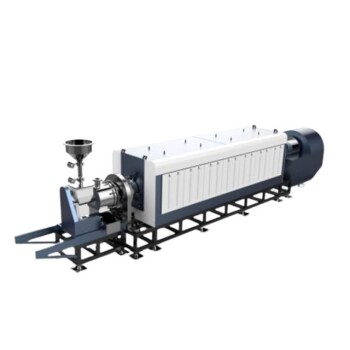
A tube reactor functions as the critical isolation chamber during the pyrolysis of food waste, providing the specific environmental conditions necessary to turn organic matter into biochar rather than ash. Its primary role is to maintain a sealed, oxygen-free zone where precise heating drives thermochemical conversion, ensuring carbon is chemically fixed into a solid state.
Core Takeaway The tube reactor’s value lies in its ability to decouple heating from combustion. By strictly controlling temperature and utilizing an inert gas flow, it forces biomass to undergo carbonization, maximizing carbon sequestration and creating a stable, high-quality biochar product.
The Principles of Controlled Carbonization
The conversion of food waste into biochar requires a departure from standard combustion. The tube reactor creates the specific physical constraints required to achieve this.
Establishing an Inert Atmosphere
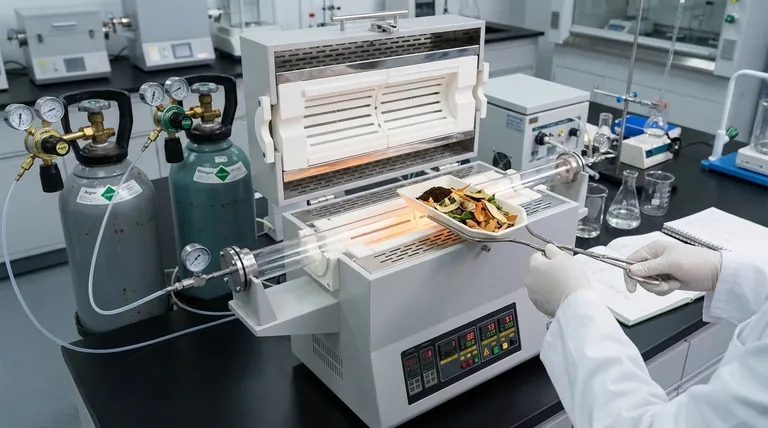
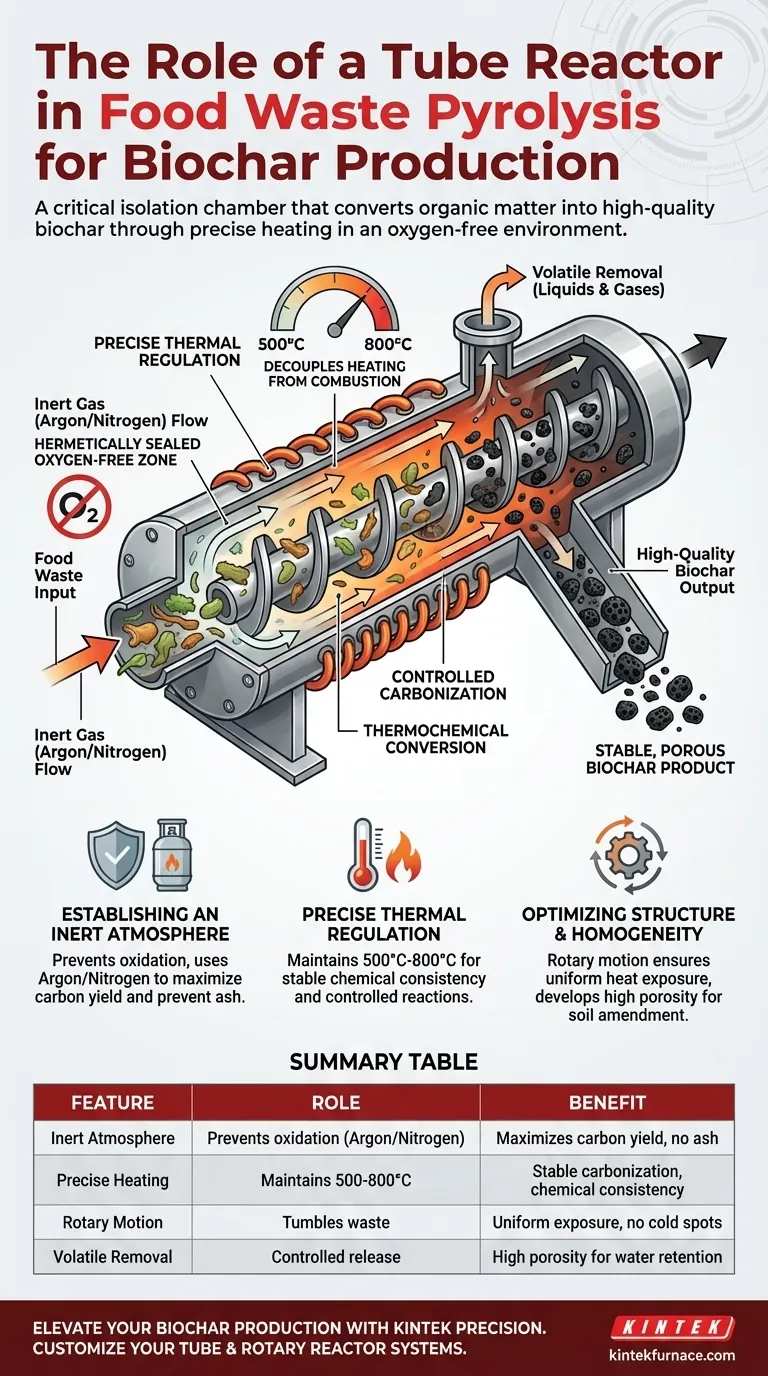
The most fundamental role of the tube reactor is preventing oxidation. The vessel is hermetically sealed to exclude ambient air.
To replace the oxygen, the system introduces an inert gas, such as argon (as noted in primary methodologies) or nitrogen. This gas flows continuously through the tube, creating a protective blanket around the food waste.
Without this isolation, the carbon in the food waste would react with oxygen and burn away as carbon dioxide (CO2). The tube reactor ensures the carbon remains trapped in the solid phase, aligning with negative carbon emission goals.
Precise Thermal Regulation
Biochar quality depends on specific temperature profiles. The tube reactor acts as a thermal regulator, maintaining the reaction environment typically between 500°C and 800°C.
This consistent high heat triggers specific chemical changes, such as dehydration and decarbonization. The reactor ensures these reactions happen at a controlled rate, preventing thermal shock or uneven processing that could degrade the final product.
Optimizing Physical Structure and Homogeneity
Beyond simple chemical conversion, the mechanical design of the tube reactor influences the physical quality of the resulting biochar.
Ensuring Uniform Heat Exposure
Food waste is a heterogeneous feedstock, meaning it often has inconsistent density and moisture content.
Many tube reactors utilized for food waste employ a rotary motion. This mechanical rotation tumbles the organic material, ensuring that every particle is exposed to the heat source evenly.
This uniformity is vital for consistent carbonization. It prevents "cold spots" where waste might remain raw and "hot spots" where it might over-cook and become brittle.
Developing Porosity
The specific environment within the tube reactor fosters the development of a high-porosity structure.
By driving off volatile compounds (liquids and gases) in a controlled manner, the reactor leaves behind a rigid carbon skeleton. This porous structure is what makes biochar valuable for soil amendment, as it retains water and nutrients.
Understanding the Trade-offs
While tube reactors offer high precision, they introduce specific operational complexities that must be managed.
Dependency on Inert Gas Supply
The system is entirely reliant on the continuous flow of inert gas (argon or nitrogen). Any interruption in gas flow or a breach in the tube's seal immediately compromises the anaerobic environment. This can lead to partial combustion, significantly reducing biochar yield and quality.
Energy and Throughput Limitations
Maintaining high temperatures (up to 800°C) generally requires substantial energy input via external heating elements. Furthermore, while rotary tube reactors improve uniformity, they may have lower throughput capacities compared to large-scale industrial incinerators, making them better suited for high-quality, targeted biochar production rather than mass waste volume reduction.
Making the Right Choice for Your Goal
The configuration of your tube reactor should depend on the specific characteristics you require in your final biochar product.
- If your primary focus is Carbon Sequestration: Prioritize a reactor with a high-integrity seal and Argon flow to maximize the fixation of carbon and minimize CO2 release.
- If your primary focus is Soil Amendment (Agriculture): Focus on a rotary tube furnace design to ensure uniform heating, which optimizes the porous structure required for water retention.
- If your primary focus is Material Activation: Operate the reactor at higher temperature ranges (near 800°C) to facilitate the advanced dehydration and skeletal formation necessary for later activation steps.
Success in biochar production is less about how hot you can get the waste, and more about how strictly you can control the environment around it.
Summary Table:
| Feature | Role in Food Waste Pyrolysis | Benefit to Biochar Quality |
|---|---|---|
| Inert Atmosphere | Prevents oxidation by using Argon/Nitrogen | Maximizes carbon yield and prevents ash formation |
| Precise Heating | Maintains 500°C - 800°C profiles | Ensures stable carbonization and chemical consistency |
| Rotary Motion | Tumbles heterogeneous food waste | Provides uniform heat exposure and prevents cold spots |
| Volatile Removal | Controlled release of liquids/gases | Develops high porosity for water and nutrient retention |
Elevate Your Biochar Production with KINTEK Precision
Unlock the full potential of your carbonization research with KINTEK’s high-performance tube and rotary reactor systems. Backed by expert R&D and manufacturing, we provide the precise thermal control and airtight environments essential for transforming food waste into high-value biochar. Whether you require Muffle, Tube, Rotary, Vacuum, or CVD systems, our lab high-temp furnaces are fully customizable to meet your unique processing needs.
Ready to optimize your pyrolysis yield? Contact us today to discuss your custom solution and see how our expertise can drive your sustainability goals forward.
Visual Guide
References
- Zsolt Dobó, Gábor Nagy. Production of Biochar by Pyrolysis of Food Waste Blends for Negative Carbon Dioxide Emission. DOI: 10.3390/en18010144
This article is also based on technical information from Kintek Furnace Knowledge Base .
Related Products
- Electric Rotary Kiln Small Rotary Furnace Biomass Pyrolysis Plant Rotating Furnace
- Electric Rotary Kiln Continuous Working Small Rotary Furnace Kiln for Pyrolysis Plant Heating
- Custom Made Versatile CVD Tube Furnace Chemical Vapor Deposition CVD Equipment Machine
- Laboratory Quartz Tube Furnace RTP Heating Tubular Furnace
- Slide PECVD Tube Furnace with Liquid Gasifier PECVD Machine
People Also Ask
- What are the key components of a rotary kiln electric furnace? Unlock Efficient Thermal Processing
- What are the main applications of a rotary kiln electric furnace? Achieve Uniform Heat Treatment for Powders
- What is the significance of the refractory lining in a rotary kiln electric furnace? Unlock Efficiency and Longevity
- What is the benefit of adjustable speed control in rotary kilns? Optimize Efficiency and Quality
- What are the two main types of rotary kilns based on heating method? Choose the Right One for Your Process