
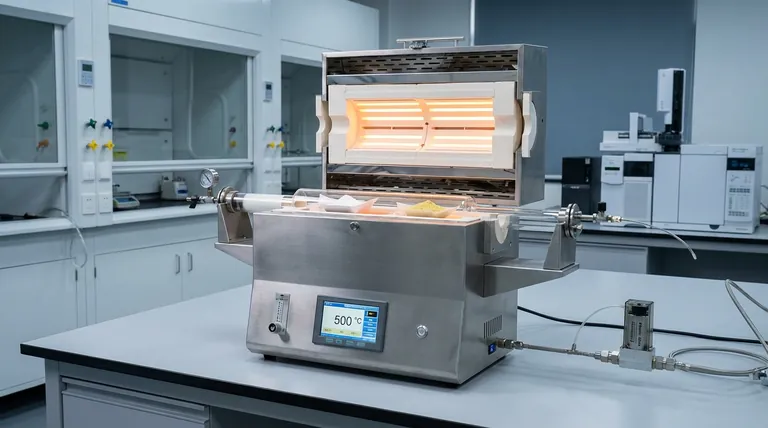
The tube furnace functions as a precision thermal reactor essential for converting raw melamine into a usable structural template. Specifically, it is used to heat melamine at 500 °C within an air atmosphere, initiating a thermal decomposition process. This calcination transforms the raw material into layered graphitic carbon nitride (g-C3N4), which serves as the fundamental skeleton for subsequent nitrogen and sulfur doping.
Core Takeaway The tube furnace's primary role in this context is to drive the calcination of melamine into graphitic carbon nitride (g-C3N4). By maintaining a consistent 500 °C temperature in an air atmosphere, it creates the critical layered structural template required to anchor nitrogen and sulfur atoms in later synthesis stages.
The Mechanism of Precursor Transformation
Thermal Decomposition via Calcination
The tube furnace is not merely a heater; it is the environment where chemical transformation occurs. By raising the temperature to exactly 500 °C, the furnace triggers the thermal decomposition of melamine.
This process converts the molecular structure of the raw melamine. The result is graphitic carbon nitride (g-C3N4), a material distinct from the starting compounds.
Creation of Structural Templates
The g-C3N4 produced in the furnace acts as a structural template. This "skeleton" is critical because it dictates the morphology of the final material.
Without this specific layered structure created during the furnace's calcination phase, the subsequent introduction of sulfur and nitrogen dopants would lack the necessary framework to be effective.
Atmosphere Management
While many carbonization processes require inert gases, the preparation of this specific g-C3N4 precursor utilizes an air atmosphere. The tube furnace allows for this specific environmental control.
This contrasts with other doping stages, where the furnace must exclude oxygen to prevent material loss. For the melamine precursor, however, the air environment is part of the requisite calcination recipe.
Precision Control Factors
Regulating Heating Rates
Beyond the final target temperature, the tube furnace controls how fast the material heats up. Precise ramp rates (e.g., 2–3 °C per minute) prevent structural collapse during decomposition.
Rapid heating can destroy the delicate morphology of the precursor. A controlled, slow rise ensures the organic ligands decompose in an orderly fashion, preserving the desired dodecahedral or layered shapes.
Thermal Stability and Homogeneity
The tube furnace ensures the entire sample is exposed to uniform heat. This eliminates "cold spots" that could result in incomplete conversion of the melamine.
Uniform heating guarantees that the resulting g-C3N4 template has consistent properties throughout the batch. This consistency is vital for reproducible performance in catalytic applications.
Understanding the Trade-offs
Atmosphere Sensitivity
The choice of atmosphere is the most critical variable. While this specific precursor step uses air, using air during subsequent high-temperature doping stages (above 500 °C) without switching to an inert gas (like Argon) will incinerate the carbon skeleton.
Temperature Precision Risks
Deviation from the target temperature impacts the material's porosity. If the furnace temperature fluctuates significantly, it can alter the pore structure size distribution, potentially rendering the catalytic active sites inaccessible.
Ramp Rate Limitations
Extremely slow heating rates, while good for structure, increase production time significantly. There is a balance to be struck between preserving morphology and maintaining process efficiency.
Making the Right Choice for Your Goal
To optimize the preparation of precursors for co-doped carbon, align your furnace settings with your specific synthesis stage:
- If your primary focus is creating the g-C3N4 template: Configure the furnace for 500 °C in an air atmosphere to ensure complete calcination of the melamine.
- If your primary focus is the subsequent doping/carbonization step: You must switch the furnace to a strict inert atmosphere (Argon) and likely higher temperatures (700–1000 °C) to prevent oxidation of the carbon matrix.
- If your primary focus is preserving pore structure: Program a low heating rate (e.g., 2 °C/min) to allow for the orderly release of volatiles without collapsing the framework.
Mastering the tube furnace is about controlling the environment to transition from raw organic material to a highly structured catalytic scaffold.
Summary Table:
| Process Parameter | Requirement for g-C3N4 Precursor | Function / Impact |
|---|---|---|
| Temperature | 500 °C | Triggers thermal decomposition of melamine |
| Atmosphere | Air | Facilitates specific calcination into g-C3N4 |
| Heating Rate | Low (e.g., 2–3 °C/min) | Prevents structural collapse; preserves morphology |
| Outcome | Layered g-C3N4 Skeleton | Provides the structural template for doping |
Elevate Your Material Synthesis with KINTEK Precision
Ready to achieve perfect thermal decomposition for your co-doped carbon precursors? KINTEK provides industry-leading Tube, Muffle, Rotary, and Vacuum furnace systems designed for the rigorous demands of advanced R&D.
Backed by expert manufacturing, our systems offer:
- Exact Temperature Uniformity: Eliminate cold spots for consistent g-C3N4 templates.
- Programmable Ramp Rates: Precision control to preserve delicate material morphology.
- Flexible Atmosphere Control: Seamlessly switch between air and inert gases (Argon/Nitrogen).
Whether you need a standard lab furnace or a fully customizable high-temp system, KINTEK has the solution for your unique research needs.
Contact KINTEK today to find your perfect furnace solution!
References
- Jiahui Li, Shaobo Tu. Pseudocapacitive Heteroatom‐Doped Carbon Cathode for Aluminum‐Ion Batteries with Ultrahigh Reversible Stability. DOI: 10.1002/eem2.12733
This article is also based on technical information from Kintek Furnace Knowledge Base .
Related Products
- Magnesium Extraction and Purification Condensing Tube Furnace
- 1400℃ High Temperature Laboratory Tube Furnace with Alumina Tube
- Vertical Laboratory Quartz Tube Furnace Tubular Furnace
- 1700℃ High Temperature Laboratory Tube Furnace with Alumina Tube
- Slide PECVD Tube Furnace with Liquid Gasifier PECVD Machine
People Also Ask
- What are the advantages of using a condensing tube furnace for magnesium extraction? Achieve High Purity and Efficient Metal Recovery
- What technical challenges are associated with tube furnace cracking? Master Extreme Heat and Material Limits
- What is the technical significance of the high-temperature environment provided by a tube furnace in the synthesis of Fe3O4@Fe-AC?
- What factors should be considered when selecting a tube furnace? Choose the Right Furnace for Your Lab Needs
- What are the technical advantages of using a tube furnace for carbon nitride? Master Advanced Defect Engineering



















