
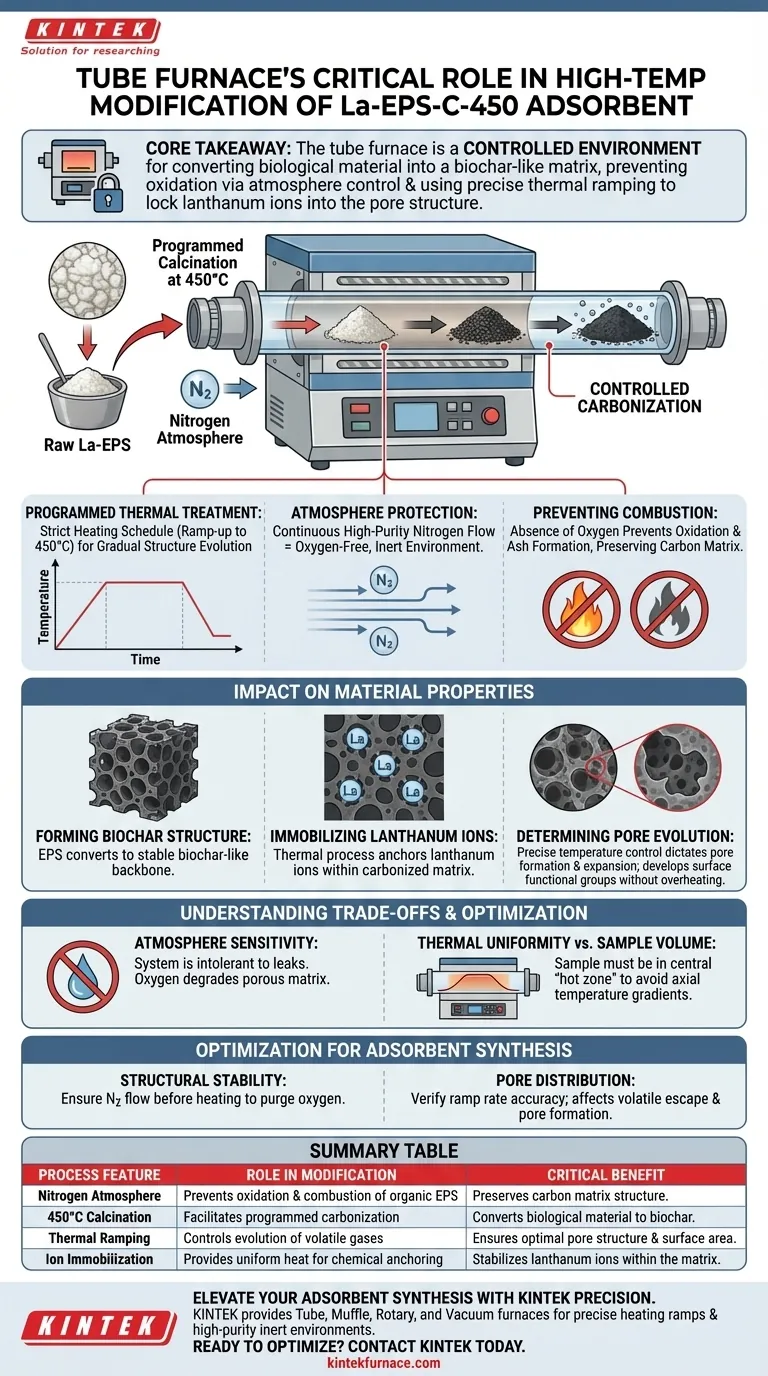
The tube furnace serves as the precise reaction vessel required to transform raw extracellular polymeric substances (EPS) into a stable, functionalized adsorbent. Specifically, it executes a programmed calcination at 450°C under a nitrogen atmosphere to facilitate carbonization without combustion.
Core Takeaway The tube furnace is not merely a heater; it is a controlled environment that enables the conversion of biological material into a biochar-like matrix. Its primary function is to prevent oxidation through atmosphere control while using precise thermal ramping to lock lanthanum ions into the developing pore structure.
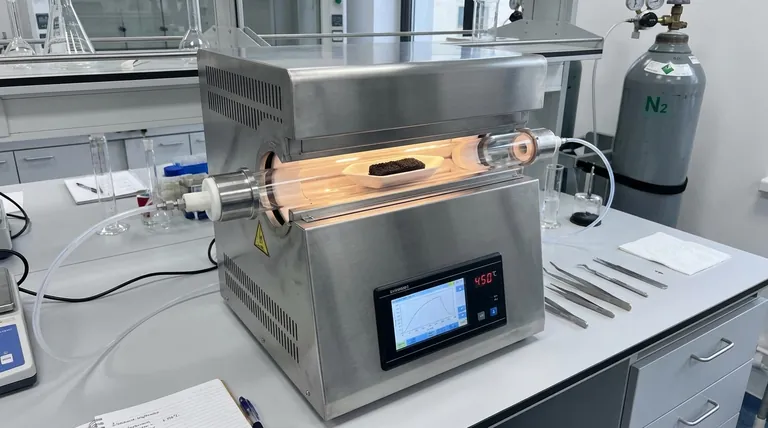
The Mechanism of Controlled Carbonization
Programmed Thermal Treatment
The production of La-EPS-C-450 relies on a specific "programmed" temperature profile culminating at 450°C. The tube furnace follows a strict heating schedule rather than simply blasting the material with heat. This controlled ramp-up is critical for the gradual evolution of the material's structure.
Atmosphere Protection
The furnace operates under a continuous flow of high-purity nitrogen. This creates an oxygen-free, inert environment.
Preventing Combustion
If oxygen were present at these temperatures, the organic EPS components would oxidize and burn away (ash). The tube furnace’s atmosphere control ensures the material undergoes carbonization instead, preserving the carbon matrix.
Impact on Material Properties
Forming the Biochar Structure
By facilitating carbonization rather than combustion, the furnace converts the EPS into a stable, biochar-like structure. This acts as the physical backbone of the adsorbent.
Immobilizing Lanthanum Ions
The thermal process anchors the lanthanum ions within the carbonized matrix. The stability of this immobilization is directly dependent on the uniform heat distribution provided by the tube furnace.
Determining Pore Evolution
The precise temperature control dictates exactly how the pores within the material form and expand. The furnace ensures the temperature remains stable enough to develop surface functional groups without destroying them through overheating.
Understanding the Trade-offs
Atmosphere Sensitivity
While tube furnaces allow for atmosphere control, the system is intolerant to leaks. Even a minor introduction of oxygen during the 450°C phase can compromise the carbonization process and degrade the porous matrix.
Thermal Uniformity vs. Sample Volume
Tube furnaces provide excellent radial heating, but axial temperature gradients can exist at the ends of the tube. To ensure the La-EPS-C-450 is uniform, the sample must be placed strictly within the central "hot zone" of the furnace.
Optimization for Adsorbent Synthesis
To achieve the best results with La-EPS-C-450 synthesis, consider these focus areas:
- If your primary focus is Structural Stability: Ensure the nitrogen flow is established well before heating begins to completely purge oxygen and prevent early-stage oxidation.
- If your primary focus is Pore Distribution: Verify the furnace's ramp rate accuracy, as the speed of heating to 450°C affects how volatiles escape and pores form.
The precision of your thermal equipment directly correlates to the chemical stability and adsorption capacity of the final material.
Summary Table:
| Process Feature | Role in La-EPS-C-450 Modification | Critical Benefit |
|---|---|---|
| Nitrogen Atmosphere | Prevents oxidation and combustion of organic EPS | Preserves the carbon matrix structure |
| 450°C Calcination | Facilitates programmed carbonization | Converts biological material to biochar |
| Thermal Ramping | Controls the evolution of volatile gases | Ensures optimal pore structure and surface area |
| Ion Immobilization | Provides uniform heat for chemical anchoring | Stabilizes lanthanum ions within the matrix |
Elevate Your Adsorbent Synthesis with KINTEK Precision
Achieving the perfect carbonized matrix for materials like La-EPS-C-450 requires uncompromising thermal and atmosphere control. KINTEK provides industry-leading Tube, Muffle, Rotary, and Vacuum furnaces designed to meet the rigorous demands of advanced R&D.
Our systems offer the precise heating ramps and high-purity inert environments essential for preventing combustion and optimizing pore evolution. Whether you need a standard setup or a customized high-temp solution, our expert manufacturing ensures your lab achieves repeatable, high-performance results.
Ready to optimize your carbonization process? Contact KINTEK today to discuss your unique project requirements with our specialist team.
Visual Guide
References
- Yaoyao Lu, Ren‐Cun Jin. Lanthanum and Sludge Extracellular Polymeric Substances Coprecipitation-Modified Ceramic for Treating Low Phosphorus-Bearing Wastewater. DOI: 10.3390/w17081237
This article is also based on technical information from Kintek Furnace Knowledge Base .
Related Products
- Vertical Laboratory Quartz Tube Furnace Tubular Furnace
- 1400℃ High Temperature Laboratory Tube Furnace with Alumina Tube
- Multi Zone Laboratory Quartz Tube Furnace Tubular Furnace
- Laboratory Quartz Tube Furnace RTP Heating Tubular Furnace
- High Pressure Laboratory Vacuum Tube Furnace
People Also Ask
- What are the key differences between single-zone and multi-zone vertical tube furnaces? Choose the Right Furnace for Your Lab
- How does a vertical tube furnace achieve precise temperature control? Unlock Superior Thermal Stability for Your Lab
- What is the purpose of using an industrial-grade vertical tube furnace in phosphorus recovery? High-Fidelity Simulation
- What are the main characteristics of vertical tube furnaces? Optimize Your Lab with Space-Saving, Uniform Heating
- How does a vertical single-temperature zone tube furnace facilitate the growth of high-quality PdSe2 single crystals?



















