
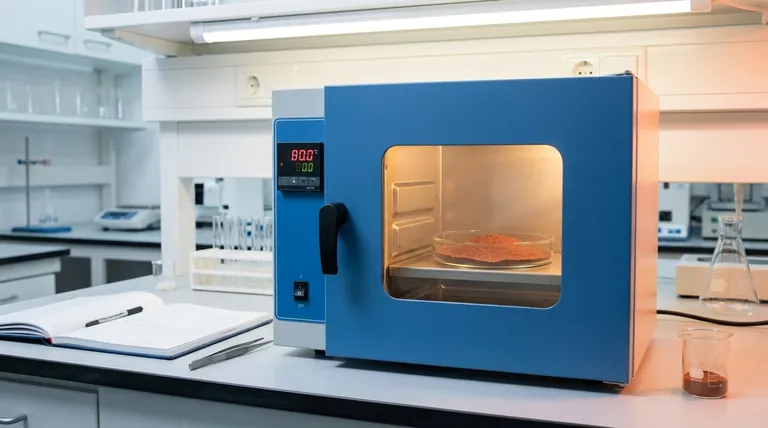
The critical function of a precision drying oven in this context is to gently eliminate physically adsorbed water from Bi-Fe oxide precursor powders prior to high-temperature processing. By maintaining a controlled temperature of roughly 80 °C overnight, the oven ensures the material is thoroughly dried without subjecting it to thermal shock.
Pre-treating powders is not merely about drying; it is about structural preservation. By removing moisture slowly, you prevent the rapid, violent evaporation that occurs in high-temperature furnaces, which directly causes particle clumping and degrades the material's functional surface area.
The Mechanics of Gentle Dehydration
Targeting Physically Adsorbed Water
The primary goal of the precision drying oven is to remove water molecules that adhere to the surface of the powder particles.
This moisture is distinct from chemically bonded water and must be removed before the material enters the calcination phase.
Controlled Thermal Application
The process utilizes a specific, low-temperature protocol, typically set at 80 °C for an overnight duration.
This "gentle" approach provides a steady thermal environment. It allows moisture to diffuse out of the powder bed gradually rather than boiling off instantaneously.
Impact on Structural Integrity
Preventing Severe Agglomeration
If precursor powders containing adsorbed water are placed directly into a high-temperature tube furnace, the moisture evaporates rapidly.
This rapid expansion creates internal pressure and surface tension changes that force particles to fuse together. The pre-treatment step in the drying oven eliminates this moisture beforehand, effectively blocking this mechanism of severe particle agglomeration.
Preserving Nanosheet Morphology
The ultimate value of this pre-treatment lies in the retention of delicate microstructures.
By avoiding agglomeration, the material maintains its intended nanosheet morphology. This preservation is directly linked to an increase in the specific surface area of the final product, which is often the key metric for performance in catalytic or electronic applications.
Understanding the Trade-offs
Process Time vs. Material Quality
The most significant trade-off in using a precision drying oven is the impact on production timelines.
Requiring an overnight heating cycle introduces a significant hold point in the manufacturing flow. This ensures quality but reduces immediate throughput compared to rapid drying techniques.
Sensitivity to Protocol Deviations
The effectiveness of this step relies heavily on the "gentle" nature of the heating.
Attempting to accelerate this stage by raising the oven temperature significantly above 80 °C risks mimicking the very problem (rapid evaporation) you are trying to avoid. There is little room for rushing this specific pre-treatment without compromising the nanosheet structure.
Making the Right Choice for Your Goal
To maximize the quality of your Bi-Fe oxide powders, align your process with the following recommendations:
- If your primary focus is maximizing Specific Surface Area: Strictly adhere to the low-temperature (80 °C) overnight protocol to ensure nanosheets remain separated and intact.
- If your primary focus is minimizing Structural Defects: Ensure complete moisture removal in the oven to prevent the violent vaporization that causes agglomeration during calcination.
The precision drying oven is not just a drying tool; it is a morphological safeguard that defines the final quality of your nanomaterial.
Summary Table:
| Feature | Precision Drying (Pre-treatment) | Direct High-Temp Calcination |
|---|---|---|
| Temperature | 80 °C (Gentle/Overnight) | High Temperature (Rapid) |
| Moisture Removal | Slow diffusion of adsorbed water | Violent evaporation/boiling |
| Particle Impact | Prevents agglomeration | Causes severe clumping |
| Morphology | Preserves delicate nanosheets | Risks structural degradation |
| Surface Area | Maximized specific surface area | Reduced due to fusion |
Elevate Your Material Precision with KINTEK
Don't let improper drying compromise your research. KINTEK’s advanced thermal solutions provide the stability and control needed to preserve delicate nanosheet structures. Backed by expert R&D and world-class manufacturing, we offer a full suite of high-performance lab equipment including Muffle, Tube, Rotary, Vacuum, and CVD systems, all fully customizable for your unique material synthesis needs.
Ready to optimize your powder pre-treatment and calcination workflows? Contact us today to discover how our high-temp furnaces and precision ovens can enhance your lab's efficiency and material quality.
References
- Yuanjun Song, Tong Zhang. A Simple One-Pot Method for the Synthesis of BiFeO3/Bi25FeO40 Heterojunction for High-Performance Photocatalytic Degradation Applications. DOI: 10.3390/ijms26010196
This article is also based on technical information from Kintek Furnace Knowledge Base .
Related Products
People Also Ask
- What thermal phenomena occur during polymer binder burnout in ceramic green bodies? Lab Furnace Guide
- What role does a high-temperature muffle furnace play in STFO synthesis? Achieve Pure Perovskite Results
- Why is controlled heat treatment in a muffle furnace necessary for calcined clay? Achieve Optimal Pozzolanic Activity
- How does a high-temperature muffle furnace facilitate the formation of LaNbxAl1−xO3+δ perovskite structures? Key Roles
- What role does a high-temperature muffle furnace play in the formation of biochar catalysts? Master Catalyst Synthesis
