
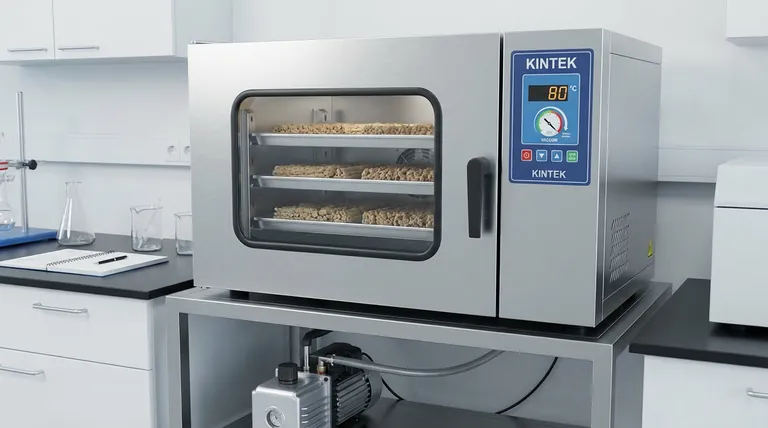
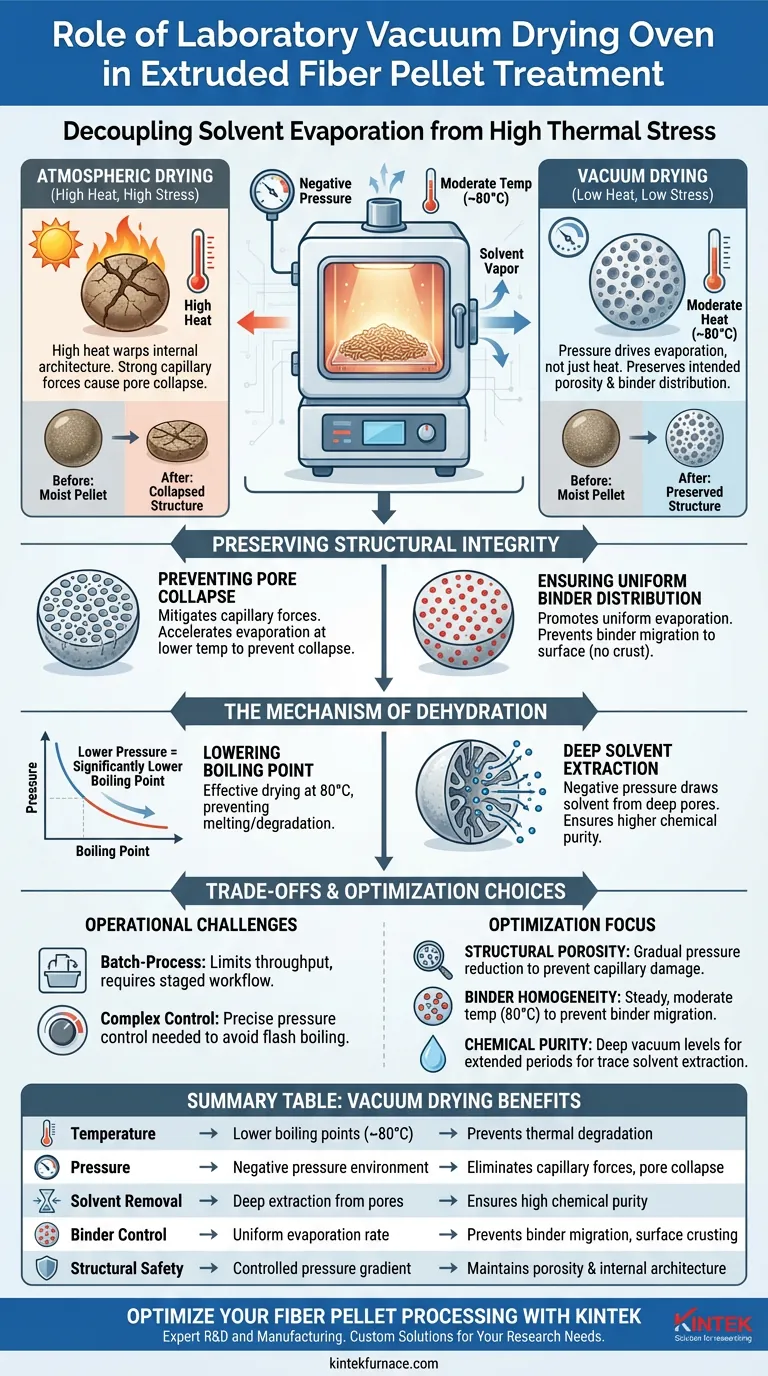
The primary role of a laboratory vacuum drying oven in treating extruded fiber pellets is to decouple solvent evaporation from high thermal stress. By operating under negative pressure at moderate temperatures (typically around 80 °C), the oven significantly lowers the boiling point of residual solvents. This allows for rapid, thorough drying without the material degradation associated with standard atmospheric drying.
Core Takeaway Standard drying methods often rely on high heat, which can warp the internal architecture of delicate materials. Vacuum drying circumvents this by using pressure—not just heat—to drive evaporation, ensuring the fiber pellets retain their intended porosity and binder distribution.
Preserving Structural Integrity
The most critical function of the vacuum oven is protecting the physical architecture of the extruded nanofiber strips.
Preventing Pore Collapse
During atmospheric drying, the capillary forces exerted by evaporating solvents can be strong enough to crush the delicate pores of the fiber.
The vacuum environment mitigates these forces. By accelerating evaporation at lower temperatures, the oven prevents the "pore collapse" that renders the pellet ineffective for applications requiring high surface area.
Ensuring Uniform Binder Distribution
In standard drying scenarios, moisture migration can carry binders to the surface of the pellet, resulting in a hard "crust" and a weak interior.
Vacuum drying promotes a more uniform evaporation rate throughout the pellet volume. This prevents binder migration, ensuring the binder remains evenly distributed to maintain the structural strength of the cylindrical strip.
The Mechanism of Dehydration
Understanding the physics behind the process clarifies why this equipment is essential for chemical purity.
Lowering the Boiling Point
The central principle is the relationship between pressure and boiling points. By reducing the pressure inside the chamber, the solvent's boiling point drops significantly.
This allows the pellets to be dried effectively at 80 °C. At atmospheric pressure, achieving the same level of dryness might require temperatures high enough to melt or degrade the nanofibers.
Deep Solvent Extraction
Extruded pellets often have complex internal geometries where solvents can become trapped.
The negative pressure environment actively draws solvent molecules out from deep within the material's pores. This ensures a higher degree of chemical purity and activation, which is critical if the pellets are precursors for sensitive downstream applications.
Understanding the Trade-offs
While vacuum drying is superior for quality, it introduces specific operational challenges that must be managed.
Throughput Limitations
Unlike continuous conveyor-belt dryers, laboratory vacuum ovens are typically batch-process devices.
This limits the volume of pellets you can process at one time. It requires a carefully staged workflow rather than a continuous production line, which can create bottlenecks in high-throughput environments.
Complexity of Process Control
Vacuum drying is not a "set and forget" method; it requires precise control over the pressure gradient.
If the pressure drops too suddenly, solvents may "flash boil" violently. While the goal is to prevent structural collapse, uncontrolled flash boiling can conversely cause mechanical damage or rupture the pellet structure.
Making the Right Choice for Your Goal
To maximize the utility of a vacuum drying oven for your specific materials, consider these distinct operational focuses:
- If your primary focus is Structural Porosity: Prioritize a gradual reduction in pressure to prevent capillary damage and ensure the pores remain open and uncollapsed.
- If your primary focus is Binder Homogeneity: Maintain a steady, moderate temperature (e.g., 80 °C) to prevent the migration of binding agents to the pellet surface.
- If your primary focus is Chemical Purity: utilize deep vacuum levels for extended periods to extract trace solvents trapped deep within the fiber matrix.
The vacuum drying oven is the definitive tool for converting raw extruded strips into stable, high-performance pellets without compromising their internal architecture.
Summary Table:
| Feature | Vacuum Drying Benefit | Impact on Fiber Pellets |
|---|---|---|
| Temperature | Lower boiling points (~80°C) | Prevents thermal degradation and melting |
| Pressure | Negative pressure environment | Eliminates capillary forces and pore collapse |
| Solvent Removal | Deep extraction from pores | Ensures high chemical purity and activation |
| Binder Control | Uniform evaporation rate | Prevents binder migration and surface crusting |
| Structural Safety | Controlled pressure gradient | Maintains porosity and internal architecture |
Optimize Your Fiber Pellet Processing with KINTEK
Ensure the structural integrity and chemical purity of your materials with high-performance laboratory solutions. Backed by expert R&D and manufacturing, KINTEK offers a wide range of advanced equipment—including Muffle, Tube, Rotary, Vacuum, and CVD systems—all customizable for your unique research needs. Whether you are aiming to prevent pore collapse in nanofibers or achieve uniform binder distribution, our vacuum systems provide the precision control you require.
Ready to elevate your lab's drying efficiency? Contact us today to find your custom solution!
Visual Guide
References
- Victor Selmert, Rüdiger‐A. Eichel. Breakthrough analysis of the CO2/CH4 separation on electrospun carbon nanofibers. DOI: 10.1007/s10450-023-00435-6
This article is also based on technical information from Kintek Furnace Knowledge Base .
Related Products
- Vacuum Heat Treat Sintering and Brazing Furnace
- Vacuum Heat Treat Sintering Furnace Molybdenum Wire Vacuum Sintering Furnace
- Dental Porcelain Zirconia Sintering Ceramic Vacuum Press Furnace
- Vacuum Hot Press Furnace Machine for Lamination and Heating
- Vacuum Hot Press Furnace Machine Heated Vacuum Press
People Also Ask
- What are the benefits of using vacuum heat treating furnaces for metal alloys? Achieve Superior Metal Properties and Performance
- What is one of the most important uses of vacuum heat treating furnaces in aerospace? Achieve Superior Strength in Aircraft Alloys
- How does vacuum heat treating affect the grain structure of metal alloys? Achieve Precise Microstructure Control
- What is the temperature of a vacuum furnace brazing? Optimize Your Joint Strength and Cleanliness
- What are the steps involved in a typical vacuum brazing treatment? Master the Process for Strong, Clean Joints







