
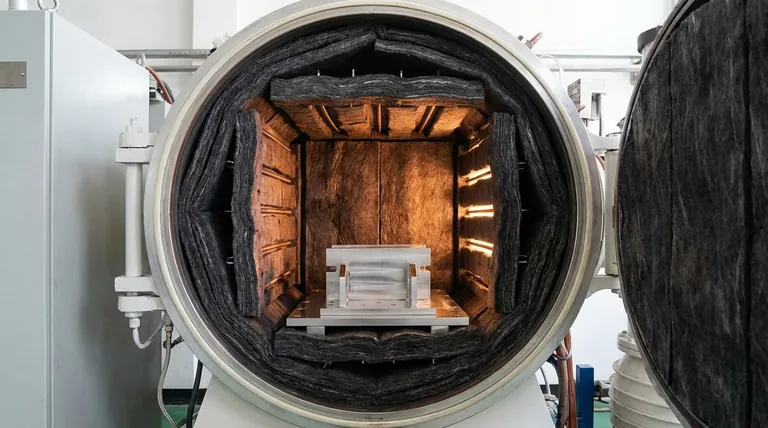
In short, graphite felt is the standard for vacuum furnace insulation due to its exceptional thermal performance, structural integrity, and chemical stability at extreme temperatures. It provides superior heat retention, is lightweight yet strong, and resists chemical corrosion, making it the ideal material for creating a stable and efficient high-temperature processing environment.
The true advantage of graphite felt isn't a single feature, but its unique combination of properties. It simultaneously solves the challenges of thermal management, structural load, and chemical inertness required inside a high-temperature vacuum furnace.
The Core Function: Thermal Management
The primary purpose of any furnace insulation is to control heat. Graphite felt excels in this role through several key mechanisms.
Superior Thermal Insulation
Graphite felt has very low thermal conductivity. This means it is extremely effective at preventing heat from escaping the furnace's hot zone.
This high-efficiency insulation directly translates to lower energy consumption and more precise control over the heating process.
High-Temperature Stability
Graphite can withstand temperatures up to 3000°C (5432°F) in a vacuum or inert gas atmosphere without melting or degrading.
This allows for stable, repeatable performance in demanding processes like brazing, sintering, and heat treating where other materials would fail.
Enhanced Temperature Uniformity
By effectively containing heat, graphite felt insulation helps create a highly uniform temperature environment within the hot zone.
This uniformity is critical for ensuring that every part of the workpiece receives the exact same thermal treatment, leading to consistent and high-quality results.
Structural and Chemical Integrity
Beyond managing heat, the insulation material must survive the harsh physical and chemical conditions inside the furnace.
Lightweight and High Strength
Despite its strength, graphite is remarkably lightweight. This makes the large insulation packs easier and safer to handle during furnace assembly and maintenance.
The lower weight reduces the structural load on the furnace chamber and minimizes the risk of damage to the insulation during installation.
Excellent Chemical Resistance
Graphite is naturally inert and highly resistant to corrosion from acids, alkalis, and other reactive chemicals.
This chemical stability prevents the insulation from degrading over time and, just as importantly, prevents it from contaminating the products being processed in the furnace.
Resistance to Thermal Shock
Vacuum furnace processes often involve rapid heating and cooling cycles. Graphite has excellent thermal shock resistance, meaning it can endure these drastic temperature changes without cracking or breaking.
Understanding the Trade-offs
While graphite is the preferred material, its performance is dependent on specific operating conditions. Understanding these limitations is key to its successful application.
The Critical Role of Atmosphere
Graphite's remarkable high-temperature properties are only present in a vacuum or inert gas atmosphere.
In the presence of oxygen at high temperatures, graphite will rapidly oxidize (burn). This is why it is unsuitable for conventional air-fired furnaces but perfect for vacuum environments.
Versatility Beyond Insulation
The same properties that make graphite felt an ideal insulator also make solid graphite an excellent material for other furnace components.
It is commonly used for heating elements, fixtures, and workpiece holders due to its thermal conductivity, mechanical strength, and stability.
Making the Right Choice for Your Application
Selecting the right materials is about aligning their properties with your primary operational goals.
- If your primary focus is process efficiency and energy savings: Graphite felt's low thermal conductivity is its most important benefit, as it directly reduces heat loss and power consumption.
- If your primary focus is furnace longevity and low maintenance: The chemical inertness and resistance to thermal shock ensure the insulation will have a long service life with minimal degradation.
- If your primary focus is high-quality, repeatable results: The ability of graphite felt to help maintain excellent temperature uniformity is the key to consistent product outcomes.
Ultimately, choosing graphite felt is a decision to invest in stability, efficiency, and reliability for your high-temperature processes.
Summary Table:
| Key Benefit | Why It Matters |
|---|---|
| Superior Thermal Insulation | Reduces energy consumption and enables precise temperature control. |
| High-Temperature Stability (up to 3000°C) | Ensures stable, repeatable performance in demanding processes. |
| Excellent Chemical Resistance | Prevents insulation degradation and product contamination. |
| Lightweight & High Strength | Reduces structural load and simplifies handling during maintenance. |
| Resistance to Thermal Shock | Withstands rapid heating/cooling cycles without cracking. |
Ready to optimize your high-temperature processes with superior furnace insulation?
At KINTEK, we leverage our exceptional R&D and in-house manufacturing to provide advanced thermal solutions. Our expertise in high-temperature furnaces, including Muffle, Tube, Rotary, Vacuum & Atmosphere Furnaces, and CVD/PECVD Systems, is complemented by strong deep customization capabilities. We can help you select or design the perfect insulation solution, like graphite felt, to precisely meet your unique experimental requirements for stability, efficiency, and reliability.
Contact our experts today to discuss how we can enhance your lab's performance!
Visual Guide

Related Products
- 2200 ℃ Graphite Vacuum Heat Treat Furnace
- Dental Porcelain Zirconia Sintering Ceramic Vacuum Press Furnace
- Molybdenum Vacuum Heat Treat Furnace
- Vacuum Dental Porcelain Sintering Furnace for Dental Laboratories
- Vacuum Heat Treat Furnace with Ceramic Fiber Liner
People Also Ask
- Why are vacuum heat treating furnaces essential for aerospace? Ensure Superior Material Integrity for High-Stakes Applications
- What is the primary application of vacuum heat treating furnaces in aerospace? Enhance Component Performance with Precision
- What is the process of vacuum heat treating? Achieve Superior Metallurgical Properties
- How does a vacuum heat treating furnace improve the condition of metal alloys? Achieve Superior Metal Performance
- How does vacuum heat treating work in terms of temperature and time control? Master Precise Material Transformations








