
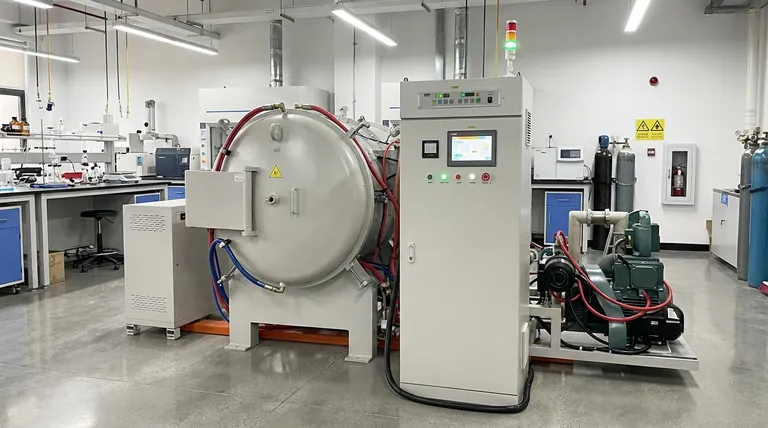
A high-temperature vacuum furnace serves as the critical consolidation environment used to transform a loose magnesium structure into a cohesive, durable scaffold.
During the second stage of sintering for porous magnesium-based composites, this furnace utilizes thermal energy (specifically around 400 °C) to drive diffusion bonding and the formation of sintering necks between magnesium particles. Simultaneously, the vacuum atmosphere plays a defensive role, suppressing the natural reactivity of magnesium to prevent excessive oxide layer growth, ensuring both mechanical strength and predictable biological degradation.
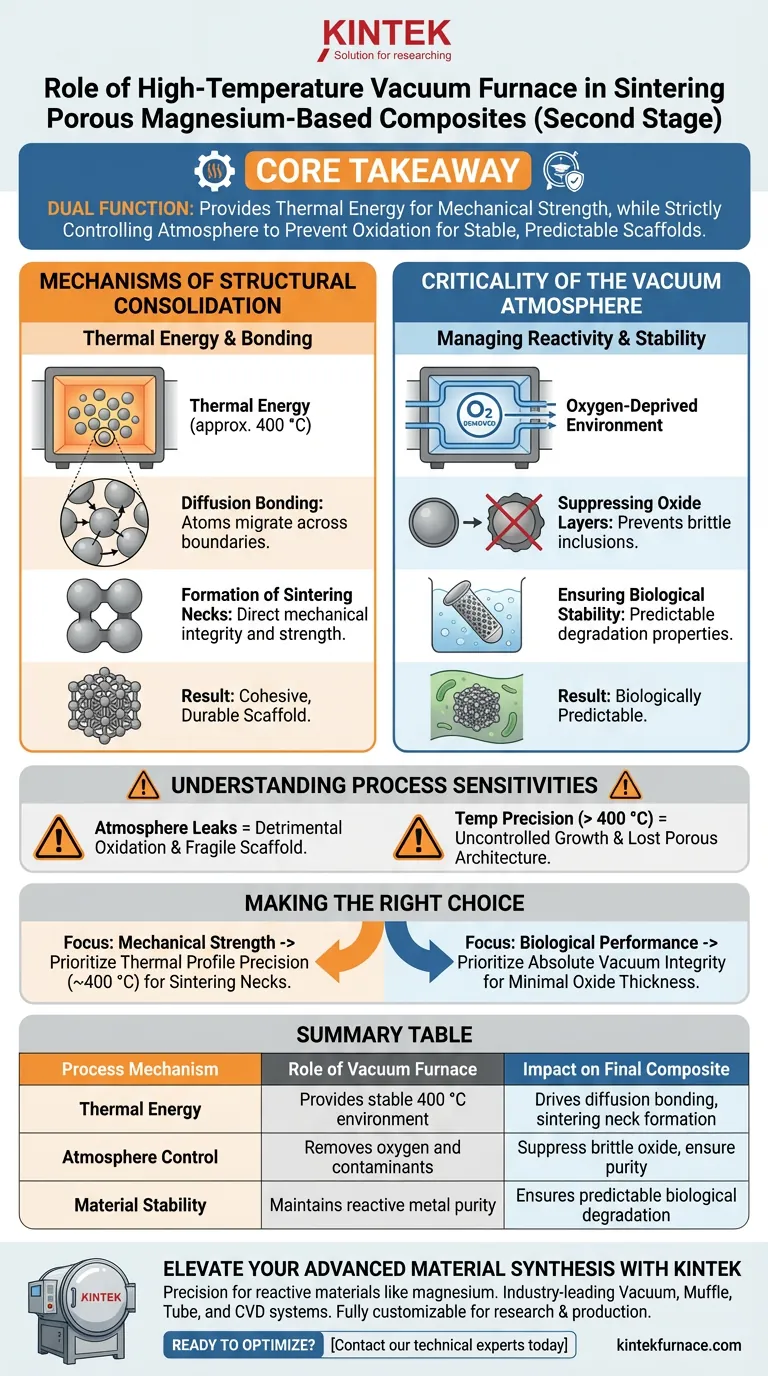
Core Takeaway The vacuum furnace performs a dual function: it provides the thermal energy necessary to physically fuse magnesium particles for mechanical strength, while strictly controlling the atmosphere to prevent oxidation. This balance is essential for creating a stable, high-strength porous scaffold that degrades predictably in biological environments.
Mechanisms of Structural Consolidation
The Role of Thermal Energy
The primary function of the furnace during this stage is to elevate the material to a specific sintering temperature, typically around 400 °C.
At this temperature, the magnesium particles do not melt completely; rather, they reach a state where atomic activity is high enough to facilitate bonding.
Diffusion Bonding
The thermal energy promotes diffusion bonding, a process where atoms migrate across particle boundaries.
This atomic movement is the fundamental mechanism that turns separate powder particles into a unified solid mass.
Formation of Sintering Necks
As diffusion progresses, connections known as sintering necks form at the contact points between magnesium particles.
The growth of these necks is directly responsible for the mechanical integrity of the porous scaffold, significantly increasing its overall strength.
The Criticality of the Vacuum Atmosphere
Managing Magnesium Reactivity
Magnesium is a highly reactive metal that oxidizes rapidly when exposed to oxygen, especially at high temperatures.
The vacuum furnace creates an oxygen-deprived environment that is essential for processing these reactive alloys safely and effectively.
Suppressing Oxide Layers
By removing oxygen, the vacuum environment effectively suppresses the excessive growth of oxide layers on the surface of the magnesium particles.
Uncontrolled oxidation would create brittle inclusions that weaken the material and inhibit the diffusion process described above.
Ensuring Biological Stability
For magnesium composites intended for biomedical use, the composition of the surface is vital.
By controlling oxide formation, the vacuum process ensures the stability of the material's structure and guarantees its biological degradation properties remain within design specifications.
Understanding Process Sensitivities
The Consequence of Atmosphere Leaks
Because magnesium is so reactive, even minor compromises in the vacuum level can lead to detrimental oxidation.
If the vacuum fails or is insufficient, the material may develop thick oxide shells that prevent the formation of sintering necks, resulting in a fragile scaffold that crumbles under stress.
Temperature Precision vs. Material Limits
While heat drives strength, the temperature must be capped strictly (e.g., near 400 °C) to avoid altering the magnesium's microstructure negatively.
Excessive heat could lead to uncontrolled grain growth or melting, destroying the porous architecture required for the application.
Making the Right Choice for Your Goal
To achieve the best results with porous magnesium-based composites, you must balance thermal input with atmospheric control.
- If your primary focus is mechanical strength: Prioritize the precision of the thermal profile (maintaining ~400 °C) to maximize the formation of sintering necks and diffusion bonding.
- If your primary focus is biological performance: Ensure the vacuum integrity is absolute to minimize oxide layer thickness, which dictates the material's degradation rate and stability.
Ultimately, the high-temperature vacuum furnace is not just a heater; it is a reaction-control chamber that dictates the final quality and safety of the magnesium composite.
Summary Table:
| Process Mechanism | Role of Vacuum Furnace | Impact on Final Composite |
|---|---|---|
| Thermal Energy | Provides stable 400 °C environment | Drives diffusion bonding and atom migration |
| Structural Growth | Facilitates sintering neck formation | Increases mechanical strength and integrity |
| Atmosphere Control | Removes oxygen and contaminants | Suppresses brittle oxide layer growth |
| Material Stability | Maintains reactive metal purity | Ensures predictable biological degradation |
Elevate Your Advanced Material Synthesis with KINTEK
Precision is non-negotiable when processing reactive materials like magnesium. KINTEK provides industry-leading Vacuum, Muffle, Tube, and CVD systems designed to meet the rigorous demands of specialized sintering.
Backed by expert R&D and world-class manufacturing, our lab high-temperature furnaces are fully customizable to your unique research or production needs. Whether you require absolute atmospheric integrity for biomedical scaffolds or precise thermal profiles for complex composites, KINTEK delivers the reliability you need to succeed.
Ready to optimize your sintering process? Contact our technical experts today to find the perfect furnace solution for your laboratory.
Visual Guide
References
- Divyanshu Aggarwal, Manoj Gupta. Porous Mg–Hydroxyapatite Composite Incorporated with Aloe barbadensis Miller for Scaphoid Fracture Fixation: A Natural Drug Loaded Orthopedic Implant. DOI: 10.3390/app14041512
This article is also based on technical information from Kintek Furnace Knowledge Base .
Related Products
- 2200 ℃ Tungsten Vacuum Heat Treat and Sintering Furnace
- 2200 ℃ Graphite Vacuum Heat Treat Furnace
- Molybdenum Vacuum Heat Treat Furnace
- 1400℃ Controlled Inert Nitrogen Atmosphere Furnace
- Vacuum Heat Treat Sintering Furnace Molybdenum Wire Vacuum Sintering Furnace
People Also Ask
- How does a tungsten-heated vacuum sintering furnace prepare (TbxY1-x)2O3 ceramics? Achieve 99%+ Density & Purity
- What wear-resistance enhancements are achieved by powder coating? The Role of Vacuum Sintering Furnaces
- How do compaction pressure and vacuum sintering optimize porous ceramics? Maximize Density & Toughness
- What role does a high-temperature vacuum sintering furnace play in the densification of WC-10(Ni, Ni/Co) alloys?
- How does high-temp vacuum sintering influence Y-TZP mechanical properties? Achieve Max Toughness



















