
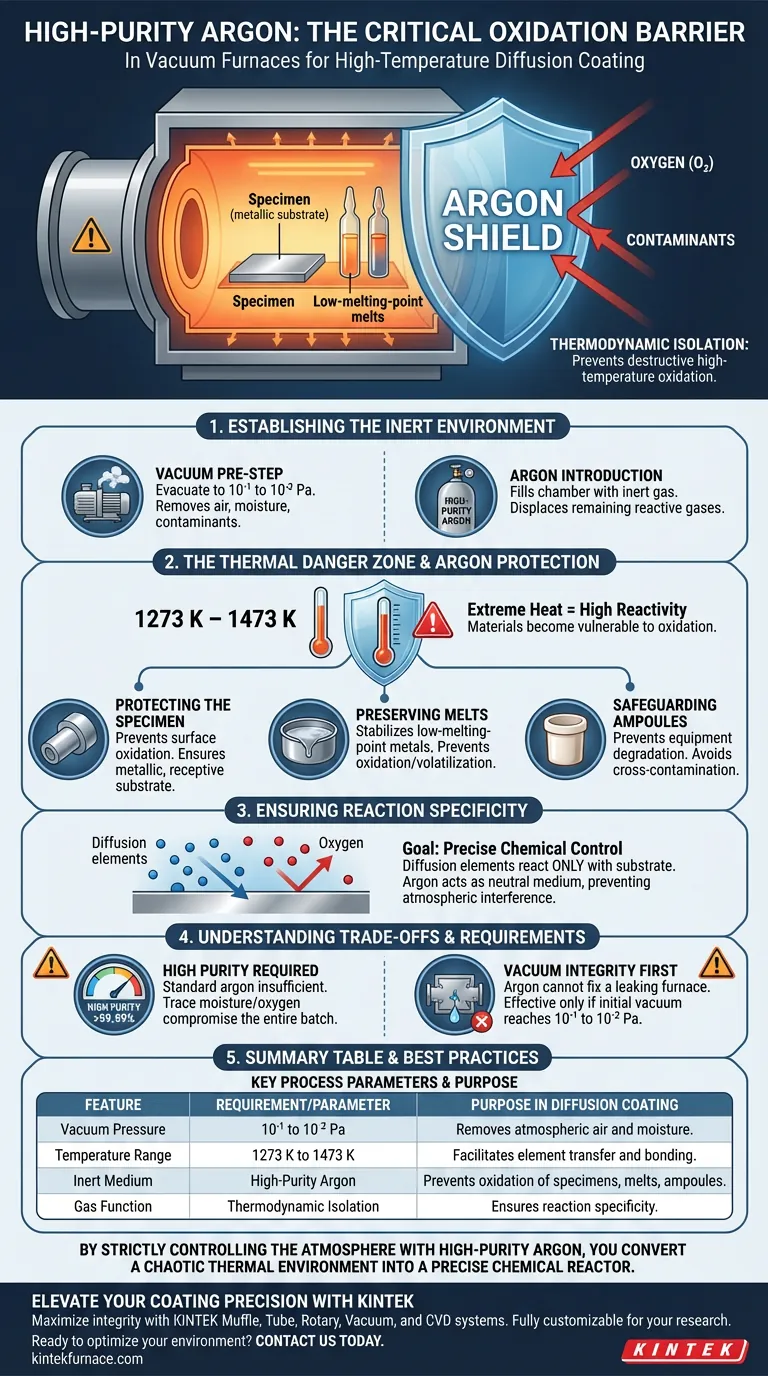
High-purity argon serves as a critical barrier against high-temperature oxidation during the diffusion coating process.
Once the furnace chamber is evacuated to a residual pressure of 10⁻¹ to 10⁻² Pa, introducing argon establishes a completely inert environment. This protective atmosphere is essential at operating temperatures between 1273 K and 1473 K to prevent oxygen from reacting with the specimens, molten metals, or equipment, ensuring the diffusion chemistry remains pure.
Core Takeaway The introduction of high-purity argon is not merely about filling space; it is about thermodynamic isolation. By displacing reactive gases, argon ensures that chemical reactions occur exclusively between the diffusion elements and the substrate, preventing the destructive oxidation that inevitably occurs in high-heat environments.
Establishing the Inert Environment
The Vacuum Pre-step
Before argon is introduced, the system must undergo a vacuum process.
The chamber is evacuated to a residual pressure of 10⁻¹ to 10⁻² Pa.
This step removes the bulk of atmospheric air, moisture, and contaminants that would otherwise contaminate the coating process.
The Thermal Danger Zone
Diffusion coating typically requires extreme heat, specifically ranging from 1273 K to 1473 K.
At these temperatures, materials become highly reactive.
Without an inert gas shield, the substrate and coating materials would immediately degrade upon contact with even trace amounts of oxygen.
What Argon Specifically Protects
Protecting the Specimen
The primary goal is to preserve the integrity of the part being coated.
Argon prevents high-temperature oxidation of the specimen surface.
This ensures the substrate remains metallic and receptive to the diffusion elements, rather than forming a brittle oxide scale.
Preserving Low-Melting-Point Melts
Diffusion processes often utilize low-melting-point metals to facilitate element transfer.
These melts are highly susceptible to oxidation and volatilization.
The inert argon atmosphere stabilizes these melts, ensuring they remain active and effective throughout the diffusion cycle.
Safeguarding Working Ampoules
The protection extends to the processing equipment itself, such as the working ampoules.
Argon prevents these containers from oxidizing and degrading under thermal stress.
This prevents cross-contamination where material from the ampoule might leach into the coating.
Ensuring Reaction Specificity
Isolating the Chemistry
The ultimate engineering goal is precise chemical control.
You want the diffusion elements to react only with the substrate.
Argon acts as a neutral medium, preventing atmospheric interference and ensuring the resulting coating composition is exactly as designed.
Understanding the Trade-offs
The Requirement for High Purity
Standard industrial argon is often insufficient for these processes.
You must use high-purity argon; traces of moisture or oxygen within the gas supply itself can compromise the entire batch at these temperatures.
Using lower-grade gas introduces the very impurities you are trying to avoid.
Vacuum Integrity vs. Argon Filling
Argon cannot "fix" a leaking furnace.
If the initial vacuum does not reach the required 10⁻¹ to 10⁻² Pa, filling the chamber with argon will simply trap residual contaminants inside.
The argon fill is only effective if the initial evacuation was successful.
Making the Right Choice for Your Goal
To ensure a high-quality diffusion coating, align your process parameters with your specific objectives:
- If your primary focus is Surface Purity: Ensure the furnace is evacuated strictly to 10⁻² Pa before introducing argon to eliminate all pre-existing contaminants.
- If your primary focus is Process Consistency: Monitor the argon purity levels to guarantee that the gas itself does not introduce trace oxygen during the 1273 K–1473 K heating cycle.
By strictly controlling the atmosphere with high-purity argon, you convert a chaotic thermal environment into a precise chemical reactor.
Summary Table:
| Feature | Requirement/Parameter | Purpose in Diffusion Coating |
|---|---|---|
| Vacuum Pressure | 10⁻¹ to 10⁻² Pa | Removes atmospheric air and moisture contaminants. |
| Temperature Range | 1273 K to 1473 K | Facilitates element transfer and substrate bonding. |
| Inert Medium | High-Purity Argon | Prevents oxidation of specimens, melts, and ampoules. |
| Gas Function | Thermodynamic Isolation | Ensures reaction specificity between elements and substrate. |
Elevate Your Coating Precision with KINTEK
Maximize the integrity of your thermal processes with industry-leading laboratory equipment. Backed by expert R&D and manufacturing, KINTEK offers a comprehensive range of Muffle, Tube, Rotary, Vacuum, and CVD systems, as well as other lab high-temperature furnaces. Our systems are fully customizable to meet the unique requirements of your diffusion coating and material research applications.
Ready to optimize your high-temperature environment? Contact us today to discuss how our specialized vacuum furnaces can provide the precise chemical control your lab demands.
Visual Guide
References
- Ismatov Jumaniez Faizullaevich. Mplementation Of The Process Of High Temperature Diffusion Treatment. DOI: 10.37547/ajast/volume05issue11-22
This article is also based on technical information from Kintek Furnace Knowledge Base .
Related Products
- Vacuum Hot Press Furnace Machine Heated Vacuum Press Tube Furnace
- Vacuum Hot Press Furnace Machine Heated Vacuum Press
- 2200 ℃ Tungsten Vacuum Heat Treat and Sintering Furnace
- 600T Vacuum Induction Hot Press Vacuum Heat Treat and Sintering Furnace
- Vacuum Heat Treat Sintering Furnace with Pressure for Vacuum Sintering
People Also Ask
- Why use Vacuum Hot Press (VHP) for ZnS Ceramics? Achieve Superior IR Transparency and Mechanical Strength
- What are the benefits of the vacuum environment system in a vacuum hot press furnace? Unlock High-Density Sintering
- What safety features are incorporated in vacuum hot press furnaces? Ensure Operator and Equipment Protection
- How does the uniaxial pressure applied by a vacuum hot press furnace affect the microstructure of ZrC-SiC materials?
- Why is a high vacuum environment crucial when preparing copper-carbon nanotube composites in a vacuum hot press furnace? Achieve Superior Composite Integrity



















