
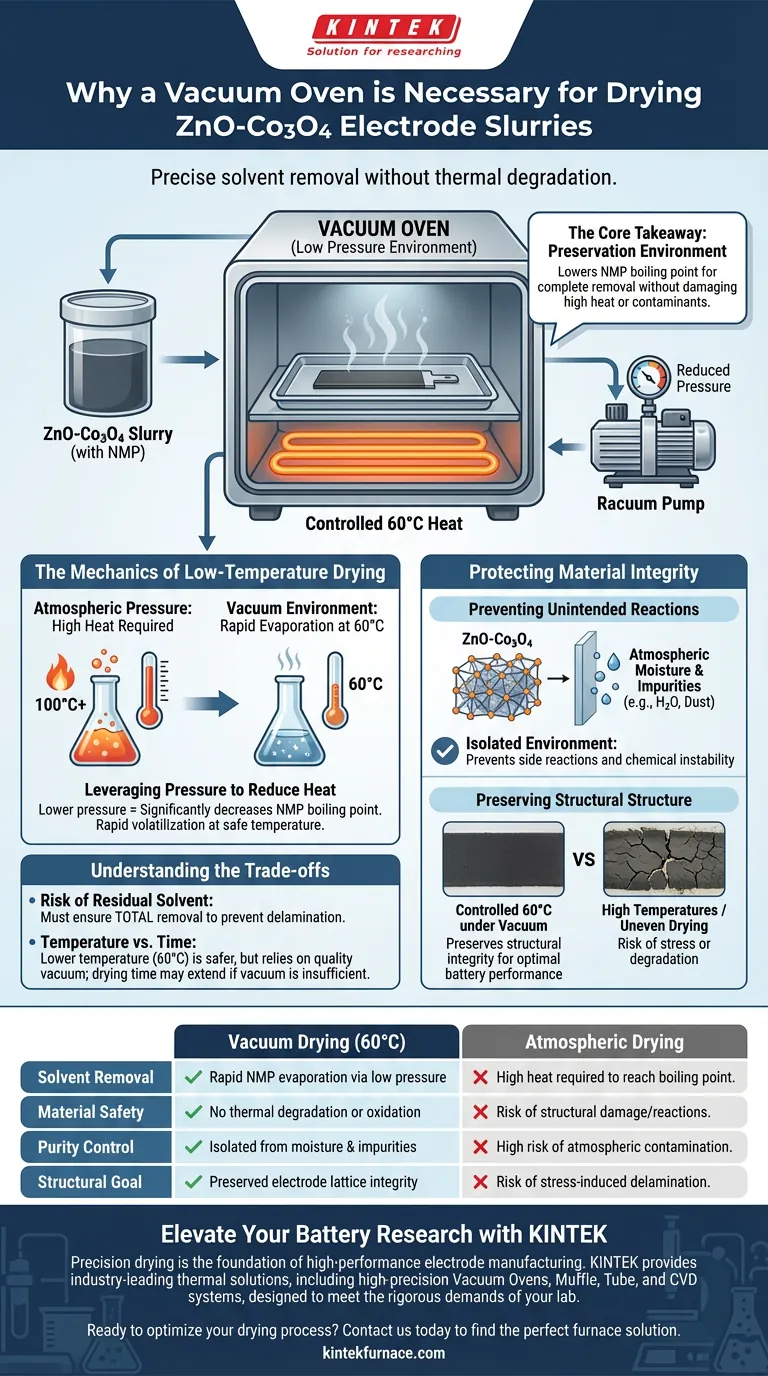
Precise solvent removal without thermal degradation. A vacuum oven is strictly necessary for drying ZnO-Co3O4 electrode slurries to efficiently remove N-Methyl-2-pyrrolidone (NMP) solvents at a safe, low temperature of 60°C. This specific environment accelerates solvent evaporation while simultaneously shielding the active materials from reacting with atmospheric moisture or impurities.
Core Takeaway The vacuum oven is not just a drying tool; it is a preservation environment. It lowers the boiling point of NMP, allowing for complete solvent removal without subjecting the delicate ZnO-Co3O4 structure to damaging high heat or environmental contaminants.
The Mechanics of Low-Temperature Drying
Overcoming the NMP Barrier
N-Methyl-2-pyrrolidone (NMP) is a common solvent in electrode preparation, but it is difficult to remove completely without significant energy.
Under standard atmospheric pressure, removing NMP often requires temperatures that could be detrimental to the slurry components.
Leveraging Pressure to Reduce Heat
The vacuum oven solves this by lowering the pressure within the drying chamber.
By reducing the atmospheric pressure, the boiling point of the NMP solvent decreases significantly.
This allows the solvent to volatilize rapidly at just 60°C, a temperature that is safe for the ZnO-Co3O4 composite.
Protecting Material Integrity
Preventing Unintended Reactions
ZnO-Co3O4 active materials are sensitive to their environment during the curing phase.
The vacuum creates an isolated environment that prevents the slurry from interacting with atmospheric moisture or airborne impurities.
This is critical because moisture ingress can lead to side reactions that compromise the chemical stability of the electrode.
Preserving Structural Structure
High temperatures or uneven drying can cause stress or degradation in the electrode coating.
By drying at a controlled 60°C under vacuum, the process preserves the structural integrity of the electrode.
This ensures the active materials maintain the correct molecular arrangement required for optimal battery performance.
Understanding the Trade-offs
The Risk of Residual Solvent
While the vacuum aids evaporation, the process must be maintained long enough to ensure total removal.
Failing to remove all NMP can lead to electrode delamination or poor adhesion to the current collector later in the process.
Temperature vs. Time
Using a lower temperature like 60°C is safer for the material, but it relies heavily on the quality of the vacuum to be efficient.
If the vacuum pressure is not sufficiently low, the drying time may extend significantly compared to higher-temperature methods used for more robust materials (such as graphite or silicon-based anodes).
Making the Right Choice for Your Goal
To ensure the highest quality ZnO-Co3O4 electrode, apply these principles:
- If your primary focus is Material Purity: strictly maintain the temperature at 60°C to prevent thermal degradation or oxidation of the active components.
- If your primary focus is Structural Stability: Ensure a consistent, deep vacuum is applied to prevent moisture-induced side reactions or impurities from compromising the electrode lattice.
Success lies in using the vacuum to substitute pressure for heat, achieving dryness without destruction.
Summary Table:
| Feature | Vacuum Drying (60°C) | Atmospheric Drying |
|---|---|---|
| Solvent Removal | Rapid NMP evaporation via low pressure | High heat required to reach boiling point |
| Material Safety | No thermal degradation or oxidation | Risk of structural damage/reactions |
| Purity Control | Isolated from moisture & impurities | High risk of atmospheric contamination |
| Structural Goal | Preserved electrode lattice integrity | Risk of stress-induced delamination |
Elevate Your Battery Research with KINTEK
Precision drying is the foundation of high-performance electrode manufacturing. KINTEK provides industry-leading thermal solutions, including high-precision Vacuum Ovens, Muffle, Tube, and CVD systems, designed to meet the rigorous demands of your lab.
Backed by expert R&D and manufacturing, our systems ensure your ZnO-Co3O4 slurries and other sensitive materials are processed with the exact temperature control and vacuum stability required to prevent degradation and maximize performance. All our laboratory high-temp furnaces are fully customizable to your unique research needs.
Ready to optimize your drying process? Contact us today to find the perfect furnace solution.
Visual Guide
References
- Х. А. Абдуллин, Abay Serikkanov. Enhancing the Electrochemical Performance of ZnO-Co3O4 and Zn-Co-O Supercapacitor Electrodes Due to the In Situ Electrochemical Etching Process and the Formation of Co3O4 Nanoparticles. DOI: 10.3390/en17081888
This article is also based on technical information from Kintek Furnace Knowledge Base .
Related Products
- Vacuum Heat Treat Sintering and Brazing Furnace
- Vacuum Heat Treat Sintering Furnace Molybdenum Wire Vacuum Sintering Furnace
- Dental Porcelain Zirconia Sintering Ceramic Vacuum Press Furnace
- Vacuum Hot Press Furnace Machine for Lamination and Heating
- Vacuum Hot Press Furnace Machine Heated Vacuum Press
People Also Ask
- What is one of the most important uses of vacuum heat treating furnaces in aerospace? Achieve Superior Strength in Aircraft Alloys
- What are the benefits of using vacuum heat treating furnaces for metal alloys? Achieve Superior Metal Properties and Performance
- How does vacuum heat treating affect the grain structure of metal alloys? Achieve Precise Microstructure Control
- What is the temperature of a vacuum furnace brazing? Optimize Your Joint Strength and Cleanliness
- What are the steps involved in a typical vacuum brazing treatment? Master the Process for Strong, Clean Joints



















