
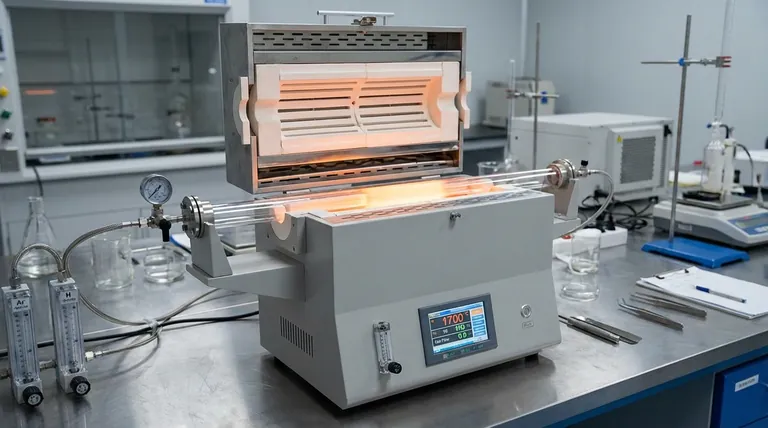
A high-temperature tube furnace serves as the precision reactor necessary to convert Hydrogen Silsesquioxane (HSQ) into silicon quantum dots (SiQDs). By establishing a strictly controlled thermal environment between 1,100 °C and 1,500 °C, the furnace drives the specific disproportionation reaction required to transform the HSQ cage structure into silicon nanocrystals embedded within a silica matrix.
The tube furnace is not merely a heat source; it is a critical tuning instrument. Its ability to maintain exact temperatures directly dictates the final size of the silicon quantum dot cores, effectively programming their quantum confinement properties.
The Mechanism of Synthesis
Driving the Disproportionation Reaction
The primary function of the furnace is to facilitate the thermal pyrolysis of HSQ.
At extreme temperatures (1,100 °C – 1,500 °C), the heat energy forces the HSQ cage structure to collapse and rearrange.
This rearrangement is known as a disproportionation reaction, where the precursor material separates into distinct phases: elemental silicon and silicon dioxide (SiO2).
Creating the Composite Matrix
The result of this thermal process is not just isolated silicon.
The furnace facilitates the growth of silicon nanocrystals—the quantum dots—which are encapsulated within a robust silicon dioxide matrix.
This solid-state matrix provides essential passivation and protection for the reactive silicon cores.
Maintaining a Reductive Atmosphere
Thermal pyrolysis of HSQ cannot occur in standard air or a vacuum; it requires a specific chemical environment.
The tube furnace allows for the continuous flow of a specific gas mixture, typically 95% Argon (Ar) and 5% Hydrogen (H2).
This reductive atmosphere is crucial for preventing unwanted oxidation and ensuring the chemistry proceeds toward the formation of pure silicon crystals.
Controlling Quantum Properties
Temperature as a Sizing Tool
The most critical variable in quantum dot synthesis is the size of the core, as this determines the material's optical and electronic behaviors.
The tube furnace acts as the control mechanism for this variable.
Precise manipulation of the temperature directly correlates to the final size of the silicon quantum dots. Higher or lower temperatures will yield different crystal diameters.
Ensuring Thermal Uniformity
Just as in industrial biomass or polymer processing, the uniformity of heat transfer is vital.
The tube furnace design utilizes heating elements surrounding the reaction vessel to ensure the entire sample experiences the exact same thermal conditions.
This uniformity prevents "cold spots" that could lead to incomplete reactions or inconsistent dot sizes within a single batch.
Understanding the Trade-offs
The Precision vs. Throughput Balance
While tube furnaces offer exceptional control over the reaction environment, they are inherently batch-process or low-volume continuous systems.
Achieving the high temperatures (up to 1,500 °C) required for HSQ pyrolysis demands significant energy and time for ramping and cooling.
This makes the process highly effective for high-quality synthesis but potentially slower than lower-temperature chemical methods.
Atmosphere Management Risks
The requirement for a hydrogen-containing atmosphere introduces complexity regarding safety and equipment capability.
Standard furnaces cannot simply handle reductive gases; the system must be sealed and rated for hydrogen use to prevent leaks or combustion.
Failure to maintain the precise 95/5 Ar/H2 ratio can lead to poor crystal formation or oxidation of the silicon.
Making the Right Choice for Your Goal
To optimize your synthesis of silicon quantum dots via HSQ pyrolysis, consider the following:
- If your primary focus is specific optical properties: Prioritize a furnace with high-precision temperature controllers (+/- 1°C), as temperature acts as the direct dial for quantum dot size.
- If your primary focus is crystal purity: Ensure your furnace setup includes high-quality mass flow controllers to maintain the strict 95% Ar / 5% H2 atmospheric ratio without fluctuation.
- If your primary focus is batch consistency: Invest in a furnace with a long uniform temperature zone to ensure every millimeter of the sample undergoes identical thermal history.
Mastering the thermal profile of your tube furnace is the single most important step in controlling the physics of your quantum dots.
Summary Table:
| Parameter | Role in SiQD Synthesis | Critical Function |
|---|---|---|
| Temperature Range | 1,100 °C – 1,500 °C | Drives HSQ disproportionation into Si nanocrystals |
| Atmosphere Control | 95% Ar / 5% H2 | Prevents oxidation and maintains a reductive environment |
| Thermal Uniformity | Multi-zone heating | Ensures consistent quantum dot size across the batch |
| Reaction Matrix | Solid-state pyrolysis | Embeds Si cores within a protective SiO2 matrix |
Elevate Your Nanomaterial Synthesis with KINTEK
Precision is the difference between a successful batch and a failed experiment. KINTEK provides industry-leading Tube, Vacuum, and CVD systems designed to meet the rigorous demands of HSQ thermal pyrolysis. Backed by expert R&D and world-class manufacturing, our high-temperature furnaces are fully customizable to ensure exact temperature stability and atmospheric integrity for your lab's unique needs.
Ready to achieve superior quantum confinement and crystal purity? Contact KINTEK today to discuss your custom furnace solution.
References
- Ken‐ichi Saitow. Bright silicon quantum dot synthesis and LED design: insights into size–ligand–property relationships from slow- and fast-band engineering. DOI: 10.1093/bulcsj/uoad002
This article is also based on technical information from Kintek Furnace Knowledge Base .
Related Products
- 1700℃ High Temperature Laboratory Tube Furnace with Alumina Tube
- 1400℃ High Temperature Laboratory Tube Furnace with Alumina Tube
- 1200℃ Split Tube Furnace Laboratory Quartz Tube Furnace with Quartz Tube
- Vertical Laboratory Quartz Tube Furnace Tubular Furnace
- Laboratory Quartz Tube Furnace RTP Heating Tubular Furnace
People Also Ask
- How do high-temperature laboratory tube furnaces ensure environmental stability? Precision Thermal Reduction Tips
- How are high-temperature laboratory tube furnaces applied in long-term vacuum homogenization heat treatments for intermetallic samples?
- How are high-temp tube furnaces used to measure diffusion coefficients per Fick's law? Master Precision Annealing
- How are high-temperature tube furnaces applied in testing ceramic-supported alloy membranes? Insights
- In what scenarios are laboratory high-temperature tube furnaces or muffle furnaces utilized? Study MgTiO3-CaTiO3 Ceramics



















