
Secondary pyrolysis activation at 800 °C transforms the carbon structure through aggressive chemical etching. Inside a high-precision tube furnace, potassium hydroxide (KOH) reacts with the carbon framework to trigger strong redox reactions. This generates expanding gases—specifically carbon monoxide, carbon dioxide, and metallic potassium vapor—that carve out a vast network of micropores and mesopores, creating a 3D honeycomb-like interconnected framework.
By leveraging high-temperature redox reactions, this process amplifies the specific surface area of the material by over 100 times, shifting it from a dense primitive state (8.78 m²·g⁻¹) to a highly porous, activated state (997.46 m²·g⁻¹).
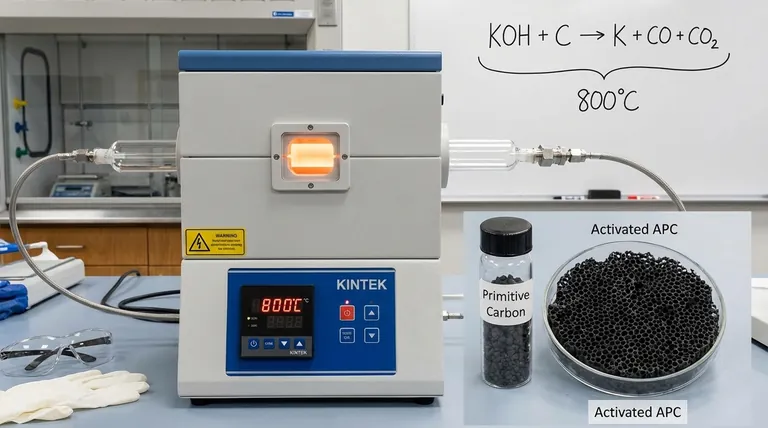
The Mechanism of Structural Transformation
The Catalyst: High-Temperature Redox Reactions
The transformation begins when the material reaches 800 °C within the tube furnace. At this temperature, the potassium hydroxide (KOH) does not merely coat the carbon; it chemically attacks it.
This triggers intense redox reactions between the KOH and the carbon skeleton. The high thermal energy provided by the furnace is essential to overcome the activation energy required for these reactions to occur efficiently.
The Agents of Etching: Gas Generation
The primary drivers of pore formation are the reaction byproducts. As the KOH reduces and the carbon oxidizes, distinct gases are released.
Specifically, the process generates carbon monoxide (CO), carbon dioxide (CO2), and metallic potassium vapor. These are not passive byproducts; they act as physical agents that force their way out of the material.
Creating the Honeycomb Framework
As these gases expand and escape, they aggressively etch the carbon surface. This etching process is what converts the solid mass into a sponge-like structure.
The result is a 3D honeycomb-like interconnected framework. This geometry is critical because it creates a pathway for ions or molecules to move through the material, rather than just sitting on the surface.
Quantifying the Surface Area Shift
From Dense to Porous
The impact of this activation on the material's physical properties is drastic. Before activation, the primitive carbon is relatively dense and closed off.
The primary reference notes a starting specific surface area of just 8.78 m²·g⁻¹. This indicates a material with very few accessible sites for adsorption or reaction.
The Leap to Activated Carbon
Post-activation, the material evolves into Activated Pomelo Peel Carbon (APC). The aggressive etching opens up a massive number of micropores and mesopores.
This spikes the specific surface area to 997.46 m²·g⁻¹. This increase of two orders of magnitude is what defines the material's utility for high-performance applications.
Understanding the Trade-offs
Balancing Etching and Integrity
While aggressive etching increases surface area, it introduces a trade-off regarding structural stability.
The description of the etching as "aggressive" implies that the carbon framework is being consumed to create voids. If the reaction proceeds too far or the temperature exceeds 800 °C significantly, you risk collapsing the pore walls, which would destroy the honeycomb structure and reduce performance.
Process Complexity
Using a high-precision tube furnace at 800 °C requires significant energy input and precise control.
Furthermore, the generation of metallic potassium vapor poses safety and equipment maintenance challenges, as alkali metals are highly reactive and corrosive to heating elements if not properly managed.
Making the Right Choice for Your Goal
When designing porous carbon materials, the activation method must match your specific application requirements.
- If your primary focus is maximizing surface area: Utilize high-temperature KOH activation (800 °C) to aggressively etch the material and achieve surface areas approaching 1,000 m²·g⁻¹.
- If your primary focus is transport kinetics: Ensure the process creates an interconnected 3D honeycomb framework, as isolated pores provide surface area but poor accessibility.
The effectiveness of APC lies in the precise conversion of a dense biomass into a highly open, interconnected architecture through controlled chemical etching.
Summary Table:
| Feature | Primitive Carbon | Activated Pomelo Peel Carbon (APC) |
|---|---|---|
| Specific Surface Area | 8.78 m²·g⁻¹ | 997.46 m²·g⁻¹ |
| Pore Structure | Dense & Closed | 3D Honeycomb / Microporous & Mesoporous |
| Mechanism | N/A | KOH Redox Etching (CO, CO₂, K Vapor) |
| Activation Temp | N/A | 800 °C (Precise Tube Furnace Control) |
Unlock High-Precision Carbon Activation with KINTEK
Achieving a 100x increase in surface area requires absolute thermal stability and precise atmosphere control. KINTEK provides industry-leading Tube, Muffle, Vacuum, and CVD systems specifically designed to handle aggressive chemical etching and high-temperature redox reactions.
Whether you are developing advanced biomass carbons or high-performance supercapacitors, our expert-backed R&D team can deliver customizable lab high-temp furnaces tailored to your unique research needs. Ensure structural integrity and maximize your material's potential today.
📧 Contact KINTEK for a Custom Solution
Visual Guide

References
- Jing Gong, Baowei Hu. Honeycomb-structured biochar from waste pomelo peel for synergistic adsorptive and photocatalytic removal of Cr(VI). DOI: 10.1007/s44246-024-00174-5
This article is also based on technical information from Kintek Furnace Knowledge Base .
Related Products
- Vacuum Sealed Continuous Working Rotary Tube Furnace Rotating Tube Furnace
- 1400℃ High Temperature Laboratory Tube Furnace with Alumina Tube
- 1700℃ High Temperature Laboratory Tube Furnace with Alumina Tube
- Magnesium Extraction and Purification Condensing Tube Furnace
- High Pressure Laboratory Vacuum Tube Furnace
People Also Ask
- What is the purpose of rotary tube furnaces? Achieve Uniform Heat Treatment for Powders and Granules
- What are the key advantages of using a rotary tube furnace? Achieve Dynamic, Uniform Heating for Powders
- How does the amount of material processed vary between batch and continuous rotary tube furnaces? Scale Your Production Efficiently
- What are the advantages of rotary tube furnaces in fuel compatibility? Boost Efficiency and Cut Costs
- What is the temperature range of some rotary tube furnaces? Achieve Uniform Heating Up to 1200°C



















