
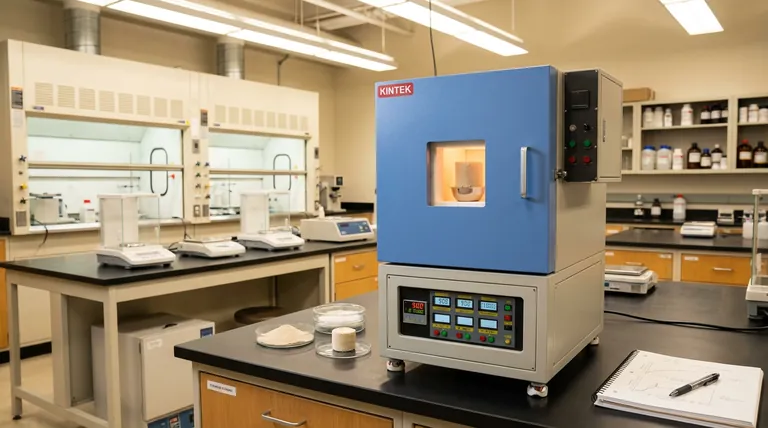
The high-temperature Muffle Furnace serves as the critical consolidation tool in the final production stage of biomimetic Bouligand structural ceramic aerogels. Its primary function is to execute the annealing and calcination processes, typically subjecting samples to temperatures of 900 °C for one hour. This thermal treatment converts the precursor materials into a final, robust state.
By providing a stable high-temperature environment, the furnace drives the transition from a loose fiber assembly to a solid ceramic. It facilitates the ceramization of the chemical sol, locks in the structural cross-linking, and ensures the material achieves its target mechanical properties.
Transforming Precursors into Ceramics
Ceramization of the Sol
The central role of the furnace is to facilitate the ceramization of the aluminum borosilicate (AlBSi) sol. Before this stage, the material exists as a chemically active precursor.
The high heat drives the phase transition, converting the sol into a hard, stable ceramic phase. This is the moment the material gains its fundamental thermal and chemical resistance.
Completing Chemical Cross-Linking
Mechanical strength in aerogels relies on strong connections between the internal fibers. The furnace heat completes the chemical cross-linking between these fibers.
Without this thermal bonding step, the structure would remain a "loose fiber assembly." The furnace effectively "locks" the fibers together, solidifying the complex Bouligand architecture.
Ensuring Structural Purity
Removal of Organic Components
During the precursor stages, organic binders or additives are often present. The furnace performs calcination, a process that burns off these volatile organic components.
Removing these organics is essential for creating a pure ceramic skeleton. Residual organics could compromise the high-temperature performance or structural integrity of the final aerogel.
Densification of the Skeleton
While aerogels are inherently porous, the solid parts of the structure must be dense and defect-free. The furnace promotes the transition from a green body to a solid ceramic aerogel.
This densification ensures that while the material remains lightweight, the individual struts and walls of the aerogel are mechanically robust.
Understanding the Trade-offs
While the muffle furnace is essential for solidification, improper management of the thermal profile can lead to critical defects.
Temperature Precision vs. Structural Collapse The target temperature (e.g., 900 °C) must be maintained precisely. Excessive heat can induce over-sintering, causing the porous aerogel structure to collapse or melt, destroying the very porosity you are trying to create.
Thermal Shock Risks The heating and cooling rates must be controlled. Rapid changes in temperature inside the furnace can cause internal stress, leading to cracking or delamination of the ceramic, particularly given the fragile nature of the aerogel before full ceramization.
Making the Right Choice for Your Goal
To maximize the quality of your biomimetic Bouligand structural ceramic aerogel, tailor your furnace usage to your specific objective:
- If your primary focus is mechanical robustness: Ensure the dwell time at 900 °C is sufficient to achieve complete chemical cross-linking and ceramization of the AlBSi sol.
- If your primary focus is material purity: Verify that the furnace atmosphere allows for the total oxidation and removal of all organic precursors during the calcination phase.
The muffle furnace is not merely a heater; it is the reactor that defines the final structural integrity of your ceramic aerogel.
Summary Table:
| Process Stage | Function of Muffle Furnace | Key Outcome |
|---|---|---|
| Annealing/Calcination | Sustained heat at 900 °C for 1 hour | Conversion of precursors into stable ceramic phase |
| Ceramization | Phase transition of AlBSi sol | Formation of hard, heat-resistant ceramic skeleton |
| Cross-Linking | Chemical bonding of internal fibers | Structural solidification and mechanical strength |
| Calcination | Oxidation of organic binders/additives | High material purity and structural integrity |
| Densification | Transition from green body to solid | Robust individual struts and walls within the aerogel |
Elevate Your Advanced Material Research with KINTEK
Precision is the difference between a loose fiber assembly and a high-performance ceramic aerogel. At KINTEK, we understand that the final thermal treatment defines your material's structural integrity.
Backed by expert R&D and world-class manufacturing, we provide high-precision Muffle, Tube, Rotary, Vacuum, and CVD systems designed for the rigorous demands of advanced lab work. Whether you are scaling biomimetic Bouligand structures or developing new ceramic composites, our lab high-temp furnaces are fully customizable to meet your unique temperature profiles and atmospheric needs.
Ready to achieve superior ceramization? Contact KINTEK today to discuss your customized furnace solution.
References
- Hongxing Wang, Bin Ding. Biomimetic Bouligand chiral fibers array enables strong and superelastic ceramic aerogels. DOI: 10.1038/s41467-023-44657-2
This article is also based on technical information from Kintek Furnace Knowledge Base .
Related Products
- 1700℃ High Temperature Muffle Oven Furnace for Laboratory
- 1800℃ High Temperature Muffle Oven Furnace for Laboratory
- 1400℃ Muffle Oven Furnace for Laboratory
- 1200℃ Muffle Oven Furnace for Laboratory
- High Temperature Muffle Oven Furnace for Laboratory Debinding and Pre Sintering
People Also Ask
- What is the primary function of a high-temperature laboratory muffle furnace in chemical synthesis? Achieve Precision.
- How does a high-temperature laboratory muffle furnace affect material properties? Transform Anodic Oxide Films Fast
- What role does a muffle furnace play in BCZY712 electrolyte powder production? Achieve Perfect Phase Purity
- What is the role of a high-temperature muffle furnace in guava leaf carbonization? Master Precise Pyrolysis Control
- How does the two-stage sintering process contribute to the synthesis of MeCuFeO3 perovskite? Optimize crystal purity.



















