
The high-temperature calcination furnace acts as the primary activation tool in the production of HZSM-5, specifically responsible for converting the precursor ammonium-form zeolite (NH4-ZSM-5) into the active proton-form (HZSM-5). By subjecting the material to static air at 550°C, the furnace drives the critical chemical and physical changes necessary to prepare the catalyst for industrial use.
This process is not merely a drying step; it is a fundamental chemical transformation that generates essential Bronsted acid sites, clears organic blockages from the micropores, and creates a stable framework capable of withstanding rigorous catalytic cracking operations.
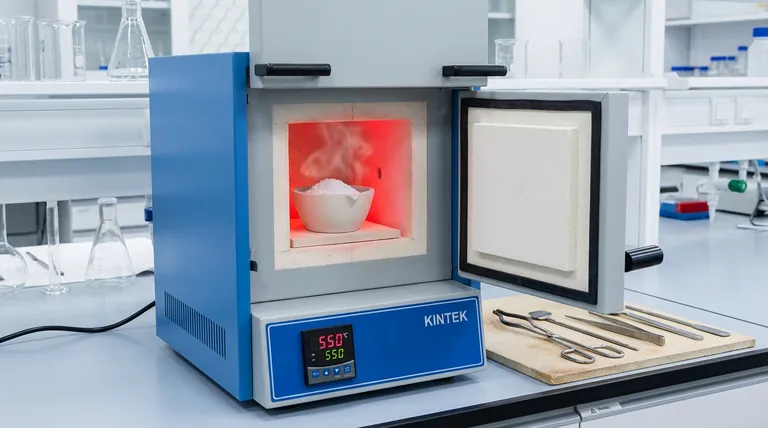
The Mechanism of Catalyst Activation
Generating Active Acid Sites
The primary function of the furnace is to facilitate deammoniation.
During synthesis, the zeolite exists in an ammonium form (NH4-ZSM-5), which lacks the specific acidity required for many reactions.
Thermal treatment expels ammonia gas from the structure, leaving behind protons (H+). This conversion creates Bronsted acid sites, which serve as the active centers required for processes like gas oil catalytic cracking.
Removing Organic Impurities
The synthesis of zeolite often involves organic templates or residues that remain trapped within the material's pores.
The high-temperature environment oxidizes and decomposes these organic compounds.
By eliminating these residues, the furnace removes steric hindrance (physical blockages), effectively opening the microporous space for reactants or subsequent metal ion exchange.
Structural Enhancement and Stability
Stabilizing the Zeolite Framework
Beyond chemical activation, the furnace serves a critical structural role.
The precise thermal treatment stabilizes the crystalline framework of the zeolite.
This ensures that the catalyst maintains its mechanical integrity and pore structure when subjected to the harsh conditions of actual reactor environments.
Enabling Solid-Phase Reactions
In cases where metals are introduced, the calcination process can induce beneficial solid-phase reactions.
Heat promotes the interaction between active species and the support material.
This helps form stable structures that improve the catalyst's mechanical strength and resistance to sintering (clumping of particles).
Understanding the Trade-offs
The Risk of Thermal Degradation
While 550°C is the target for HZSM-5 activation, deviating from this can be detrimental.
Excessive heat or rapid temperature spikes can cause the collapse of the zeolite framework, permanently destroying the catalyst's surface area.
Atmosphere Sensitivity
The specific atmosphere (static air vs. flowing gas) plays a major role in the outcome.
While static air is standard for HZSM-5 activation, using incorrect atmospheres (like reducing hydrogen environments) would trigger different chemical pathways, potentially altering the metal states rather than activating the acid sites.
Making the Right Choice for Your Goal
To maximize the performance of your HZSM-5 catalyst, you must tailor the furnace protocol to your specific objectives:
- If your primary focus is Maximum Acidity: Ensure the temperature is held precisely at 550°C to achieve complete deammoniation without damaging the Bronsted acid sites.
- If your primary focus is Pore Accessibility: Prioritize a controlled heating rate to fully decompose organic templates without collapsing the microporous channels.
- If your primary focus is Mechanical Stability: Verify that the thermal dwell time is sufficient to induce the solid-phase reactions necessary to reinforce the catalyst framework.
The high-temperature furnace effectively bridges the gap between a raw synthesized precursor and a fully functional, industrial-grade catalyst.
Summary Table:
| Process Phase | Primary Function | Key Outcome |
|---|---|---|
| Deammoniation | Expels ammonia gas from NH4-ZSM-5 | Generates active Bronsted acid sites |
| Organic Removal | Oxidizes templates/residues | Clears steric hindrance in micropores |
| Structural Dwell | Precise thermal stabilization | Ensures framework mechanical integrity |
| Solid-Phase Reaction | Promotes species-support interaction | Enhances resistance to sintering |
Precision is paramount when preparing catalysts like HZSM-5. KINTEK’s high-temperature calcination furnaces provide the exact thermal control and atmospheric stability needed to maximize Bronsted acidity and pore accessibility. Backed by expert R&D and world-class manufacturing, KINTEK offers customizable Muffle, Tube, Rotary, and Vacuum systems designed specifically for your laboratory's unique synthesis requirements. Don't compromise your catalyst's performance—contact KINTEK today for a custom high-temp solution!
References
- Optimization of Operational Parameters for Improved Light Olefin Production in Gasoil Cracking over HZSM-5 Catalyst: Temperature and Catalyst Loading Weight as Key Parameters. DOI: 10.21203/rs.3.rs-7402064/v1
This article is also based on technical information from Kintek Furnace Knowledge Base .
Related Products
- 1400℃ High Temperature Laboratory Tube Furnace with Alumina Tube
- 1700℃ High Temperature Laboratory Tube Furnace with Alumina Tube
- High Temperature Muffle Oven Furnace for Laboratory Debinding and Pre Sintering
- 1800℃ High Temperature Muffle Oven Furnace for Laboratory
- 1700℃ High Temperature Muffle Oven Furnace for Laboratory
People Also Ask
- How does zone-melting in tube furnaces synthesize bismuth micro-wires? Master Single-Crystal Thermoelectric Growth
- How are high-temperature laboratory tube furnaces applied in long-term vacuum homogenization heat treatments for intermetallic samples?
- How do high-temperature laboratory tube furnaces ensure environmental stability? Precision Thermal Reduction Tips
- How are high-temp tube furnaces used to measure diffusion coefficients per Fick's law? Master Precision Annealing
- How are high-temperature tube furnaces applied in testing ceramic-supported alloy membranes? Insights



















