
The primary process objective is the controlled thermal conversion of impregnated nitrate precursors into their active oxide states. Specifically, for Fischer-Tropsch catalysts supported on titanium dioxide (TiO2), the goal is to transform metal salts into preliminary oxide distributions, such as Cobalt oxide (Co3O4) or Cobalt-Manganese (CoO-MnO) solid solutions. This is achieved by maintaining a precise air environment at approximately 300°C for a constant duration of 12 hours.
By meticulously controlling the calcination temperature and duration, you are not merely drying the material; you are establishing the structural "fingerprint" of the catalyst. This step creates the necessary oxide foundation that dictates how effectively the catalyst can be reduced and activated in subsequent processing stages.
The Physics of Precursor Conversion
Decomposition of Metal Salts
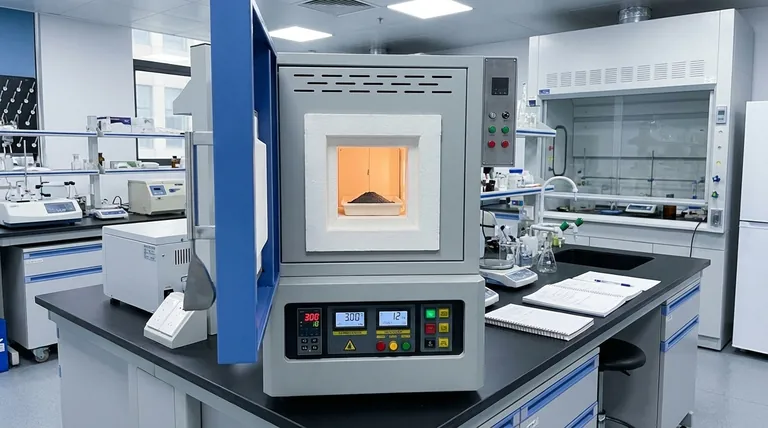
The muffle furnace drives the thermal decomposition of the impregnated metal salts. In this specific application, nitrate precursors act as the vehicle for metal delivery but must be removed to leave behind the active metal species. The heat breaks the chemical bonds of the nitrates, releasing nitrogen oxides and leaving stable metal oxides on the support.
Formation of Oxide Phases
The objective is not just decomposition, but the formation of specific crystallographic phases. At the target temperature of 300°C, the process facilitates the nucleation of Co3O4 or CoO-MnO solid solutions. These specific oxide forms are the required precursors for the metallic active sites used in Fischer-Tropsch synthesis.
Interaction with the Support
The thermal treatment promotes the interaction between the active metal oxides and the TiO2 support. This ensures that the active components are not just sitting loosely on the surface but are anchored sufficiently to prevent agglomeration during later reaction stages.
Critical Process Parameters
Thermal Field Stability
A key advantage of the laboratory muffle furnace is its ability to maintain a consistent thermal field. Uniform heat distribution is critical to ensure that every particle within the batch undergoes the same rate of decomposition, preventing heterogeneity in the final catalyst performance.
Time-Temperature Profile
The process relies on a specific recipe: 300°C for 12 hours. This extended duration ensures that the phase transformation is complete throughout the bulk of the material, rather than just on the surface layer. It allows for the slow, controlled release of gases, which helps preserve the integrity of the pore structure.
Understanding the Trade-offs
The Risk of Thermal Overshoot
While heat is necessary to decompose nitrates, excessive temperatures are detrimental. If the furnace temperature significantly exceeds the 300°C target (moving towards sintering temperatures like 500°C or 1000°C used for other catalyst types), you risk collapsing the pore structure or causing the metal oxides to sinter into large, inactive clusters.
Incomplete Decomposition
Conversely, failing to maintain the temperature or duration (e.g., shortening the 12-hour cycle) results in residual nitrates. These impurities can block active sites and release erratic amounts of gas during the subsequent reduction phase, destabilizing the catalyst's final structure.
Making the Right Choice for Your Project
The success of your Fischer-Tropsch catalyst preparation hinges on how strictly you adhere to the calcination parameters.
- If your primary focus is Phase Purity: Ensure your furnace calibration is precise at 300°C to guarantee the formation of Co3O4 without inducing unwanted phase transitions.
- If your primary focus is Batch Consistency: Prioritize a furnace with excellent thermal field uniformity to ensure that the decomposition rate is identical across the entire sample tray.
Precision in this preliminary calcination stage is the single most important factor in defining the potential activity of your final catalyst.
Summary Table:
| Process Parameter | Target Value/Objective | Role in Catalyst Performance |
|---|---|---|
| Calcination Temp | 300°C | Facilitates phase nucleation (Co3O4/CoO-MnO) |
| Duration | 12 Hours | Ensures complete decomposition and gas release |
| Environment | Controlled Air | Enables oxidative conversion of metal salts |
| Support Interaction | TiO2 Anchoring | Prevents metal agglomeration during reaction |
| Risk Control | < 500°C | Avoids sintering and pore structure collapse |
Optimize Your Catalyst Precursor Conversion with KINTEK
Precise thermal field stability is non-negotiable for the structural integrity of Fischer-Tropsch catalysts. KINTEK provides industry-leading Muffle, Tube, Rotary, Vacuum, and CVD systems engineered specifically for the rigorous demands of lab-scale R&D and manufacturing.
Whether you need exact 300°C maintenance for 12-hour cycles or specialized high-temp furnaces customizable for unique material needs, our expert solutions ensure batch consistency and phase purity.
Ready to elevate your lab's thermal processing? Contact our technical team today to find your solution!
References
- M. W. Lindley, Sarah J. Haigh. Tuning the Size of TiO<sub>2</sub>-Supported Co Nanoparticle Fischer–Tropsch Catalysts Using Mn Additions. DOI: 10.1021/acscatal.4c02721
This article is also based on technical information from Kintek Furnace Knowledge Base .
Related Products
- 1700℃ High Temperature Muffle Oven Furnace for Laboratory
- 1800℃ High Temperature Muffle Oven Furnace for Laboratory
- 1400℃ Muffle Oven Furnace for Laboratory
- 1200℃ Muffle Oven Furnace for Laboratory
- High Temperature Muffle Oven Furnace for Laboratory Debinding and Pre Sintering
People Also Ask
- What is the primary function of a high-temperature laboratory muffle furnace in chemical synthesis? Achieve Precision.
- How does a high-temperature laboratory muffle furnace affect material properties? Transform Anodic Oxide Films Fast
- What role does a muffle furnace play in BCZY712 electrolyte powder production? Achieve Perfect Phase Purity
- What is the role of a high-temperature muffle furnace in guava leaf carbonization? Master Precise Pyrolysis Control
- What role does a muffle furnace play in sintering photocathodes? Enhance Electrode Conductivity & Catalytic Activity



















