
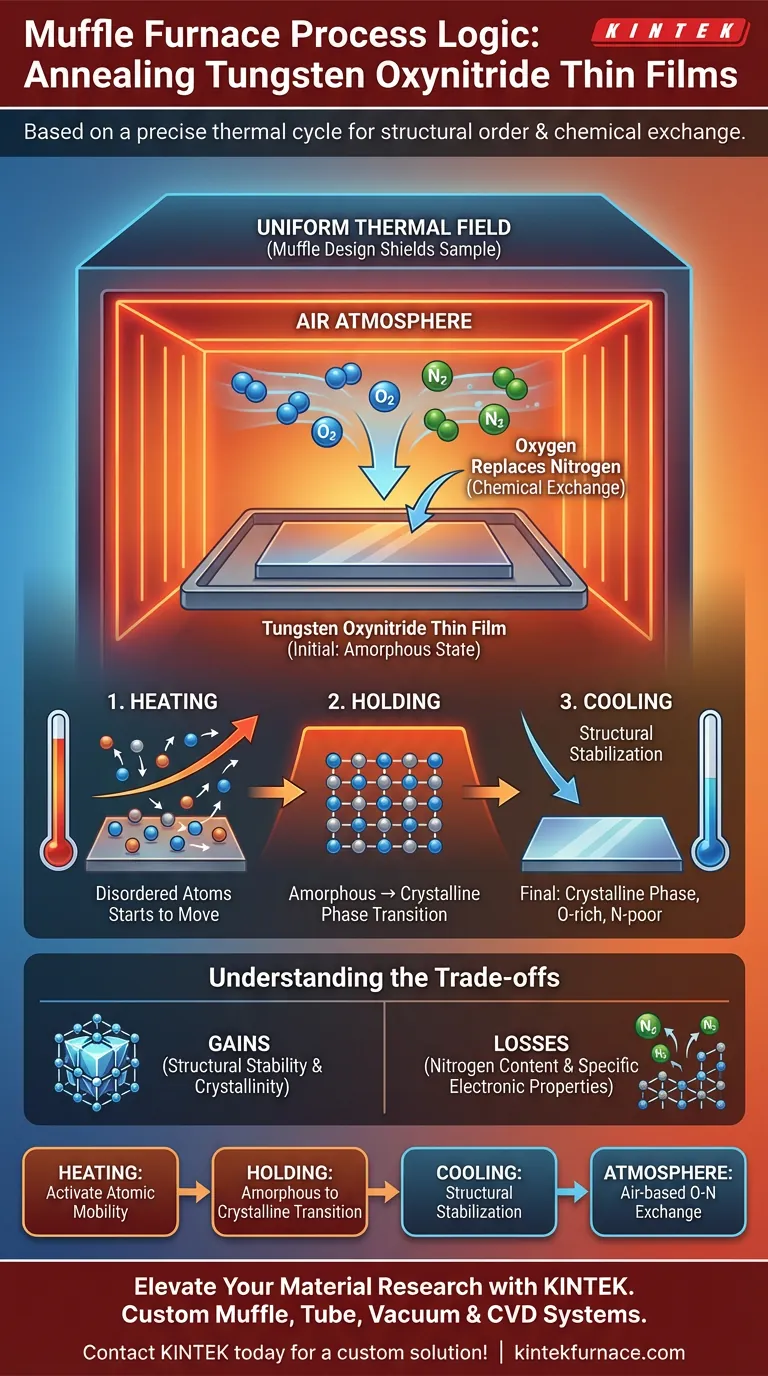
The process logic of a muffle furnace relies on a precisely programmed thermal cycle designed to impose structural order on a disordered material. Specifically, for tungsten oxynitride thin films, the furnace executes a sequence of heating, constant temperature holding, and controlled cooling to fundamentally alter the film's physical and chemical state.
Core Takeaway The muffle furnace functions as a transformation chamber that converts tungsten oxynitride films from an amorphous state to a crystalline phase using a uniform thermal field. Crucially, this process leverages an air environment to facilitate a chemical exchange where atmospheric oxygen replaces nitrogen atoms, directly impacting the film's electrochromic performance.
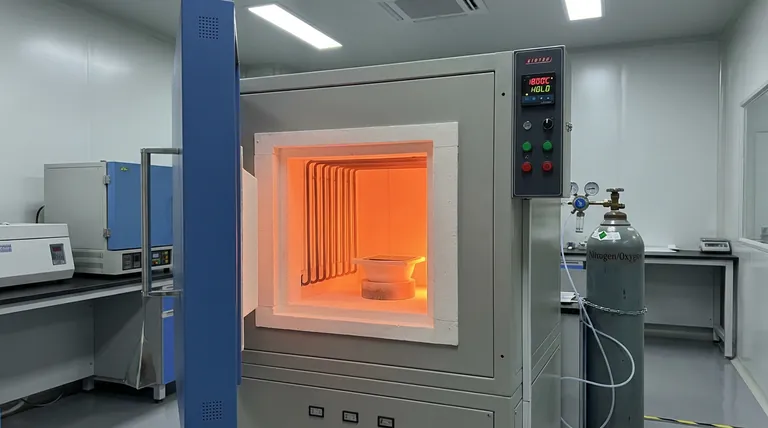
The Mechanics of the Thermal Cycle
Establishing the Thermal Field
The primary mechanism of the muffle furnace is the creation of a uniform thermal field. Unlike direct heating methods, the muffle design shields the sample from direct flame or heating elements, ensuring the thin film is exposed to even, radiant heat. This uniformity is critical for preventing stress fractures or uneven crystallization across the film surface.
The Three-Stage Sequence
The process logic follows a strict linear progression: heating, holding, and cooling. The "holding" phase is particularly vital, as it provides the necessary time for the thermal energy to permeate the material and activate the atomic rearrangement required for phase transition.
Structural and Chemical Transformation
From Amorphous to Crystalline
Initially, the tungsten oxynitride film exists in an amorphous state, where its atomic structure is disordered. The thermal energy provided by the furnace facilitates atomic mobility. This allows the atoms to rearrange themselves into a structured, repetitive lattice, transforming the material into a crystalline phase.
The Air Annealing Effect
Unlike vacuum or inert gas furnaces, a muffle furnace typically operates with an air atmosphere. During the annealing of tungsten oxynitride, this environment is not passive.
Oxygen-Nitrogen Exchange
The process logic relies on the chemical interaction between the film and the environment. As the temperature rises, oxygen from the air replaces nitrogen atoms within the film. This stoichiometric change is a deliberate part of the treatment to study how composition shifts affect thermal stability.
Understanding the Trade-offs
Composition vs. Crystallinity
The use of a muffle furnace involves a specific trade-off. While you gain high crystallinity and structural stability, you inevitably alter the chemical composition of the film.
Loss of Nitrogen Content
By annealing in air, you are actively reducing the nitrogen content of the tungsten oxynitride. If your goal is to maintain high nitrogen levels for specific electronic properties, a standard air-filled muffle furnace may be counterproductive compared to a vacuum or nitrogen-rich tube furnace.
Making the Right Choice for Your Goal
The "logic" of the muffle furnace is best applied when you need to stabilize the material structure while understanding the effects of oxidation.
- If your primary focus is Structural Stability: The muffle furnace is ideal for converting amorphous films into robust crystalline structures through uniform heating.
- If your primary focus is Electrochromic Research: Use this process to observe how the replacement of nitrogen with oxygen influences the color-changing capabilities of the device.
Ultimately, the muffle furnace acts as both a structural organizer and a chemical reactor, using heat and air to finalize the properties of your thin film.
Summary Table:
| Process Phase | Action | Transformation Goal |
|---|---|---|
| Heating | Uniform radiant heat application | Activation of atomic mobility |
| Holding | Constant temperature maintenance | Amorphous to crystalline phase transition |
| Cooling | Controlled temperature reduction | Structural stabilization of the lattice |
| Atmosphere | Air-based oxygen-nitrogen exchange | Chemical stoichiometric modification |
Elevate Your Material Research with KINTEK
Maximize the potential of your thin film applications with precision thermal technology. KINTEK provides industry-leading, customizable Muffle, Tube, Rotary, Vacuum, and CVD systems designed for the rigorous demands of modern laboratories. Whether you are performing air annealing for structural stability or require inert environments for nitrogen retention, our expert R&D and manufacturing teams deliver the high-temperature solutions you need.
Ready to refine your annealing process? Contact KINTEK today for a custom furnace solution!
Visual Guide
References
- Insaf F. Malikov, Л. Р. Тагиров. Anion Doping of Tungsten Oxide with Nitrogen: Reactive Magnetron Synthesis, Crystal Structure, Valence Composition, and Optical Properties. DOI: 10.3390/cryst14020109
This article is also based on technical information from Kintek Furnace Knowledge Base .
Related Products
- 1400℃ Muffle Oven Furnace for Laboratory
- 1700℃ High Temperature Muffle Oven Furnace for Laboratory
- 1800℃ High Temperature Muffle Oven Furnace for Laboratory
- 1200℃ Muffle Oven Furnace for Laboratory
- High Temperature Muffle Oven Furnace for Laboratory Debinding and Pre Sintering
People Also Ask
- How does a high-temperature laboratory muffle furnace affect material properties? Transform Anodic Oxide Films Fast
- What is the primary function of a high-temperature laboratory muffle furnace in chemical synthesis? Achieve Precision.
- What is the muffle furnace function in ilmenite oxidative roasting? Enhance Phase Change & Magnetic Separation
- How does a muffle furnace facilitate Ag/ATP catalyst preparation? Optimize Calcination for Superior Performance
- What is the role of a laboratory high-temperature muffle furnace in H13 steel treatment? Optimize Tool Performance



















