
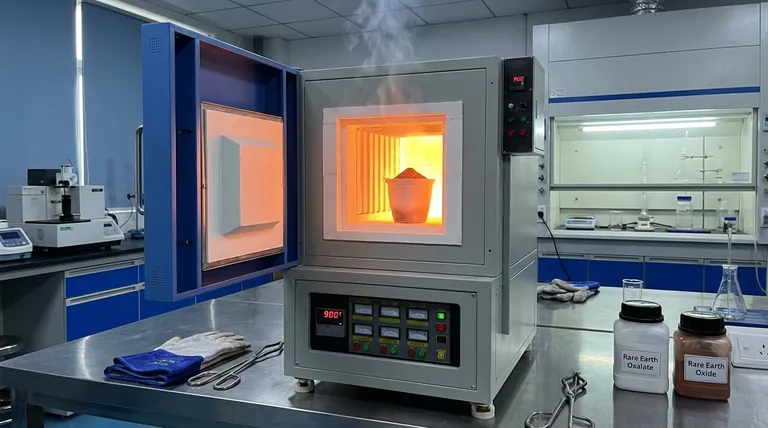
The primary purpose of employing a high-temperature muffle furnace in this context is to thermally decompose rare earth oxalate precipitates into chemically stable rare earth oxides (REOs). By maintaining a consistent 900°C environment, the furnace effectively drives off moisture and carbon dioxide to yield a high-purity final product.
The muffle furnace serves as a critical purification tool, utilizing precise thermal treatment to induce a phase transformation that converts unstable raw precipitates into the stable oxide forms required for advanced industrial applications.
The Mechanism of Transformation
The calcination process is not merely about drying; it is a fundamental chemical restructuring of the material.
Decomposition of Unstable Precipitates
Rare earth oxalates are chemical precipitates that are thermally unstable. The high heat of the furnace breaks down the oxalate bond structure, initiating the transition to a more durable form.
Removal of Volatile Impurities
As the temperature rises, the furnace drives the removal of specific volatile by-products. This specifically targets moisture and carbon dioxide entrapped within the precipitate structure.
Formation of Stable Oxides
The endpoint of this decomposition is the creation of mixed rare earth oxides (REOs). Unlike the precursor oxalates, these oxides are chemically stable, making them suitable for use as high-purity raw materials in downstream manufacturing.
The Role of the Muffle Furnace Environment
A muffle furnace is chosen over other heating methods because of its ability to control the thermal "field" surrounding the material.
Precise Temperature Maintenance
For rare earth oxalates, the process specifically requires a stable environment of 900°C. The muffle furnace isolates the chamber to maintain this specific heat profile, which is the activation energy threshold required for complete decomposition.
Ensuring Reaction Completion
The process typically follows a defined timeline, such as a two-hour calcination window. This duration allows sufficient time for the heat to penetrate the material fully, ensuring that the chemical reaction reaches completion throughout the entire batch.
Uniform Thermal Field
Muffle furnaces are designed to provide a uniform thermal field. This consistency prevents "cold spots" in the chamber, ensuring that every gram of the precipitate undergoes the same phase transformation.
Understanding the Trade-offs
While the muffle furnace is the standard tool for this process, operators must be aware of potential pitfalls to ensure quality.
The Risk of Incomplete Decomposition
If the temperature drops below the 900°C threshold or the duration is shortened, the decomposition may remain incomplete. This leaves residual carbon or moisture in the material, compromising the purity of the final rare earth product.
Thermal Gradients and Diffusion
Although muffle furnaces aim for uniformity, improper loading can impede heat diffusion. Without sufficient spacing or diffusion time, you risk creating a product with inconsistent crystallinity or phase purity, similar to issues seen in ceramic powder synthesis.
Making the Right Choice for Your Goal
To maximize the efficacy of your calcination process, align your operational parameters with your specific quality metrics.
- If your primary focus is Chemical Purity: Strictly adhere to the 900°C setpoint to ensure the total volatilization of carbon dioxide and moisture impurities.
- If your primary focus is Phase Stability: Ensure the full two-hour residence time is met to allow the complete phase transformation from oxalate to stable oxide.
- If your primary focus is Batch Consistency: Verify the uniformity of the furnace's thermal field to prevent heterogeneous reactions within the precipitate bed.
The muffle furnace ultimately acts as the critical bridge between raw chemical recovery and the production of industrial-grade rare earth materials.
Summary Table:
| Process Parameter | Requirement | Purpose in Calcination |
|---|---|---|
| Target Temperature | 900°C | Provides activation energy for oxalate decomposition |
| Retention Time | ~2 Hours | Ensures complete chemical reaction and phase transformation |
| Impurity Removal | Moisture & CO2 | Volatilizes unstable elements to produce high-purity oxides |
| Thermal Profile | Uniform Field | Prevents cold spots and ensures batch-wide consistency |
| Final Product | Rare Earth Oxides (REOs) | Creates chemically stable raw materials for industrial use |
Maximize Your Rare Earth Recovery with KINTEK
Ensure total chemical purity and phase stability in your calcination processes. Backed by expert R&D and manufacturing, KINTEK offers high-precision Muffle, Tube, Rotary, Vacuum, and CVD systems, all customizable to meet your unique laboratory and industrial needs.
Our advanced high-temperature furnaces provide the uniform thermal field required to transform unstable precipitates into high-purity rare earth oxides. Don't let thermal gradients compromise your product quality—contact our experts today to find your perfect furnace solution.
References
- Xinglan Li, Jiangfeng Guo. Recovery of rare earths and lithium from rare earth molten salt electrolytic slag by lime transformation, co-leaching and stepwise precipitation. DOI: 10.37190/ppmp/186333
This article is also based on technical information from Kintek Furnace Knowledge Base .
Related Products
- 1700℃ High Temperature Muffle Oven Furnace for Laboratory
- 1800℃ High Temperature Muffle Oven Furnace for Laboratory
- 1200℃ Muffle Oven Furnace for Laboratory
- High Temperature Muffle Oven Furnace for Laboratory Debinding and Pre Sintering
- 1400℃ Muffle Oven Furnace for Laboratory
People Also Ask
- What is the primary function of a high-temperature laboratory muffle furnace in chemical synthesis? Achieve Precision.
- How does a high-temperature laboratory muffle furnace affect material properties? Transform Anodic Oxide Films Fast
- What role does a muffle furnace play in BCZY712 electrolyte powder production? Achieve Perfect Phase Purity
- What is the role of a high-temperature muffle furnace in guava leaf carbonization? Master Precise Pyrolysis Control
- How does the two-stage sintering process contribute to the synthesis of MeCuFeO3 perovskite? Optimize crystal purity.



















