
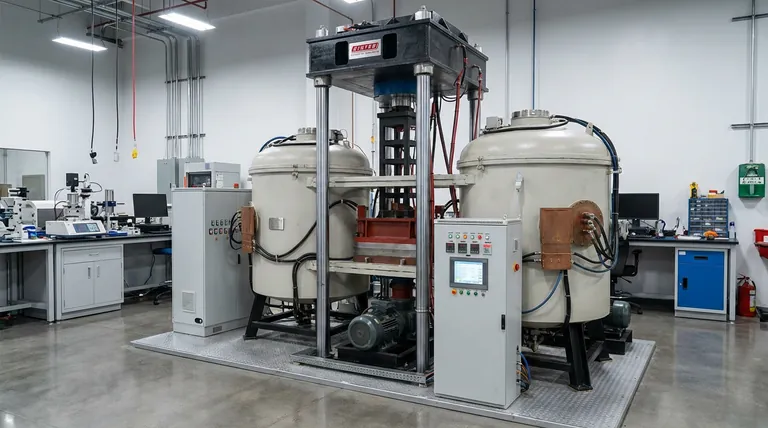
A high-performance sintering furnace serves as the definitive control mechanism for the final microstructure of Potassium-Sodium Niobate (KNN) piezoelectric ceramics. It influences the material by providing a precise energy gradient within the critical 1050°C to 1120°C range, driving particle fusion through diffusion while simultaneously preventing the destructive volatilization of alkali elements.
The core value of a high-performance furnace lies in its ability to reconcile two conflicting needs: applying enough heat to eliminate pores while maintaining enough precision to keep volatile elements like Potassium and Sodium locked within the crystal lattice.
The Mechanics of Densification
Driving Particle Fusion
To achieve a high-performance ceramic, the material must reach near-theoretical density. A high-performance furnace delivers the necessary energy gradient to trigger this process.
Diffusion Mechanisms
Within the specific temperature window of 1050°C to 1120°C, the furnace facilitates mass transport. This occurs primarily through grain boundary diffusion and surface diffusion, which are essential for merging individual particles into a solid mass.
Elimination of Pores
As diffusion accelerates, the internal pores between particles are filled. The furnace's ability to maintain high thermal energy drives this elimination of voids, resulting in a dense, robust ceramic body.
The Critical Role of Temperature Precision
Suppressing Alkali Volatilization
The greatest challenge in sintering KNN ceramics is the high volatility of alkali metal elements, specifically potassium and sodium. If the temperature fluctuates or exceeds specific limits uncontrolled, these elements evaporate.
Stabilizing the Grain Boundary
Superior temperature control precision strictly suppresses this intense volatilization. By preventing the loss of potassium and sodium, the furnace ensures the chemical composition remains stable at the grain boundaries.
Promoting Uniform Growth
When the chemical composition is stabilized, grains can grow uniformly. This prevents abnormal grain growth (where some grains become massive while others remain small), leading to a uniform microstructure that is essential for consistent piezoelectric properties.
Common Pitfalls and Trade-offs
The Risk of Temperature Overshoot
While high temperatures are needed for density, exceeding the optimal range (even slightly) in a lower-quality furnace leads to rapid volatilization. This results in compositional deviation and degrades the electrical properties of the ceramic.
The Cost of Inconsistency
If the furnace lacks thermal uniformity, different parts of the ceramic sample will sinter at different rates. This leads to warping, internal stresses, and varying grain sizes, rendering the final component unreliable for precision applications.
Making the Right Choice for Your Goal
When selecting sintering protocols or equipment for KNN ceramics, consider your specific performance targets:
- If your primary focus is Maximum Density: Prioritize a furnace capability that can sustain the upper end of the 1050°C–1120°C range without fluctuation to drive maximum pore elimination.
- If your primary focus is Compositional Stoichiometry: Focus on temperature control precision to minimize the loss of potassium and sodium, ensuring the chemical structure remains intact.
Mastering the sintering environment is not just about heating the material; it is about precisely engineering the atmosphere to protect the delicate balance of the KNN crystal structure.
Summary Table:
| Factor | Influence on KNN Microstructure | Importance |
|---|---|---|
| Temperature Range | 1050°C to 1120°C | Critical window for particle fusion |
| Energy Gradient | Drives grain boundary diffusion | Essential for maximum densification |
| Thermal Precision | Suppresses K and Na volatilization | Maintains chemical stoichiometry |
| Uniformity | Prevents abnormal grain growth | Ensures consistent piezoelectric properties |
Elevate Your Ceramic Research with KINTEK
Precise microstructure control in KNN-based ceramics requires a furnace that balances high-energy diffusion with extreme temperature stability. KINTEK provides industry-leading Muffle, Tube, and Vacuum systems specifically engineered to prevent alkali volatilization and ensure uniform grain growth.
Backed by expert R&D and manufacturing, our systems are fully customizable to meet your unique sintering protocols. Don't compromise on your material's electrical properties.
Contact us today to find your custom high-temp solution
Visual Guide

References
- Michaela Roudnická, Dalibor Vojtěch. Hydrogen Embrittlement of Ti-Al6-V4 Alloy Manufactured by Laser Powder Bed Fusion Induced by Electrochemical Charging. DOI: 10.3390/met14020251
This article is also based on technical information from Kintek Furnace Knowledge Base .
Related Products
- Chairside Dental Porcelain Zirconia Sintering Furnace with Transformer for Ceramic Restorations
- Dental Porcelain Zirconia Sintering Ceramic Vacuum Press Furnace
- High Temperature Muffle Oven Furnace for Laboratory Debinding and Pre Sintering
- Vacuum Dental Porcelain Sintering Furnace for Dental Laboratories
- 9MPa Air Pressure Vacuum Heat Treat and Sintering Furnace
People Also Ask
- What factors determine the quality of sintered zirconia restorations? Master Material, Equipment, and Technique
- How do conventional vs rapid sintering in dental furnaces affect zirconia? Optimize Efficiency Without Sacrificing Strength
- What industries use zirconia sintering furnaces? Beyond Dental and Jewelry Applications
- Why is a zirconia sintering furnace considered essential for dental laboratories and clinics? Unlock Precision and Durability
- What type of heating elements are preferred for zirconia sintering and why? Choose SiC or MoSi2 for Optimal Results



















