
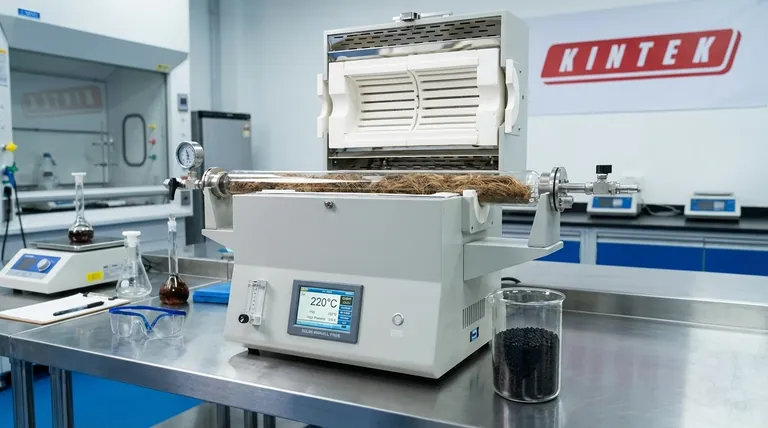
The high-pressure reactor serves as the critical vessel for hydrothermal carbonization, creating the specific environmental conditions necessary to transform raw biomass into hydrochar. By sealing the biomass within a controlled system, the reactor sustains high temperatures—typically around 220°C—and the resulting pressure required to drive chemical decomposition.
By subjecting biomass to high pressure and temperature, the reactor forces the material to shed oxygen and hydrogen, effectively converting complex plant structures into a carbon-dense intermediate known as hydrochar.
The Mechanics of Transformation
Establishing the Environment
The primary function of the high-pressure reactor is to maintain a stable environment that mimics natural coal formation, but at a vastly accelerated rate.
To achieve this, the reactor must sustain temperatures of approximately 220°C.
Because the vessel is sealed, these temperatures generate significant internal pressure, forcing the reactions to occur in a liquid-phase environment rather than through dry combustion.
Chemical Decomposition
Inside this high-pressure environment, the biomass undergoes specific chemical changes: dehydration and decarboxylation.
Dehydration removes water molecules from the chemical structure, while decarboxylation removes carboxyl groups (carbon and oxygen).
Together, these reactions systematically strip away non-carbon elements, significantly increasing the carbon density of the remaining solid.
Breaking Down the Biomass Structure
Lignocellulosic Degradation
Raw biomass, such as palm oil empty fruit bunches, is naturally rigid due to its lignocellulosic structure.
The high-pressure reactor acts as a digestion system that effectively breaks down this tough, fibrous framework.
This degradation is essential for converting the physical state of the material from raw plant matter into a friable, carbon-rich solid.
Creating a Foundation for Activation
The hydrochar produced in the reactor is not merely a fuel source; it serves as a crucial intermediate material.
The process establishes the necessary physical and chemical foundation required for subsequent processing.
By breaking down the original structure, the reactor prepares the carbon skeleton for future activation processes that enhance its surface area and porosity.
Understanding the Role’s Limits
The "Intermediate" Nature
It is critical to view the high-pressure reactor as part of a multi-stage workflow rather than a standalone solution.
While the reactor successfully produces carbon-rich hydrochar, this material is often intended as a precursor.
The reactor's job is to prepare the material for subsequent activation, meaning further chemical or physical processing is often required to reach the final product's desired specifications.
Making the Right Choice for Your Goal
To maximize the utility of a high-pressure reactor in your biomass processing line, consider your end-game:
- If your primary focus is material preparation: Use the reactor to ensure the complete breakdown of the lignocellulosic structure, creating a uniform feedstock for activation.
- If your primary focus is process control: Monitor the reactor to strictly maintain the 220°C threshold, as this temperature is the driver for the essential dehydration and decarboxylation reactions.
The high-pressure reactor is the gateway technology that turns low-value agricultural residue into high-value carbon precursors.
Summary Table:
| Process Feature | Detail | Impact on Hydrochar Production |
|---|---|---|
| Core Temperature | Approximately 220°C | Drives thermal decomposition without dry combustion |
| Pressure State | High-pressure, liquid-phase | Facilitates dehydration and decarboxylation reactions |
| Structural Change | Lignocellulosic Degradation | Breaks down rigid plant fibers into friable solids |
| Chemical Outcome | Increased Carbon Density | Removes oxygen and hydrogen to create carbon-rich precursors |
| Primary Function | Environment Stabilization | Mimics natural coal formation at an accelerated rate |
Elevate Your Biomass Transformation with KINTEK
Transitioning from raw agricultural waste like palm oil empty fruit bunches to high-value carbon precursors requires precision and reliability. Backed by expert R&D and world-class manufacturing, KINTEK provides advanced high-pressure reactors and high-temperature furnace systems—including Muffle, Tube, and Vacuum options—tailored for hydrothermal carbonization and subsequent activation.
Whether you need customizable lab-scale systems or industrial-grade solutions, KINTEK's equipment ensures the stable temperature and pressure controls essential for superior hydrochar quality. Contact us today to find the perfect reactor for your unique research and production needs!
Visual Guide

References
- Ria Yolanda Arundina, Bambang Subiyanto. Preparation of nitrogen-doped activated carbon from palm oil empty fruit bunches for electrodes in electric double-layer capacitance-type supercapacitors: effect of pyrolysis temperature. DOI: 10.1093/ce/zkae100
This article is also based on technical information from Kintek Furnace Knowledge Base .
Related Products
- High Pressure Laboratory Vacuum Tube Furnace
- 9MPa Air Pressure Vacuum Heat Treat and Sintering Furnace
- Custom Made Versatile CVD Tube Furnace Chemical Vapor Deposition CVD Equipment Machine
- MPCVD Machine System Reactor Bell-jar Resonator for Lab and Diamond Growth
- Vacuum Hot Press Furnace Machine Heated Vacuum Press
People Also Ask
- What role does a high vacuum tube furnace play in Co-Al sintering? Master High-Purity Porous Material Synthesis
- What are the different types of tube furnaces available? Find the Perfect Fit for Your Lab's Needs
- What are the main advantages of vacuum tube furnaces in the market? Achieve Purity and Precision in Material Processing
- What is the role of a vacuum tube furnace during the final thermal treatment stage of Fe3O4@CSAC catalysts?
- What conditions do tube furnaces provide for Au-Seeded TiO2 nanowires? Master Precision Thermal Synthesis



















