
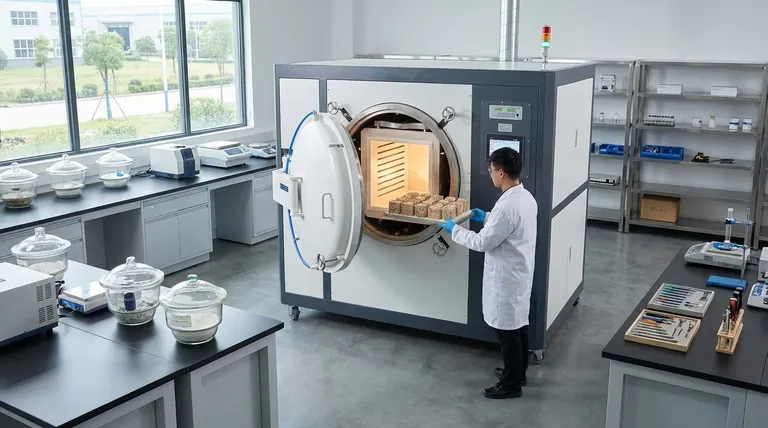
Vacuum drying acts as the critical stabilization step that bridges the gap between chemical cleaning and high-temperature carbonization. It functions by effectively removing residual solvents, such as water or acetone, from the deep interior of porous precursors without subjecting them to damaging heat or atmospheric stress. By operating under reduced pressure, the oven enables evaporation at low temperatures, directly preventing physical deformations and ensuring the crosslinked structure remains intact.
The Core Mechanism The vacuum environment fundamentally changes the physics of drying by lowering solvent boiling points and eliminating oxygen. This prevents capillary forces from tearing apart delicate porous structures (micro-cracking) and stops oxidative degradation, ensuring the precursor is structurally sound before carbonization.
Preserving Physical Integrity
Mitigating Capillary Forces and Surface Tension
When drying porous materials at atmospheric pressure, the evaporation of solvents can create significant surface tension. This force pulls on the pore walls, often leading to structural collapse.
A vacuum drying oven creates a low-pressure environment that minimizes these surface tension issues. This prevents the formation of micro-cracks and deformations in the fine structures of the precursor, protecting the integrity of the crosslinking achieved during sulfonation.
Eliminating Thermal Deformation
High temperatures are typically required to drive off solvents quickly, but heat can warp crosslinked polymers.
By lowering the pressure, the vacuum oven allows solvents like water and acetone to boil off at significantly lower temperatures (e.g., 60°C - 80°C). This "gentle" drying ensures the precursor retains its dimensional accuracy and does not suffer from heat-induced warping or shrinkage.
Ensuring Chemical Stability
Preventing Oxidative Reactions
Crosslinked precursors, particularly those based on lignin or specific polymers, are susceptible to oxidation when heated in air.
The vacuum environment removes air and oxygen from the chamber. This creates an inert atmosphere that prevents oxidative degradation reactions, ensuring the chemical composition of the precursor remains pure and unaltered for the next stage of processing.
Deep Solvent Removal
Residual solvents trapped deep within the pores of a precursor can be disastrous during later processing stages.
The vacuum mechanism creates a pressure differential that draws solvents out from the interior of porous precursors, not just the surface. This deep dehydration is essential to ensure the material is chemically "clean" and physically "loose" rather than clumped or saturated.
Preventing Failure During Carbonization
Avoiding Structural Collapse
If a precursor contains residual moisture when it enters the high-temperature carbonization furnace, the water will flash into steam.
The rapid expansion of steam inside the material can cause the structure to explode or collapse. By ensuring deep dehydration beforehand, vacuum drying safeguards the precursor against this sudden evaporation damage.
Maintaining Active Sites
For materials where specific surface area is critical, proper drying is non-negotiable.
By preventing agglomeration (clumping) and collapse, the vacuum process preserves the high specific surface area and active sites of the material. This ensures the crosslinked precursor is in the ideal physical state to be converted into a high-quality carbon material.
Understanding the Trade-offs
Batch Processing vs. Continuous Flow
While vacuum drying offers superior quality control, it is inherently a batch process. Unlike conveyor-belt atmospheric ovens, vacuum ovens require sealing and depressurizing cycles, which can introduce bottlenecks in high-throughput manufacturing lines.
Complexity of Parameter Control
Achieving the perfect dry state requires balancing vacuum levels and temperature. If the pressure drops too suddenly, solvents may "bump" (boil explosively), potentially damaging the very structure you are trying to protect. Careful modulation of the vacuum ramp rate is required.
Making the Right Choice for Your Goal
To maximize the quality of your crosslinked precursors, align your drying strategy with your specific material constraints:
- If your primary focus is Structural Integrity: Prioritize vacuum drying to eliminate surface tension forces, specifically to prevent micro-cracks in highly porous or fine-structured materials.
- If your primary focus is Chemical Purity: Utilize the vacuum environment to lower drying temperatures, ensuring that oxidation-sensitive components (like lignin or specific polymers) do not degrade before carbonization.
Ultimately, vacuum drying is not just a cleaning step; it is a preservation technique that ensures your precursor survives the transition from wet chemistry to solid-state carbonization.
Summary Table:
| Feature | Impact on Precursor Quality | Benefit in Post-Sulfonation Cleaning |
|---|---|---|
| Low-Temp Evaporation | Minimizes thermal stress | Prevents warping and heat-induced shrinkage |
| Oxygen Removal | Eliminates oxidative degradation | Maintains chemical purity of polymer/lignin |
| Pressure Differential | Extracts deep-seated solvents | Ensures internal dehydration and prevents clumping |
| Reduced Surface Tension | Eliminates capillary forces | Prevents micro-cracks and pore structural collapse |
| Safe Outgassing | Prevents steam-flash damage | Prepares material for safe, high-heat carbonization |
Elevate Your Materials Research with KINTEK
Maximize the potential of your crosslinked precursors with precision vacuum technology. Backed by expert R&D and manufacturing, KINTEK offers high-performance Muffle, Tube, Rotary, Vacuum, and CVD systems—all customizable to meet your unique laboratory needs. Whether you are scaling up post-sulfonation cleaning or refining delicate carbonization stages, our specialized lab high-temp furnaces ensure structural integrity and chemical purity every time.
Ready to optimize your drying process? Contact KINTEK today to find the perfect thermal solution for your application.
References
- Paul N. Smith, Zhe Qiang. Accurate additive manufacturing of lightweight and elastic carbons using plastic precursors. DOI: 10.1038/s41467-024-45211-4
This article is also based on technical information from Kintek Furnace Knowledge Base .
Related Products
- Vacuum Heat Treat Sintering and Brazing Furnace
- Vacuum Heat Treat Sintering Furnace Molybdenum Wire Vacuum Sintering Furnace
- Dental Porcelain Zirconia Sintering Ceramic Vacuum Press Furnace
- Molybdenum Vacuum Heat Treat Furnace
- Vacuum Hot Press Furnace Machine Heated Vacuum Press
People Also Ask
- What are the benefits of using vacuum heat treating furnaces for metal alloys? Achieve Superior Metal Properties and Performance
- How does vacuum heat treating affect the grain structure of metal alloys? Achieve Precise Microstructure Control
- What is one of the most important uses of vacuum heat treating furnaces in aerospace? Achieve Superior Strength in Aircraft Alloys
- What is the temperature of a vacuum furnace brazing? Optimize Your Joint Strength and Cleanliness
- What are the steps involved in a typical vacuum brazing treatment? Master the Process for Strong, Clean Joints












