
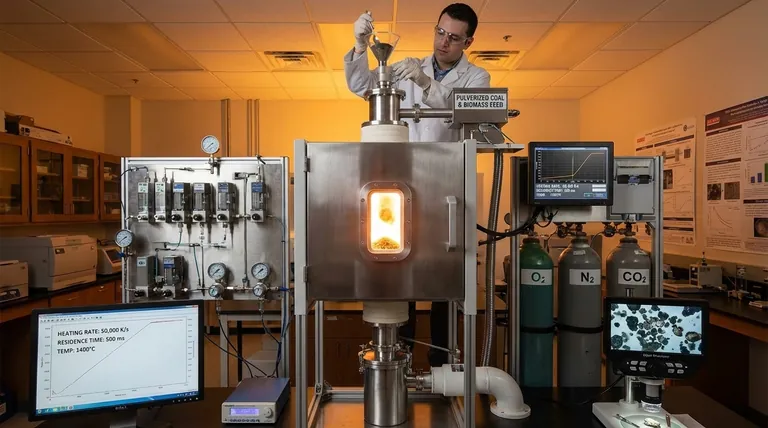
A Drop Tube Furnace (DTF) functions as a high-fidelity simulator for the extreme environments found within industrial power plants. Its primary role in experimental research is to replicate the rapid heating rates—specifically between 10,000 and 100,000 K/s—that pulverized coal particles experience in actual boilers. By offering precise regulation over temperature, gas flow, and fuel feeding, the DTF allows researchers to isolate and analyze critical combustion phases, from volatile release to char oxidation, under conditions that standard laboratory equipment cannot achieve.
The core value of a Drop Tube Furnace lies in its ability to bridge the gap between basic laboratory analysis and full-scale industrial operation. While standard tests measure fuel properties statically, the DTF reveals how fuel behaves dynamically under the intense thermal shock and short residence times of a working boiler.
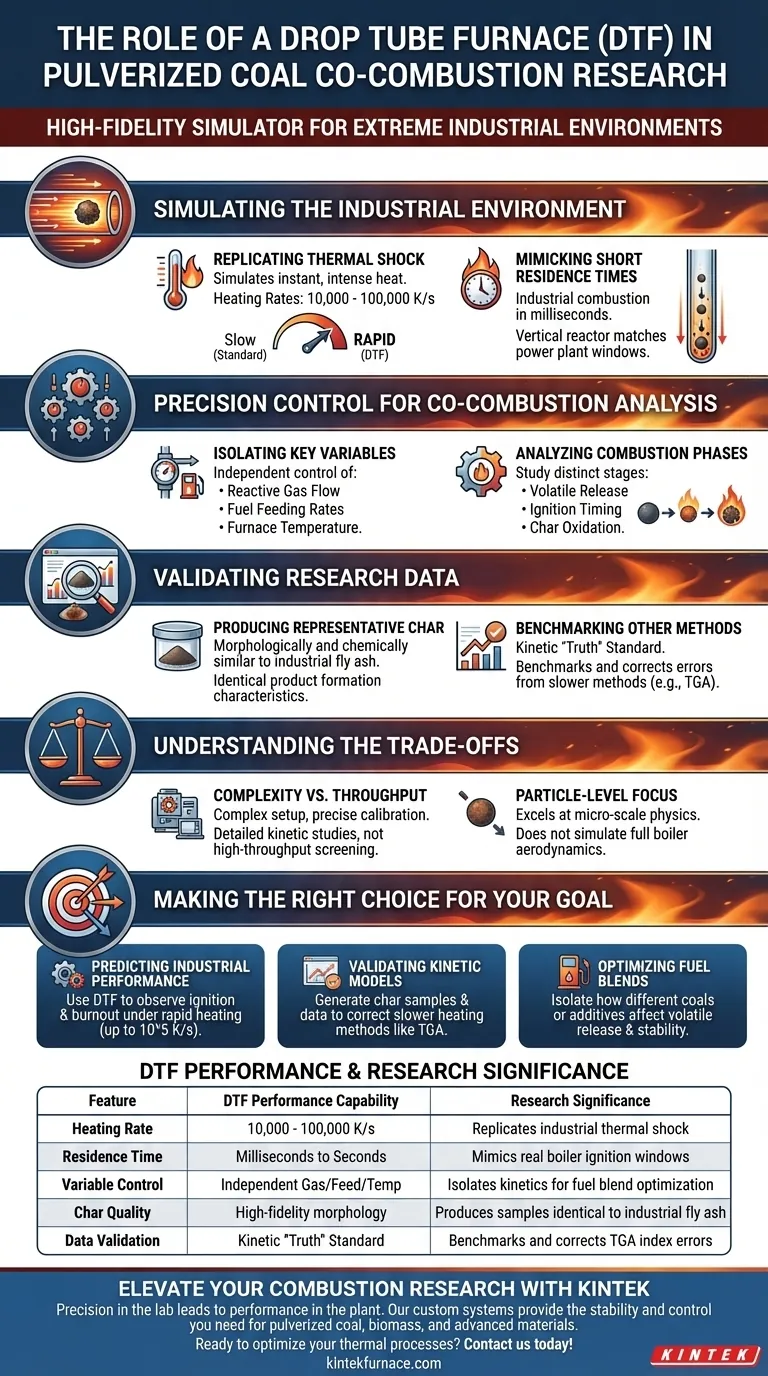
Simulating the Industrial Environment
Replicating Thermal Shock
The most critical capability of a DTF is the simulation of high heating rates. In a real industrial boiler, fuel particles are not heated gradually; they are subjected to instant, intense heat.
Standard thermal analysis often heats fuel slowly, which can lead to inaccurate predictions of industrial performance. The DTF corrects this by achieving heating rates of 10^4 to 10^5 K/s.
Mimicking Short Residence Times
Industrial combustion happens in milliseconds. The DTF uses a vertical reactor design to match these short residence times.
This ensures that the devolatilization and ignition processes observed in the lab occur within the same time window as they would in a power plant, preserving the kinetic accuracy of the data.
Precision Control for Co-Combustion Analysis
Isolating Key Variables
To understand how different fuels interact during co-combustion, researchers need to isolate specific parameters.
The DTF provides independent control over reactive gas flow, fuel feeding rates, and furnace temperature. This allows for the creation of controlled, isothermal conditions to test specific hypotheses without the noise of uncontrolled variables.
Analyzing Combustion Phases
The device is specifically designed to observe the distinct stages of combustion.
Researchers use the DTF to study volatile release, ignition timing, and char oxidation behaviors. This breakdown is essential for optimizing fuel blends for co-combustion.
Validating Research Data
Producing Representative Char
Because the DTF mimics the rapid heating of a boiler, the solid residue (char) it produces is morphologically and chemically similar to industrial fly ash.
This makes the DTF a critical tool for generating samples that are truly representative of the product formation characteristics found in large-scale operations.
Benchmarking Other Methods
Data derived from a DTF acts as a "truth" standard for other experimental methods.
It serves as a critical benchmark for validating thermogravimetric indices. If a simpler thermal test conflicts with DTF data, the DTF data is generally considered more predictive of real-world behavior due to the realistic devolatilization phase.
Understanding the Trade-offs
Complexity vs. Throughput
While a DTF offers superior data quality regarding industrial simulation, it is a complex experimental setup compared to standard thermal analysis.
It requires precise calibration of flow and feed rates to maintain stability. It is intended for detailed kinetic studies rather than rapid, high-throughput screening of raw materials.
Particle-Level Focus
The DTF excels at studying the physics of individual particles or small clusters.
It does not simulate the complex aerodynamic mixing or bulk macro-dynamics of a full boiler combustion chamber. It is a tool for understanding fuel chemistry and micro-scale physics, not full-scale furnace aerodynamics.
Making the Right Choice for Your Goal
- If your primary focus is predicting industrial performance: Use the DTF to observe ignition and burnout, as it accurately simulates the rapid heating rates (up to 10^5 K/s) that dictate real-world efficiency.
- If your primary focus is validating kinetic models: Use the DTF to generate char samples and combustion data to benchmark and correct results obtained from slower heating methods like thermogravimetric analysis (TGA).
- If your primary focus is optimizing fuel blends: Use the DTF's precise feed and flow controls to isolate how different coal types or biomass additives affect volatile release and stability.
The Drop Tube Furnace is the definitive tool for researchers who need to understand not just what a fuel is, but exactly how it performs under the thermal stress of industrial combustion.
Summary Table:
| Feature | DTF Performance Capability | Research Significance |
|---|---|---|
| Heating Rate | 10,000 - 100,000 K/s | Replicates industrial thermal shock |
| Residence Time | Milliseconds to Seconds | Mimics real boiler ignition windows |
| Variable Control | Independent Gas/Feed/Temp | Isolates kinetics for fuel blend optimization |
| Char Quality | High-fidelity morphology | Produces samples identical to industrial fly ash |
| Data Validation | Kinetic "Truth" Standard | Benchmarks and corrects TGA index errors |
Elevate Your Combustion Research with KINTEK
Precision in the lab leads to performance in the plant. At KINTEK, we understand that accurate experimental data requires equipment capable of simulating real-world extremes. Backed by expert R&D and manufacturing, we offer a comprehensive suite of Muffle, Tube, Rotary, Vacuum, and CVD systems, alongside specialized high-temp furnaces—all fully customizable to meet your unique research requirements.
Whether you are studying pulverized coal, biomass co-combustion, or advanced material synthesis, our systems provide the stability and control you need to succeed.
Ready to optimize your thermal processes? Contact us today to discuss your custom furnace needs!
Visual Guide
Related Products
- Vacuum Sealed Continuous Working Rotary Tube Furnace Rotating Tube Furnace
- Slide PECVD Tube Furnace with Liquid Gasifier PECVD Machine
- Custom Made Versatile CVD Tube Furnace Chemical Vapor Deposition CVD Equipment Machine
- 1200℃ Split Tube Furnace Laboratory Quartz Tube Furnace with Quartz Tube
- Laboratory Vacuum Tilt Rotary Tube Furnace Rotating Tube Furnace
People Also Ask
- What is the purpose of rotary tube furnaces? Achieve Uniform Heat Treatment for Powders and Granules
- What are the key advantages of using a rotary tube furnace? Achieve Dynamic, Uniform Heating for Powders
- How does the amount of material processed vary between batch and continuous rotary tube furnaces? Scale Your Production Efficiently
- What are the advantages of rotary tube furnaces in fuel compatibility? Boost Efficiency and Cut Costs
- What is the temperature range of some rotary tube furnaces? Achieve Uniform Heating Up to 1200°C



















