
A controlled curing environment is the fundamental regulator of the chemical and physical changes occurring during the early hardening of refractory castables. By rigorously maintaining constant temperature and humidity levels, specifically around 20±1 °C, you dictate the pace of hydration to ensure the material develops a stable, defect-free structural framework.
Core Insight While external environmental control regulates the overall reaction rate of aluminate cement, it specifically enables the efficacy of "internal curing" agents. A stable environment allows additives like pre-wetted Cenospheres to release moisture slowly, counteracting the natural tendency of the material to self-desiccate and crack.
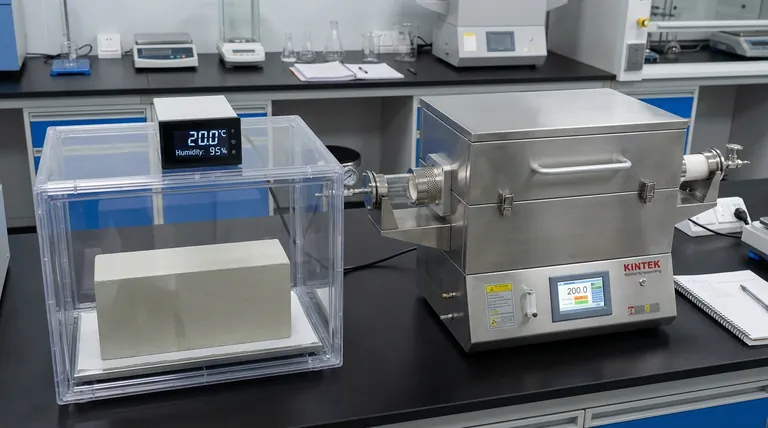
Regulating the Hydration Framework
Controlling Aluminate Cement Reactions
The primary function of a controlled environment is to regulate the early hydration rate of aluminate cement.
If the temperature fluctuates or deviates significantly from the 20±1 °C standard, the chemical reaction can become erratic.
By keeping these variables constant, you ensure the formation of a stable hydration product framework, which serves as the skeleton for the hardened material.
Preparation for High Temperatures
The integrity of the material during high-temperature sintering is determined during this early phase.
A controlled curing stage prevents the formation of weak points that would otherwise compromise the material when exposed to extreme heat later.
It effectively "sets the stage" for the material's ultimate thermal performance.
The Mechanics of Internal Curing
The Role of Pre-wetted Cenospheres
In this specific context, the curing environment facilitates the function of additives like pre-wetted Cenospheres.
These components act as internal water reservoirs within the castable mix.
They are designed to hold moisture initially and release it only when necessary during the hardening process.
Mitigating Self-Desiccation
As aluminate cement hydrates, it consumes water, leading to a phenomenon known as self-desiccation.
This internal drying creates stress and shrinkage, which are the primary causes of early-stage structural failure.
The controlled environment allows the Cenospheres to release their internal moisture slowly, providing an internal curing effect that replenishes water exactly where it is being consumed.
Understanding the Risks of Uncontrolled Curing
The Danger of Micro-Cracks
Without the synergy of a controlled external environment and internal curing agents, the material is highly susceptible to micro-cracks.
These microscopic defects may not be immediately visible but significantly weaken the refractory structure.
They act as stress concentrators that can propagate into major fractures under thermal load.
The Sensitivity of Hydration
It is critical to understand that aluminate cement hydration is highly sensitive.
Deviations in the curing environment do not just slow down the process; they can fundamentally alter the resulting crystal structure.
Reliance on internal curing agents (like Cenospheres) is only effective if the external boundary conditions (temperature and humidity) remain stable.
Ensuring Quality in Refractory Production
To maximize the performance of your refractory castables, you must view curing as a precision process rather than a passive waiting period.
- If your primary focus is Structural Integrity: Strictly maintain the curing temperature at 20±1 °C to guarantee a uniform hydration framework.
- If your primary focus is Defect Prevention: Utilize pre-wetted porous aggregates (like Cenospheres) to provide internal curing and eliminate shrinkage cracks.
Mastering the curing environment is the single most effective way to bridge the gap between a raw mix and a high-performance sintered refractory.
Summary Table:
| Factor | Influence on Refractory Castables | Benefit |
|---|---|---|
| Temperature (20±1 °C) | Regulates aluminate cement hydration rate | Stable hydration skeleton |
| Humidity Control | Prevents rapid surface evaporation | Elimination of micro-cracks |
| Internal Curing | Cenospheres release moisture as needed | Counteracts self-desiccation |
| Framework Stability | Prepares sample for high-temp sintering | Enhanced thermal performance |
Elevate Your Refractory Research with KINTEK
Precise thermal processing starts with the right equipment. KINTEK provides industry-leading Muffle, Tube, Vacuum, and CVD systems, specifically engineered to help labs achieve the rigorous temperature control required for high-performance refractory production. Whether you need a standard solution or a customizable high-temp furnace for unique R&D needs, our expert manufacturing ensures your materials reach their ultimate potential.
Ready to optimize your material testing? Contact our experts today to find the perfect furnace for your laboratory.
References
- Effect of Prewetting Cenospheres on Hydration Kinetics, Microstructure, and Mechanical Properties of Refractory Castables. DOI: 10.3390/cryst15010068
This article is also based on technical information from Kintek Furnace Knowledge Base .
Related Products
- High Temperature Muffle Oven Furnace for Laboratory Debinding and Pre Sintering
- 1200℃ Controlled Inert Nitrogen Atmosphere Furnace
- 1700℃ High Temperature Muffle Oven Furnace for Laboratory
- Multi Heating Zones CVD Tube Furnace Machine for Chemical Vapor Deposition Equipment
- 1700℃ Controlled Inert Nitrogen Atmosphere Furnace
People Also Ask
- What thermal phenomena occur during polymer binder burnout in ceramic green bodies? Lab Furnace Guide
- Why is controlled heat treatment in a muffle furnace necessary for calcined clay? Achieve Optimal Pozzolanic Activity
- What role does a high-temperature muffle furnace play in STFO synthesis? Achieve Pure Perovskite Results
- How does a high-temperature muffle furnace facilitate the formation of LaNbxAl1−xO3+δ perovskite structures? Key Roles
- What role does a high-temperature muffle furnace play in the formation of biochar catalysts? Master Catalyst Synthesis



















