
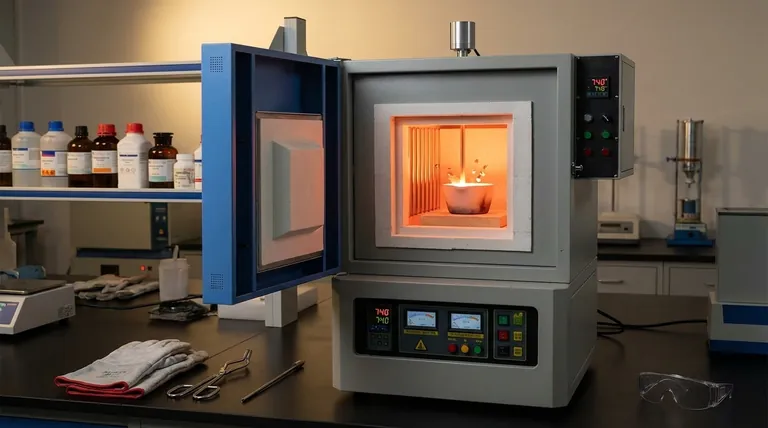
In the preparation of Al-6.8Zn-2Mg-2Cu-0.1Zr-0.2Sc alloys, the high-temperature melting furnace serves as the central vessel for thermodynamic stabilization and chemical homogenization.
Its primary function is to maintain a precise, stable environment at 740 ℃. This specific thermal threshold ensures the base aluminum is completely molten while facilitating the full dissolution of high-melting-point elements like Copper (Cu) and critical master alloys containing Zirconium (Zr) and Scandium (Sc).
The furnace acts as a solvent chamber, not just a heater. Its ability to maintain thermal stability allows for the complete integration of refractory elements, which is the defining factor in eliminating compositional segregation and producing high-quality ingots.
The Mechanics of Alloy Homogenization
Precise Temperature Regulation
The furnace must sustain a temperature of exactly 740 ℃ throughout the melting phase.
At this temperature, the furnace ensures the aluminum base transitions fully into a liquid state. This thermal floor is critical for creating a medium capable of accepting heavier alloying elements.
Dissolving Refractory Elements
The specific composition of this alloy includes Copper (Cu) and master alloys like Al-5% Zr and Al-2% Sc.
These materials have higher melting points or dissolution energies than the base metal. The furnace’s high-temperature environment provides the energy required to break down these solids and integrate them into the liquid matrix.
Facilitating Mechanical Mixing
Heat alone is often insufficient for complex alloys.
The furnace design accommodates mechanical or manual stirring processes. This physical agitation, combined with the 740 ℃ heat, accelerates the dissolution kinetics of the master alloys.
Why Thermal Stability Matters
Eliminating Compositional Segregation
Without a stable high-temperature environment, heavier elements tend to separate from the lighter aluminum base.
The furnace prevents this "compositional segregation" by maintaining the solution's fluidity. This ensures that every section of the melt contains the correct ratio of Zinc, Magnesium, Copper, Zirconium, and Scandium.
Establishing Ingot Quality
The ultimate output of this furnace process is the cast ingot.
By ensuring uniform chemical distribution in the liquid phase, the furnace establishes the foundation for a defect-free solid ingot. A consistent melt leads to consistent mechanical properties in the final material.
Critical Considerations and Risks
The Necessity of Agitation
It is a common pitfall to assume that reaching 740 ℃ is sufficient for homogenization.
The primary reference highlights that stirring is essential. Relying solely on thermal convection without manual or mechanical intervention may leave undissolved master alloys, resulting in a chemically uneven product.
Temperature Stability vs. Fluctuation
The process relies on a stable 740 ℃ environment.
Significant fluctuations below this temperature can prevent the full dissolution of Zirconium and Scandium master alloys. If these elements do not dissolve completely, they form inclusions rather than strengthening the alloy matrix.
Making the Right Choice for Your Goal
To maximize the quality of your Al-6.8Zn-2Mg-2Cu-0.1Zr-0.2Sc preparation, consider these specific focus areas:
- If your primary focus is Chemical Uniformity: Prioritize a furnace with advanced temperature regulation to hold exactly 740 ℃ without fluctuation.
- If your primary focus is Process Efficiency: Implement a robust mechanical stirring schedule during the peak heating phase to accelerate the dissolution of Cu, Zr, and Sc.
Success in preparing this alloy depends on treating the furnace as a precision instrument for chemical mixing, rather than a simple heating tool.
Summary Table:
| Feature | Function in Alloy Preparation | Impact on Quality |
|---|---|---|
| 740 ℃ Thermal Stability | Maintains molten base & dissolves refractory elements | Prevents compositional segregation |
| Energy Delivery | Breaks down Al-Zr and Al-Sc master alloys | Ensures full integration of strengthening elements |
| Agitation Support | Facilitates mechanical or manual stirring | Accelerates dissolution kinetics & uniformity |
| Atmosphere Control | Minimizes inclusion formation during melting | Produces high-purity, defect-free cast ingots |
Elevate Your Alloy Research with KINTEK
Precise temperature control is the difference between a failed melt and a high-performance alloy. At KINTEK, we understand the rigorous demands of preparing complex materials like Al-Zn-Mg-Cu-Zr-Sc.
Backed by expert R&D and manufacturing, KINTEK offers a comprehensive range of Muffle, Tube, Rotary, Vacuum, and CVD systems. Our lab high-temperature furnaces are fully customizable to provide the 740 ℃ thermal stability and agitation capabilities your unique research requires.
Ready to eliminate compositional segregation in your samples? Contact KINTEK today to discuss your custom furnace needs
References
- Influence of Aging Temperature on the Electrochemical Corrosion Behavior of an Age-Hardening 7xxx Aluminum Alloy. DOI: 10.3390/cryst15020107
This article is also based on technical information from Kintek Furnace Knowledge Base .
Related Products
- 1400℃ High Temperature Laboratory Tube Furnace with Alumina Tube
- 1700℃ High Temperature Laboratory Tube Furnace with Alumina Tube
- Molybdenum Vacuum Heat Treat Furnace
- Vacuum Induction Melting Furnace
- High Temperature Muffle Oven Furnace for Laboratory Debinding and Pre Sintering
People Also Ask
- How does zone-melting in tube furnaces synthesize bismuth micro-wires? Master Single-Crystal Thermoelectric Growth
- How do high-temperature laboratory tube furnaces ensure environmental stability? Precision Thermal Reduction Tips
- How are high-temperature laboratory tube furnaces applied in long-term vacuum homogenization heat treatments for intermetallic samples?
- How are high-temp tube furnaces used to measure diffusion coefficients per Fick's law? Master Precision Annealing
- How are high-temperature tube furnaces applied in testing ceramic-supported alloy membranes? Insights



















