
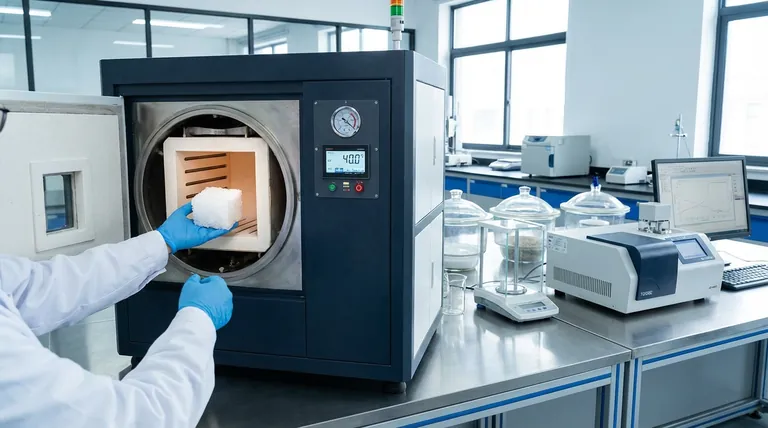
To accurately analyze magnesium silicate hydrate (M-S-H), a vacuum drying oven is strictly necessary because it halts the hydration reaction immediately without damaging the material's delicate chemical structure. By utilizing a low-pressure environment at a moderate 40 °C, the oven removes free water rapidly while leaving the critical chemically bound water intact.
Core Takeaway
The vacuum drying oven allows researchers to "freeze" the state of M-S-H test blocks by lowering the boiling point of solvents. This prevents the thermal decomposition of the M-S-H gel, ensuring that subsequent analyses like Thermogravimetric Analysis (TG/DSC) and NMR characterize the actual mineral components rather than heat-damaged artifacts.
The Critical Need for Preservation
Stopping the Reaction
To analyze hydration degree, you must effectively stop the clock on the chemical reaction. The vacuum drying oven quickly halts the hydration reaction of the cured M-S-H test blocks.
Preserving Chemically Bound Water
The primary challenge in M-S-H analysis is distinguishing between free water and water that is part of the crystal structure. High-temperature heating drives off both, destroying the sample's utility.
Maintaining Gel Structure
Vacuum drying at 40 °C is gentle enough to prevent the loss of chemically bound water within the M-S-H gel. This preservation is non-negotiable for obtaining accurate data on the mineral's actual state.
The Physics of Vacuum Efficiency
Lowering the Boiling Point
By reducing the pressure within the chamber, the vacuum oven lowers the boiling point of the water in the sample. This allows for rapid dehydration at significantly lower temperatures than atmospheric ovens require.
Preventing Thermal Decomposition
Because the water evaporates easily at low heat, the sample is spared from high thermal stress. This capability is essential for handling heat-sensitive chemical substances like M-S-H, preventing decomposition or oxidation that occurs at higher temperatures.
Understanding the Risks of Improper Drying
The Risk of Surface Hardening
In standard atmospheric drying, the exterior of a sample often dries faster than the interior, forming a crust. This surface hardening traps internal moisture, leading to inaccurate measurements of the total water content.
The Impact on Advanced Analysis
If the sample is improperly dried, the data derived from Thermogravimetric Analysis (TG/DSC) and Nuclear Magnetic Resonance (NMR) will be flawed. These sensitive methods require a sample where the mineral components are preserved in their "as-cured" state, not altered by heat or trapped moisture.
Making the Right Choice for Your Goal
To ensure the integrity of your M-S-H research, apply the drying method that aligns with your specific analytical requirements.
- If your primary focus is Structural Integrity: Use vacuum drying to ensure chemically bound water remains within the M-S-H gel for accurate NMR characterization.
- If your primary focus is Process Efficiency: Leverage the vacuum environment to lower solvent boiling points, achieving rapid drying without the risks of high-temperature decomposition.
By controlling pressure rather than just temperature, you ensure your data reflects the chemistry of the material, not the artifacts of the drying process.
Summary Table:
| Feature | Vacuum Drying (40 °C) | Standard Atmospheric Drying |
|---|---|---|
| Hydration Status | Immediately halted; preserves state | May continue during slow drying |
| Water Type Removed | Free water & solvents only | Risk of removing bound water |
| Sample Integrity | Prevents thermal decomposition | High risk of heat-induced artifacts |
| Drying Uniformity | Avoids surface hardening/crusting | Frequent surface crusting issues |
| Analysis Suitability | Ideal for TG/DSC and NMR | Poor for sensitive chemical analysis |
Elevate Your Research Precision with KINTEK
Ensure the integrity of your heat-sensitive samples with KINTEK’s advanced thermal solutions. Backed by expert R&D and world-class manufacturing, KINTEK provides specialized Vacuum Drying Ovens, Muffle, Tube, and CVD systems designed for the most rigorous laboratory requirements.
Whether you are analyzing M-S-H hydration or developing new chemical compounds, our customizable high-temperature furnaces deliver the precise pressure and temperature control necessary to prevent decomposition and ensure accurate data.
Ready to optimize your drying process? Contact us today to find the perfect customized solution for your lab!
References
- Qiang Song, Fuan Cheng. The Properties of Magnesium Silicate Hydrate Prepared from the Magnesium Silicate Minerals in the Earth’s Crust. DOI: 10.3390/buildings14051188
This article is also based on technical information from Kintek Furnace Knowledge Base .
Related Products
- Vacuum Heat Treat Sintering and Brazing Furnace
- Vacuum Heat Treat Sintering Furnace Molybdenum Wire Vacuum Sintering Furnace
- Dental Porcelain Zirconia Sintering Ceramic Vacuum Press Furnace
- Vacuum Hot Press Furnace Machine for Lamination and Heating
- Vacuum Hot Press Furnace Machine Heated Vacuum Press
People Also Ask
- What are the benefits of using vacuum heat treating furnaces for metal alloys? Achieve Superior Metal Properties and Performance
- How does vacuum heat treating affect the grain structure of metal alloys? Achieve Precise Microstructure Control
- What is one of the most important uses of vacuum heat treating furnaces in aerospace? Achieve Superior Strength in Aircraft Alloys
- What is the temperature of a vacuum furnace brazing? Optimize Your Joint Strength and Cleanliness
- What are the steps involved in a typical vacuum brazing treatment? Master the Process for Strong, Clean Joints







