
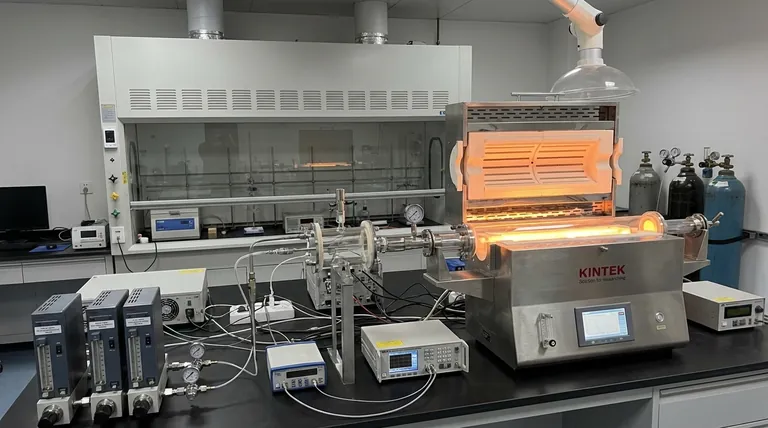
High-temperature tube furnaces paired with custom quartz reactors provide a highly precise, chemically inert thermal environment designed to isolate specific reaction kinetics. Specifically, they generate a stable temperature field ranging from 400°C to 1000°C with a precision of ±1°C, essentially replicating the cooling stages of industrial smelting flue gas while eliminating experimental interference.
Core Takeaway: To obtain valid kinetic data, you must separate thermal variables from chemical interference. This equipment combination achieves this by ensuring that the only variable influencing the gas is the precise temperature, rather than the reactor material or thermal fluctuations.
Precision Thermal Control for Industrial Simulation
Simulating Critical Cooling Stages
The primary function of the tube furnace in this context is to replicate the specific thermal history of industrial smelting.
By covering a range of 400°C to 1000°C, the furnace allows researchers to simulate the exact cooling gradients that flue gas experiences in real-world smelting operations.
Maintaining Rigorous Stability
In kinetic research, even minor temperature deviations can skew reaction rate data.
These furnaces provide a constant temperature field with a precision of ±1°C. This high stability ensures that observed changes in the gas are due to chemical kinetics, not experimental error or thermal drift.
The Role of Custom Quartz Reactors
Eliminating Chemical Interference
The material of the reactor wall is just as critical as the temperature.
Custom quartz reactors are used because of their chemical inertness. This prevents the reactor walls from acting as a catalyst or reactant, ensuring that the study focuses solely on the flue gas interactions (homogeneous or heterogeneous).
Optimizing Residence Time
Controlling how long the gas remains in the heated zone is vital for accurate data.
Quartz reactors can be customized with specific length-to-diameter ratios. This geometry is engineered to guarantee sufficient residence time, allowing catalytic reactions to proceed to a measurable extent within the controlled zone.
Understanding Operational Limitations
Material Fragility
While quartz offers superior chemical resistance, it is physically brittle compared to metal alloys.
Care must be taken during setup and maintenance, as quartz creates a risk of fracture if subjected to physical impact or extreme, rapid thermal shock outside its specifications.
Scale Restrictions
This setup is designed for precise kinetic research, not bulk processing.
The specific length-to-diameter ratios required for residence time control typically limit the volume of gas that can be processed. This setup effectively models the chemistry of the process, but not the hydrodynamics of a massive industrial flue stack.
Designing Your Kinetics Experiment
To get the most out of this equipment, align your setup with your specific research goals:
- If your primary focus is Industrial Simulation: Ensure your furnace is programmed to sweep strictly within the 400°C–1000°C range to mirror actual smelting cooling curves.
- If your primary focus is Data Purity: Rely on the chemical inertness of the quartz to rule out "wall effects" when analyzing unexpected reaction byproducts.
- If your primary focus is Reaction Efficiency: Calculate your required residence time first, then commission a quartz reactor with the specific length-to-diameter ratio that matches that calculation.
Reliable kinetic data relies on the precise isolation of variables; this setup provides the thermal stability and chemical neutrality required to achieve it.
Summary Table:
| Feature | Physical Condition Provided | Impact on Kinetics Research |
|---|---|---|
| Temperature Range | 400°C to 1000°C | Replicates industrial smelting cooling stages. |
| Thermal Precision | ±1°C Stability | Eliminates experimental error from thermal drift. |
| Reactor Material | Chemically Inert Quartz | Prevents catalytic 'wall effects' and interference. |
| Custom Geometry | Optimized Length-to-Diameter | Ensures precise residence time for gas reactions. |
Elevate Your Kinetic Research with KINTEK Precision
High-accuracy kinetic data requires more than just heat; it demands the absolute isolation of variables. Backed by expert R&D and manufacturing, KINTEK offers specialized Tube, Muffle, Rotary, Vacuum, and CVD systems tailored for high-temperature research. Our custom quartz reactors and furnace systems are engineered to provide the ±1°C precision and chemical neutrality your flue gas studies require.
Whether you need custom dimensions for residence time control or a robust high-temp furnace for industrial simulation, KINTEK delivers high-performance lab equipment customizable for your unique needs. Contact KINTEK today to design your optimal research setup.
Visual Guide

References
- Haipeng Liu, Hongying Yang. Generation and Inhibition of SO3 in Lead Smelting Flue Gas. DOI: 10.3390/app15084449
This article is also based on technical information from Kintek Furnace Knowledge Base .
Related Products
- 1400℃ High Temperature Laboratory Tube Furnace with Alumina Tube
- 1700℃ High Temperature Laboratory Tube Furnace with Alumina Tube
- 1200℃ Split Tube Furnace Laboratory Quartz Tube Furnace with Quartz Tube
- Vertical Laboratory Quartz Tube Furnace Tubular Furnace
- 1700℃ High Temperature Muffle Oven Furnace for Laboratory
People Also Ask
- How does zone-melting in tube furnaces synthesize bismuth micro-wires? Master Single-Crystal Thermoelectric Growth
- How are high-temperature laboratory tube furnaces applied in long-term vacuum homogenization heat treatments for intermetallic samples?
- How do high-temperature laboratory tube furnaces ensure environmental stability? Precision Thermal Reduction Tips
- How are high-temp tube furnaces used to measure diffusion coefficients per Fick's law? Master Precision Annealing
- How are high-temperature tube furnaces applied in testing ceramic-supported alloy membranes? Insights



















