
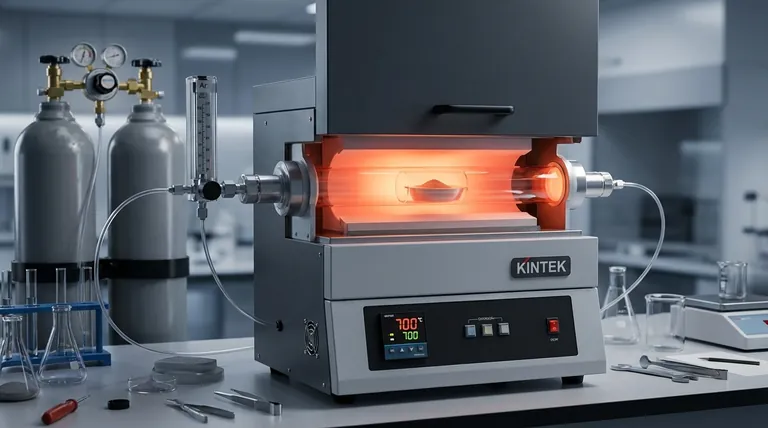
In the solid-state synthesis of sodium cobalt borate (NCBO), the Tube Furnace serves as a specialized reactor that simultaneously provides thermal energy and precise atmospheric control. It facilitates the reaction at 700 °C while maintaining a sealed environment for a continuous flow of Argon (Ar) gas.
The Tube Furnace is not merely a heat source; it is an oxidation shield. Its primary function is to couple high-temperature synthesis with an inert Argon atmosphere, preventing the unintended oxidation of cobalt ions and ensuring the phase purity of the final crystal structure.
The Role of Atmospheric Control
Preventing Cobalt Oxidation
The most critical role of the Tube Furnace in this specific synthesis is chemical protection.
At high temperatures, cobalt ions are highly susceptible to reacting with oxygen in the air.
The Tube Furnace utilizes a continuous flow of Argon (Ar) gas to displace oxygen, creating an inert environment that stabilizes the cobalt ions during the reaction.
Superior Sealing Capabilities
Unlike standard box furnaces, a Tube Furnace is designed with a cylindrical geometry that allows for exceptional sealing.
This design is essential for maintaining the integrity of the inert atmosphere throughout the duration of the synthesis.
It ensures that external air cannot leak into the reaction chamber, which would compromise the purity of the NCBO.
Thermal Precision and Reaction Mechanics
Driving the Solid-State Reaction
The synthesis requires a consistent, high-temperature environment to drive the diffusion of atoms between solid reactants.
The Tube Furnace provides this precise thermal regulation, maintaining the reaction chamber at exactly 700 °C.
This temperature provides the necessary activation energy for the precursors to form the sodium cobalt borate crystal lattice.
Ensuring Phase Purity
The combination of stable heat and a controlled atmosphere directly dictates the quality of the final product.
By eliminating redox side reactions (unwanted oxidation or reduction), the furnace ensures the resulting material is a single-phase compound.
This prevents the formation of impurities that would degrade the material's electrochemical or physical properties.
Understanding the Trade-offs
Sample Volume Limitations
While the Tube Furnace offers superior atmospheric control, it is geometrically constrained.
The diameter of the tube limits the size of the crucible and the total volume of powder you can synthesize in a single batch.
This makes it excellent for high-purity lab-scale synthesis but potentially challenging for larger-scale production compared to muffle furnaces.
Operational Complexity
Achieving the correct environment requires more than just setting a temperature controller.
You must manage gas cylinders, flow regulators, and vacuum seals to ensure the Argon flow is continuous and leak-free.
Failure to maintain the gas flow, even for a short period at 700 °C, can result in immediate oxidation of the sample.
Ensuring Synthesis Success
To maximize the quality of your sodium cobalt borate synthesis, consider the following operational priorities:
- If your primary focus is Phase Purity: Prioritize the integrity of your seals and Argon flow rate to strictly prevent cobalt oxidation.
- If your primary focus is Reaction Efficiency: Ensure the sample is centered in the "hot zone" of the tube to maintain a precise 700 °C across the entire powder bed.
The Tube Furnace is the definitive tool for this synthesis because it treats the atmosphere as a reagent as critical as the raw materials themselves.
Summary Table:
| Feature | Role in NCBO Synthesis |
|---|---|
| Temperature Control | Maintains precise 700°C for solid-state diffusion and activation. |
| Atmospheric Control | Provides continuous Argon (Ar) flow to prevent cobalt oxidation. |
| Sealing Design | Superior cylindrical sealing ensures oxygen-free reaction environment. |
| Phase Purity | Prevents redox side reactions to ensure a single-phase compound. |
| Sample Volume | Geometrically optimized for high-purity lab-scale batch synthesis. |
Elevate Your Material Synthesis with KINTEK Precision
Achieving the perfect phase purity for complex compounds like sodium cobalt borate (NCBO) requires more than just heat—it requires total atmospheric mastery. Backed by expert R&D and manufacturing, KINTEK offers high-performance Tube, Muffle, Rotary, Vacuum, and CVD systems designed to meet the rigorous demands of modern laboratory research.
Whether you need precise gas flow control for inert atmospheres or customizable high-temp furnaces for unique reaction mechanics, our team is ready to support your breakthrough. Contact us today to find the perfect furnace solution for your lab!
Visual Guide

References
- Shivaraju Guddehalli Chandrappa, A. S. Prakash. Cobalt Borate Complex With Tetrahedrally Coordinated Co <sup>2+</sup> ‐ Promotes Lithium Superoxide Formation in Li‐O <sub>2</sub> Batteries. DOI: 10.1002/smll.202502150
This article is also based on technical information from Kintek Furnace Knowledge Base .
Related Products
- Vertical Laboratory Quartz Tube Furnace Tubular Furnace
- Slide PECVD Tube Furnace with Liquid Gasifier PECVD Machine
- Laboratory Quartz Tube Furnace RTP Heating Tubular Furnace
- Inclined Rotary Plasma Enhanced Chemical Deposition PECVD Tube Furnace Machine
- Inclined Rotary Plasma Enhanced Chemical Deposition PECVD Tube Furnace Machine
People Also Ask
- What are the key differences between single-zone and multi-zone vertical tube furnaces? Choose the Right Furnace for Your Lab
- What is the purpose of using an industrial-grade vertical tube furnace in phosphorus recovery? High-Fidelity Simulation
- What are the main characteristics of vertical tube furnaces? Optimize Your Lab with Space-Saving, Uniform Heating
- How do heat treatment processes influence the configuration of a vertical tube furnace? Optimize for Quenching, Annealing, and More
- How are metal support wires selected for sample suspension? Expert Guide to High-Temp Furnace Materials



















