
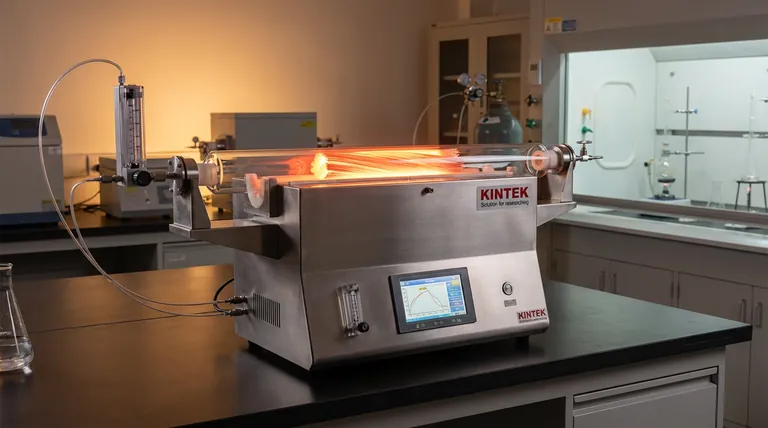
A high-temperature tube furnace serves as a precision reactor used to convert poly-dopamine-coated silk precursors into functional conductive fibers. By maintaining a specific temperature (typically 800°C) and an inert argon atmosphere, the furnace facilitates controlled pyrolysis. This process transforms organic components into a nitrogen-doped carbon network while preserving the fiber's structural integrity.
Core Takeaway: The furnace does not simply heat the material; it creates a strictly controlled flow environment that prevents oxidation and ensures uniform carbonization. This results in a stable, electrically conductive carbon skeleton derived from organic precursors.
The Mechanics of Carbonization
Facilitating Controlled Pyrolysis
The primary function of the furnace is to induce pyrolysis, the thermal decomposition of materials at elevated temperatures.
In the context of pp-fiber production, the furnace heats poly-dopamine-coated silk to approximately 800°C. This intense heat breaks down the original organic components, stripping away unstable elements and leaving behind a carbon-rich structure.
The Critical Role of Inert Atmosphere
Pyrolysis must occur without oxygen to prevent the material from burning to ash.
The tube furnace utilizes an inert gas, specifically argon, to displace air within the chamber. This protective atmosphere ensures that the material undergoes chemical transformation rather than combustion, preventing the loss of material at high temperatures.
Managing Flow Field Distribution
A unique advantage of the tube furnace design is its ability to control the flow of gas around the sample.
The distribution of the flow field within the tube is critical for maintaining the structural integrity of the fibers. A uniform flow ensures that the fibers are not physically damaged by gas turbulence during the delicate carbonization phase.
Impact on Final Material Properties
Creating Conductive Networks
The ultimate goal of this thermal process is to alter the electrical properties of the fiber.
By converting the organic coating into a nitrogen-doped carbon network, the furnace turns an insulating precursor into a conductive material. The "nitrogen-doping" occurs naturally as nitrogen atoms from the precursor are embedded into the carbon skeleton during heating.
Ensuring Uniformity
Consistency is vital for the performance of the final pp-fiber product.
The tube furnace provides a precise thermal environment that ensures the electrical conductivity is uniform across the entire batch. This prevents "hot spots" or areas of low conductivity that could cause the final product to fail.
Understanding the Trade-offs
Sensitivity to Atmosphere Purity
The success of the process relies entirely on the integrity of the inert atmosphere.
If the argon environment is compromised even slightly, oxygen ingress will lead to immediate oxidation. This destroys the carbon skeleton and results in a loss of both structural mass and electrical conductivity.
Batch Limitations
While tube furnaces offer exceptional precision, they often have limitations regarding volume compared to continuous industrial ovens.
The requirement for a controlled flow field and precise temperature gradients means these furnaces are typically optimized for quality and uniformity rather than high-volume mass production.
Making the Right Choice for Your Goal
When configuring a tube furnace for pp-fiber carbonization, focus on these specific parameters:
- If your primary focus is electrical conductivity: Ensure the furnace can maintain a stable 800°C to maximize the formation of the nitrogen-doped carbon network.
- If your primary focus is mechanical strength: Prioritize the optimization of the gas flow field to prevent physical degradation of the fiber structure during processing.
The tube furnace is the bridge between a raw organic precursor and a high-performance functional material, relying on the synergy of heat, inert gas, and flow control.
Summary Table:
| Process Element | Role in Carbonization | Benefit to Final Material |
|---|---|---|
| 800°C Thermal Profile | Induces controlled pyrolysis | Creates a stable, conductive carbon skeleton |
| Argon Atmosphere | Displaces oxygen to prevent combustion | Preserves material mass and structural integrity |
| Flow Field Control | Manages gas distribution around fibers | Ensures uniform carbonization without physical damage |
| Nitrogen Doping | Integrates nitrogen from precursors | Enhances electrical conductivity and material performance |
Elevate Your Fiber Research with KINTEK Precision
Unlock the full potential of your carbonization processes with KINTEK’s high-performance laboratory solutions. Backed by expert R&D and world-class manufacturing, we provide specialized Tube, Vacuum, and CVD systems designed to maintain the rigorous atmosphere and thermal stability required for advanced material synthesis.
Whether you are developing conductive pp-fibers or exploring new nitrogen-doped networks, our fully customizable high-temp furnaces ensure your unique research needs are met with absolute precision.
Ready to optimize your material properties? Contact KINTEK today to discuss your custom furnace requirements.
References
- Jeong Yeon, Ho Seok Park. Self‐supported VO<sub>2</sub> on polydopamine‐derived pyroprotein‐based fibers for ultrastable and flexible aqueous zinc‐ion batteries. DOI: 10.1002/cey2.469
This article is also based on technical information from Kintek Furnace Knowledge Base .
Related Products
- 1400℃ High Temperature Laboratory Tube Furnace with Alumina Tube
- 1700℃ High Temperature Laboratory Tube Furnace with Alumina Tube
- 1200℃ Split Tube Furnace Laboratory Quartz Tube Furnace with Quartz Tube
- High Pressure Laboratory Vacuum Tube Furnace
- Vertical Laboratory Quartz Tube Furnace Tubular Furnace
People Also Ask
- How does zone-melting in tube furnaces synthesize bismuth micro-wires? Master Single-Crystal Thermoelectric Growth
- How are high-temperature laboratory tube furnaces applied in long-term vacuum homogenization heat treatments for intermetallic samples?
- How are high-temp tube furnaces used to measure diffusion coefficients per Fick's law? Master Precision Annealing
- How do high-temperature laboratory tube furnaces ensure environmental stability? Precision Thermal Reduction Tips
- How are high-temperature tube furnaces applied in testing ceramic-supported alloy membranes? Insights



















